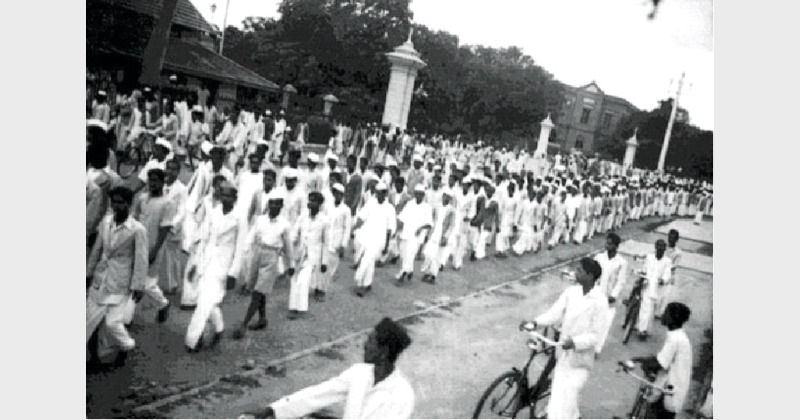
Almost all important leaders of the Congress were interned immediately after the ‘Quit India’ resolution was passed by the AICC on August 8, 1942 in Bombay. The nation was leaderless on 9th of August when the movement commenced. No working plan of any struggle had been placed before the people by the jail-going leadership. Nationalist groups and parties other than the Congress had not been taken into confidence. Therefore, the Indian masses resorted to fight against the British imperialism according to their own idea and imagination. It is no surprise then that a struggle that saw 7,000 sacrifices and 60,000 incarcerations died a silent death.
The Quit India Movement
The movement of 1942 was undoubtedly bigger than those of 1920, 1930 and 1932. All the latter three saw a combined figure of about 50,000 arrests. But in 1942, the figure was as high as 60,229, the highest in
history till then. But the important point to remember is that the 1942 movement, though having begun on the call of Mahatma Gandhi, was not Gandhian in its tone and tenor almost from the beginning. After the All India Congress Committee (AICC) passed the Quit India resolution on 8th August at Gowaliya Tank Grounds (later came to be called as August Kranti Maidan), Gandhiji addressed the delegates and public. He gave his famous slogan “Do or Die” here and added that there was no room for secretiveness in it. But as events turned out from 9th of August itself, people attacked the government apparatus not just openly, but also in clandestine manner, that is, without any prior declaration of venue and time of attack made known to the authorities as Gandhiji would like it to be done. People just did not die but they killed the Britishers too. Not just “karo ya maro”, but “karo aur maaro” too.
The 1942 August Revolution was carried forward by non-Congress organisations and common people, as most of the Congress leadership was in jail without any action plan
It indeed was a revolution, but a disjointed, an uncoordinated one. The reason is not far to seek. All the top leaders of Congress having been jailed, and only some second-rung leaders, and the Congress Socialist leaders like Jay Prakash Narain being outside, masses didn”t know the persons from whom to get directions for the running of the movement. The incarcerated top leaders had not placed any programme before them prior to proceeding to prisons. There was another important catch. Many top Congress leaders were known not to support the movement from their hearts and would themselves like it to fizzle out. This list included Jawahar Lal Nehru, Rajgopalachari, Sarojini Naidu and Bhula Bhai Desai.
Why, then Gandhiji decided to take plunge into it? It would appear from hindsight that the failure of the Cripps Mission and the knocking of eastern doors of India by Japanese forces were two important events that weighed upon him to give the clarion call. It should not be forgotten here that Netaji Subhas wanted to serve a quit notice on the Britishers in the form of a six months” ultimatum right at the Tripuri Congress in March 1939. He had foreseen the coming world war and would like to make the most of the same for the Indian freedom. When the United Kingdom was drawn into the great war on September 3, Gandhi and Nehru started saying that they didn”t intend to take advantage of British difficulties. Indians, by and large, were taken aback. To pacify them, individual satyagrah was launched from 1940. But people soon began seeing through. Hence, a mass movement had become a political necessity for the Congress. Otherwise, the whole initiative would pass to Subhas who having fled to Europe incognito, had already caught the nation”s imagination.
Indian people at long last, after almost three years of the War, and when the tide had begun turning in favour of the Allied Powers, heard the launching of a mass movement. There were attacks on police stations, chowkis, prisons, post offices, telegraph offices, railway stations, court buildings and administrative offices throughout the country. Statues of Queen Victoria and other imperial figures were broken. Tricolour was hoisted on many government buildings. A number of youth, both men and women, laid down their lives in these efforts.
Sacrifices Galore
The political leaders might have reservations about the 1942 Movement, but it electrified the nation for quite some time. People of all ages—the adolescents, the youth and the old ones, all made sacrifices in large numbers. Kanak Lata Baruah (14) laid down her life trying to unfurl tricolour in Naugaon, Assam. In Katihar (Bihar), 13-year old Dhruv Kundu was martyred by the District Magistrate of Purnea. Matangini Hazra, a 73-year old lady was gunned down by armymen at Tamluk, Bengal, while holding a tricolour in her hand. Later on a number of youth, including one Sushil Dhara, Ramchandra Bera, Satish Samant, Ajay Mukherji and others freed the area from the Britishers for a couple of weeks. The same story was repeated at Ballia, UP. Revolt led by Chittu Pandey made government officials flee from the district.
In Ahmedabad, as many as 8000 mill workers quit jobs. A large number of Railway tracks were uprooted in Bihar. The government had to deploy Air Force to keep vigil and shoot the attackers. In Bombay, a student named, Usha Mehta, started an underground radio station to broadcast news about the country-wide agitations. There were bloody events at places like Bhamori (District Meerut), Patri (District Satara), Azamgarh, Balurghat (Bengal).
Two towns, Ashti in Wardha District and Chimur in Chanda District, and also adjoining areas were made free for well over 50 days thanks to the valour and courage of the local youth under the inspiring leadership of RSS
volunteers three of whom sacrificed their lives. Later, the Britishers showed fiendish fury in dealing with the freedom fighters. Eight persons were sent to gallows. More than 15 were awarded life sentences. Amrawati had 14 martyrs. There were two martyrs in Wardha. Two from Nagpur were sent to Kala Paani. The Nagar Karyavah of Ramtek, Bala Sahab Deshpandey was given death sentence, which was later commuted to life imprisonment. The same Deshpandey in 1952 started Vanvasi Kalyan Ashram.
Treachery by the Communists
The Commies unashamedly stabbed the movement in the back, and got paid for the same by the government. Their top leaders had remained imprisoned till about the beginning of 1942 when the CPI was a banned body. But after the USSR switched sides in the War and came on the sides of the Allied powers, the ban was lifted on CPI. All communist leaders including S.A. Dange, B.T. Randive, Rahul Sankrityanan, Sunil Mukherji, Sajjad Jaheer, Soli Batliwala, S.S. Mirajkar, A.K. Ghosh, and S.G. Patkar were released from jails. They all expressed loyalty to the British, and apologised for their past anti- government activities. Later, P.C. Joshi, the CPI general secretary, in a secret deal with Rezinold Maxwell, the Home Member, got allotted for himself and his colleagues the role of fifth columnists. They also helped in the official war efforts.
While the commies went all out to get the nationalist elements arrested, the RSS volunteers sheltered many of them. Pt. Satwalekar, the Sanghachalak of Aundh kept in his house Nana Patil of Patri fame safe, Bhausahab Deshmukh, Sanghachalak of Poona sheltered Sane Guruji. Similarly, Delhi Sanghachalak Hansraj Gupta provided safety to Jay Prakash Narain and Aruna Asaf Ali.
Though absence of a common front with nationalist forces and lack of preparations by the Congress did not give immediate independence, it ultimately gave a firm resolve and created ground for future Independence. JP later candidly admitted ‘absence of efficient organisation of the national revolutionary forces and of further plan of action for the people and lack of work in the Indian army and in the Services’ did not give the immediate results.
But those well-nigh 7000 noble patriotic souls who gave the supreme sacrifice, and well over 60,000
persons who courted arrest or otherwise were imprisoned, are they to be forgotten? No, never. They will remain beacon lights for generations to come.