UGC's New Policy: From single to dual admission cycle; know its benefits for Indian university students
June 6, 2026
  • Read Ecopy
  • Circulation
  • Advertise
  • Careers
  • About Us
  • Contact Us
Android AppiPhone AppArattai
Organiser
  • ‌
  • Bharat
    • Assam
    • Bihar
    • Chhattisgarh
    • Jharkhand
    • Maharashtra
    • View All States
  • World
    • Asia
    • Europe
    • North America
    • South America
    • Africa
    • Australia
  • Editorial
  • International
  • Opinion
  • RSS @ 100
  • More
    • Op Sindoor
    • Analysis
    • Sports
    • Defence
    • Politics
    • Business
    • Economy
    • Culture
    • Special Report
    • Sci & Tech
    • Entertainment
    • G20
    • Azadi Ka Amrit Mahotsav
    • Vocal4Local
    • Web Stories
    • Education
    • Employment
    • Books
    • Interviews
    • Travel
    • Law
    • Health
    • Obituary
  • Subscribe
    • Subscribe Print Edition
    • Subscribe Ecopy
    • Read Ecopy
  • ‌
  • Bharat
    • Assam
    • Bihar
    • Chhattisgarh
    • Jharkhand
    • Maharashtra
    • View All States
  • World
    • Asia
    • Europe
    • North America
    • South America
    • Africa
    • Australia
  • Editorial
  • International
  • Opinion
  • RSS @ 100
  • More
    • Op Sindoor
    • Analysis
    • Sports
    • Defence
    • Politics
    • Business
    • Economy
    • Culture
    • Special Report
    • Sci & Tech
    • Entertainment
    • G20
    • Azadi Ka Amrit Mahotsav
    • Vocal4Local
    • Web Stories
    • Education
    • Employment
    • Books
    • Interviews
    • Travel
    • Law
    • Health
    • Obituary
  • Subscribe
    • Subscribe Print Edition
    • Subscribe Ecopy
    • Read Ecopy
Organiser
  • Home
  • Bharat
  • World
  • Operation Sindoor
  • Editorial
  • Analysis
  • Opinion
  • Culture
  • Defence
  • International Edition
  • RSS @ 100
  • Magazine
  • Read Ecopy
Home Bharat

 UGC’s New Policy: From single to dual admission cycle; know its benefits for Indian university students

The UGC's new policy allows Indian universities to admit students twice a year, starting from the 2024-25 academic session, giving more flexibility and matching global standards. This will help the students who miss the main admission cycle and boost international partnerships, but it needs careful planning and resources from universities

WEBDESKWEBDESK
Jun 13, 2024, 08:00 am IST
in Bharat, Education
Follow on Google News
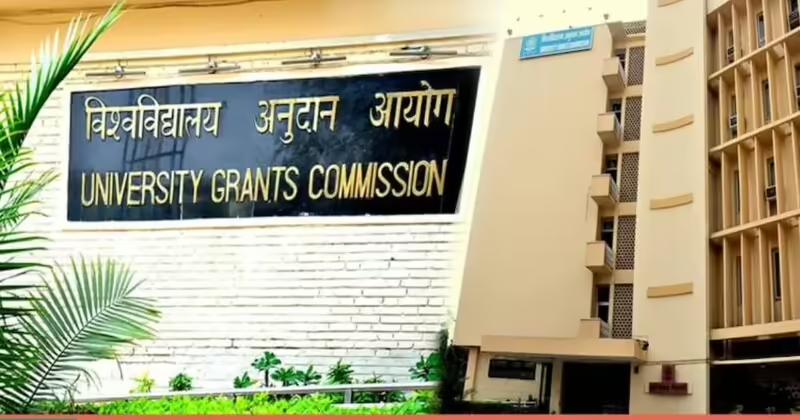
University Grans Commission

University Grans Commission

FacebookTwitterWhatsAppTelegramEmail

UGCThe University Grants Commission (UGC) made a landmark decision to allow universities and higher education institutions in India to offer admissions twice a year. This new system, which aligns with practices in many foreign universities, will be implemented from the 2024-25 academic session. With this change, Indian students will have the opportunity to apply to colleges during two distinct admission cycles: July-August and January-February.

#WATCH | University Grants Commission (UGC) Chairman Jagadeesh Kumar says, "In our country, we always start admission for one cycle in July-August but in the last commission meeting we decided that from now on all universities and colleges in India can do admission twice, once in… pic.twitter.com/Ihf23ADJ3G

— ANI (@ANI) June 11, 2024

At present, Indian universities and colleges have one admission period each year, starting in July-August and ending in May-June. UGC Chairman Jagadesh Kumar spoke to the media about the advantages of a new system where admissions will happen twice a year. He said that if universities can offer admissions in both July-August and January-February, it will be beneficial for numerous students. This includes those who miss the July-August admissions due to late board exam results, health problems, or personal reasons.

Kumar emphasized that adopting a biannual admission system could greatly improve international collaborations and student exchange programs. By aligning the admission cycles with those of universities worldwide, Indian institutions can more easily establish partnerships and participate in global academic networks. This will also help in smoother transitions for students who are moving between institutions in different countries, thereby enhancing their educational experience as well as exposure. Additionally, increased international collaboration can lead to joint research projects, faculty exchanges, and a richer academic environment overall.

Kumar also noted that many universities around the globe already implement a biannual admission system, and it has proven to be highly effective. This system not only offers more flexibility for students but also allows universities to manage their resources more efficiently throughout the year. By adopting this approach, Indian institutions can keep pace with international educational trends. This will help in being more competitive on the global stage and help Indian universities to attract more international students, improve their global rankings, and ultimately raise the standard of education offered.

However, the shift to biannual admissions will depend on each university’s resources and readiness. UGC Chairman Jagadesh Kumar emphasized that only institutions with the necessary infrastructure and capability should adopt this system. He pointed out that for biannual admissions to be effective, universities must adequately prepare their faculty, staff, and students for the changes. This means ensuring that all logistical and academic aspects are aligned to handle admissions and classes twice a year without compromising the quality of education.

Notably, the UGC has not made biannual admissions mandatory. Higher education institutions (HEIs) can continue with their current single admission cycle if they prefer. Kumar highlighted that implementing biannual admissions involves detailed planning and administrative adjustments. This includes creating systems to support students who enroll at different times of the year and ensuring that all university operations can smoothly accommodate two admission cycles. This careful preparation is crucial for making the new system work effectively and benefiting both students and institutions.

Interestingly, the concept of biannual admissions is not entirely new in India. Last year, UGC allowed open and distance learning (ODL) and online modes to have biannual admissions in January and July. This policy resulted in a significant increase in enrollments, with 19,73,056 students joining in the regular July cycle and an additional 4,28,854 students in the January 2023 cycle, marking a 22 per cent increase in admissions. However, despite the evident benefits, the UGC’s recent announcement has sparked mixed reactions from universities.

Concerns have been raised, particularly by institutions such as Delhi University, regarding the adaptability of the current academic structure to accommodate biannual admissions. Officials have highlighted issues like the reliance on the Common University Entrance Test (CUET), typically conducted in May, and the absence of clear guidelines on whether the January admissions would follow the same entrance exam procedures as the primary cycle. These uncertainties underscore the need for further clarification and careful consideration as universities navigate the transition towards biannual admissions.

Balvinder Shukla, the Vice Chancellor of Amity University, expressed approval of the UGC’s decision to introduce biannual admission cycles but also acknowledged the potential challenges associated with this change. Shukla highlighted concerns regarding the availability of necessary infrastructure and the alignment of academic sessions with school schedules. Additionally, he pointed out the likelihood of lower application numbers during the January admission cycle.

Experts agree that the new system of having two admission times each year is a good step, matching with what the National Education Policy wants. But for it to work well, universities need to plan carefully and get ready. They need to handle the administrative details well and use their resources wisely during this change. This new way of doing things will make Indian education more similar to what’s happening internationally, giving students more chances and making things more flexible.

Overall, experts think this change is a good thing, but it will only work if universities put in a lot of effort to make it successful and improve education in India.While the biannual admission system holds immense potential, its effective implementation requires thorough planning and adequate resources at the university level. Institutions must meticulously strategize to manage administrative intricacies and ensure a seamless transition for students admitted at different times of the year.

Furthermore, embracing this new system demands a shift in mindset and operational procedures, necessitating commitment and flexibility from university administrations. Only with careful planning and concerted efforts can Indian universities fully leverage the benefits of biannual admissions, enhancing both student experiences and the nation’s standing in the global education arena.




Topics: University Grants CommissionCUETCommon University Entrance TestUGC
Share1TweetSendShareSend
✮ Subscribe Organiser YouTube Channel. ✮
✮ Join Organiser's WhatsApp channel for Nationalist views beyond the news. ✮
Previous News

WHO confirms human case of bird flu in India

Next News

Reform to continue, BJP and key coalition partners share similar economic agenda

Related News

The proposed ‘Viksit Bharat Shiksha Adhishthan’ aims to transform India into a knowledge-driven, self-reliant, and globally competitive nation through modern and inclusive education

‘Viksit Bharat Shiksha Adhishthan’: A transformative vision to build a knowledge-driven and self-reliant India

UGC Mandates Aadhaar-Based Payment System for Fellowships

UGC mandates Aadhaar-based payment system for fellowships, April 15 set as deadline for completing the seeding process

UGC declares Rajeev Gandhi Institute of Technology & Management in Alwar a fake institution

UGC declares Rajeev Gandhi Institute of Technology & Management in Alwar a fake institution

DU clears air on the caste-based remarks made by Rahul Gandhi

“Refrain from making unsubstantiated statements”: DU responds to Rahul Gandhi over caste-based interview allegations

Representative Image

India’s AI Education Revolution: How policy, research and skilling are building the future workforce

Representative Image

Karnataka: UGC rules violated in faculty recruitment in universities; Minister admits over 9,000 vacancies

Load More

Latest News

Police in AAP-Ruled state of Punjab lathi charge sit-in protesters

Punjab: ITI candidates seeking jobs lathi-charged outside PSPCL HQ; opposition slams AAP Govt over police action

From constables to DGP, India's police system follows a structured chain of command that governs law enforcement across the country

From Constable to DGP: Understanding India’s police hierarchy, powers & recruitment system

The terracotta dice that challenges historical assumptions and highlights India's millennia-old civilisational heritage

How a 4,500-year-old terracotta dice is reviving the debate on India’s civilisational continuity & Vedic heritage

The Porumamilla inscription and the ancient science behind a reservoir that survived 650 years

India’s 655-Year-Old Water Policy: The Porumamilla inscription that turned stone into a manual of hydrology

India’s Permanent Representative to the United Nations Ambassador Harish Parvathaneni

India slams Pakistan at UNSC for peddling false narratives on Jammu & Kashmir

Keralam: Pathanamthitta temple property occupied beyond lease period reclaimed by devotees

A series of high-level engagements signals New Delhi's growing focus on building interoperable security networks across the Indo-Pacific

India strengthens Indo-Pacific security architecture with new defence and maritime partnerships

Prime Minister Narendra Modi

“Makes every Indian proud”: PM Modi hails India’s 7.7 per cent GDP growth in FY 2025-26

Once known for maoist violence, Minpa now leads healthcare revolution with telemedicine services in Sukma

From Maoist Stronghold to Healthcare Hub: How Chhattisgarh’s Minpa is transforming through telemedicine & development

Dr Surendra Jain, Joint General secretary, VHP

VHP Demands Audit of Waqf Properties Amid Encroachment Claims: “Land should go to rightful owner,” says Surendra Jain

Load More
  • Privacy
  • Terms
  • Cookie Policy
  • Refund and Cancellation
  • Delivery and Shipping

© Bharat Prakashan (Delhi) Limited.
Tech-enabled by Ananthapuri Technologies

  • Home
  • Search Organiser
  • Bharat
    • Assam
    • Bihar
    • Chhattisgarh
    • Jharkhand
    • Maharashtra
    • View All States
  • World
    • Asia
    • Africa
    • North America
    • South America
    • Europe
    • Australia
  • Editorial
  • Operation Sindoor
  • Opinion
  • Analysis
  • Defence
  • Culture
  • Sports
  • Business
  • RSS @ 100
  • Entertainment
  • More ..
    • Sci & Tech
    • Vocal4Local
    • Special Report
    • Education
    • Employment
    • Books
    • Interviews
    • Travel
    • Health
    • Politics
    • Law
    • Economy
    • Obituary
  • Subscribe Magazine
  • Read Ecopy
  • Advertise
  • Circulation
  • Careers
  • About Us
  • Contact Us
  • Policies & Terms
    • Privacy Policy
    • Cookie Policy
    • Refund and Cancellation
    • Terms of Use

© Bharat Prakashan (Delhi) Limited.
Tech-enabled by Ananthapuri Technologies