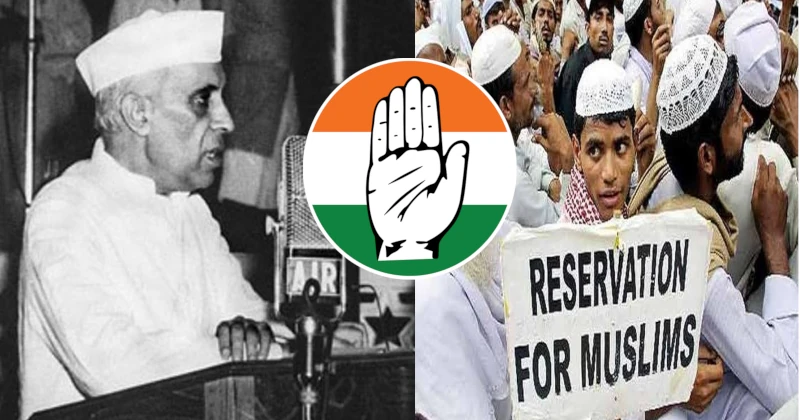
Over the years, various legislative actions undertaken by Congress-led administrations have come under scrutiny for their perceived bias against the Hindu community. Critics argue that these policies, purportedly aimed at safeguarding minority rights, have resulted in the systematic marginalisation of Hindus. Of particular concern is the role played by Jawaharlal Nehru in shaping Article 25 of the Constitution, which guarantees freedom of religion. Critics contend that Nehru’s policies, especially regarding Article 25, disproportionately favoured minority communities, contributing to the alleged discrimination against Hindus.
Article 25 and Article 28: Emphasis on Religious Change
In 1950, during Jawaharlal Nehru’s tenure, Article 25 was introduced, which guaranteed the freedom of conscience and the right to freely profess, practice, and propagate religion. Critics argue that this article was used to emphasise religious conversion. Concurrently, Article 28 was implemented, restricting Hindus’ right to religious education in educational institutions wholly maintained out of State funds. However, Article 30 allowed minorities, whether based on religion or language, to establish and administer educational institutions of their choice, leading to allegations of preferential treatment that marginalised the Hindu community’s educational rights.
Debate around Article 25
On December 6, 1948, the Constituent Assembly witnessed a heated debate over two crucial questions: Would the right to propagate religion lead to forced conversions? Should the social welfare and reform clause extend to Buddhists, Jains, and Christians?
Some members expressed concerns that the right to propagate religion might facilitate forced conversions. They proposed amendments to either remove this right entirely or limit the practice of religion to the private domain. These members argued that allowing propagation could lead to coercion and exploitation under the guise of religious freedom.
Organiser E Exit Poll: Whom will you vote for?
Opposing members countered that the Draft Article did not inherently support forced conversions. They asserted that the right to propagate religion would foster public awareness of different faiths, promoting communal understanding and peace. After extensive deliberation, the Assembly rejected the proposed amendments.
Another contentious issue was the scope of subclause (b) of clause (2) of the Draft Article. One member argued for its extension beyond Hindus to include Buddhists, Jains, and Christians, suggesting that this inclusivity would enhance religious harmony. Although the Assembly initially rejected this amendment, the Drafting Committee revised the clause to include Sikhs, Buddhists, and Jains, acknowledging the importance of a broader application.
What is Article 25 of the Indian Constitution?
Article 25 of the Indian Constitution guarantees the fundamental right to freedom of religion, encompassing the right to profess, practice, and propagate religion. This freedom is subject to reasonable public order, morality, and health restrictions. The article differentiates between religious practices and secular activities, allowing the state to regulate the latter, including social reforms and economic activities.
Critical judicial interpretations have shaped the application of Article 25. In Vaishno Devi Shrine Board v. State of Jammu and Kashmir (1997), the Supreme Court upheld the state’s right to regulate the secular services of priests. In Sardar Syedna Taher Saifuddin Saheb v. State of Bombay (1962), the court emphasised protecting essential religious practices, barring state interference unless they are immoral or disrupt public order.
The court’s decision in Commissioner, Hindu Religious Endowments, Madras v. Sri Lakshmindra Thirtha Swamiar of Sri Shirur Mutt (1954) allowed state supervision of religious institutions while safeguarding essential religious customs. In the Anand Marga case (1984), the Supreme Court ruled that prohibiting the Tandava dance in public did not violate Article 25 as it was not an essential religious practice.
In Moulana Mufti Sayeed Mohd. In Norrur Rehman Barkariq v. State of West Bengal (1999), the High Court upheld restrictions on the use of loudspeakers for Azaan. The Shyam Narayan Chouksey v. Union of India case mandated respect for the national anthem while making its playing in cinema halls optional.
The landmark Shayara Bano v. Union of India (2017) judgment declared the practice of triple talaq unconstitutional, reinforcing the judiciary’s role in balancing religious freedoms with fundamental rights.
Hindu Religious and Charitable Endowment Act (HRCE)
In 1951, Nehru introduced the Hindu Religious and Charitable Endowment Act (HRCE) to ensure the proper maintenance of large temples. Prominent temples, including Tirupati Balaji, came under government control. Critics allege that the Congress regime misused the wealth and assets of these temples, diverting resources meant for religious and charitable purposes. Notably, this act only applied to Hindu temples and did not extend to religious institutions of other faiths, raising religious discrimination concerns.
Hindu Code Bill and Uniform Civil Code
The 1956 Hindu Code Bill, introduced by the Nehru Government, aimed to reform Hindu personal law, affecting marriage, succession, and adoption. However, personal laws of minority religions remained untouched, creating a dual legal framework based on religion. Critics argue that this selective approach hindered the implementation of a Uniform Civil Code, which would have standardised personal laws across all religions, promoting legal equality.
Reservation Policies
The introduction of reservation policies was intended to promote social justice by providing quotas for Scheduled Castes (SC), Scheduled Tribes (ST), and Other Backward Classes (OBC). However, the Congress party’s extension of reservation policies beyond the initial ten years has been criticised for fostering dependency rather than empowerment. Critics argue that these policies divided the Hindu community and that the focus on reservations neglected broader socio-economic reforms.
1976 Constitutional Amendment: Secularism
In 1976, during Indira Gandhi’s Emergency rule, the term “secular” was added to the Constitution without parliamentary debate. Critics argue that this amendment undermined the Hindu majority by ensuring that India could not be officially recognised as a Hindu nation, even though many neighbouring countries are officially Muslim nations. This move has been seen as a political strategy to secularise the state apparatus while sidelining the cultural and religious heritage of the Hindu majority.
1991 Pooja Sthal Law
The 1991 Pooja Sthal (Places of Worship) Act is viewed as discriminatory. It prohibited Hindus, Sikhs, and Jains from reclaiming temples that were desecrated during Mughal rule. This law effectively barred these communities from presenting their cases in court, resulting in the loss of numerous historical temples. Critics argue that this law was designed to appease minority communities at the expense of the historical and religious rights of the Hindu majority.
Minority Commission Act of 1992
The 1992 Minority Commission Act established a Minority Commission to protect the interests of religious minorities. Critics argue that this act provided special status and benefits to religious minorities while further dividing the population. They contend that this legislation favoured minorities and neglected the needs of the Hindu majority, exacerbating religious tensions.
Waqf Board Law of 1995
In 1995, Congress introduced the Waqf Board Law, granting the board significant power over property claims. Critics argue that the Waqf Board was given authority that supersedes even the Supreme Court, making it one of the most powerful entities in the country. This law has been criticised for enabling the Waqf Board to claim properties without sufficient legal recourse for those affected, further marginalising Hindu property rights.
Ramsetu Affidavit and Allegations of Hindu Terrorism
In 2004, the Congress government filed the Ramsetu Affidavit, which dismissed the existence of Lord Ram and regarded the Ramsetu as an imaginary structure. Critics saw this as an insult to the Hindu faith and a move against the community’s religious sentiments. In 2009, the controversial identification of Hindus as terrorists by Congress further strained relations, as Hindus were labelled as extremists. This period saw the Congress party being accused of systematically eroding Hindu rights and heritage through legislative measures.
Like Aurangzeb used a knife to kill the Hindus, the Congress used the Constitution of India to defame the Hindus. Then, Congress also claims that democracy is over.