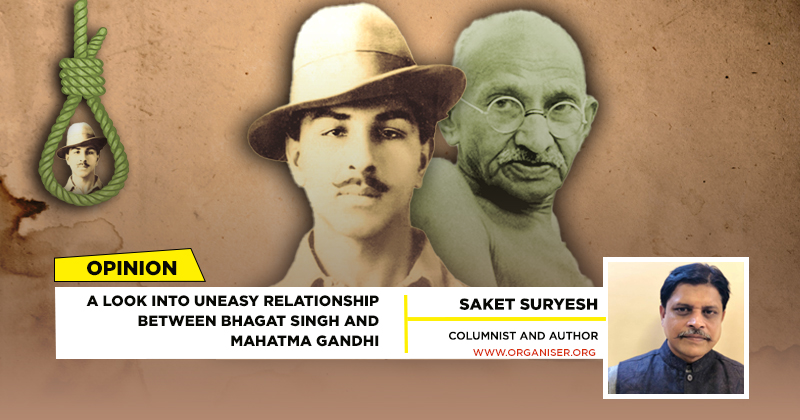
We have just passed the birth anniversary of Bhagat Singh on September 28. He was born on September 28, 1907 in an Arya Samaji household, possibly the first Sikh Arya Samaji in the region. His death sentence was given on October 7, 1930. It is a mere coincidence that on October 2, we also celebrate the birthday of Mahatma Gandhi, a tall leader of Indian Independence. . Let us look at the uneasy relationship between the two tall figures of Indian Independence- Bhagat Singh and Gandhi.
When Bhagat Singh was hanged, he was barely twenty-three years old, and Gandhi was Sixty-One. Gandhi had run one large national movement nationally by then, together with the Caliphatists, on the assurance of getting Swarajya for India within one year. The term Swarajya for Congress then referred to some degree of self-rule under the British crown. Bhagat Singh was part of a revolutionary organisation called the Hindustan Republican Army, created by legendary revolutionary Ram Prasad Bismil under the guidance of Shri Sachin Sanyal. This organisation was later renamed as Hindustan Socialist Republican Army after the hanging of Bismil and Ashfaq, at the behest of Bhagat Singh, under the leadership of Chandrashekhar Azad fondly known by revolutionaries as Pandit ji. Unlike the Congress leaders, the revolutionaries demanded complete independence for India, free of British colonial rule.
Gandhi’s public posturing was that he was against anything which had anything remotely to do with violence. Gandhi’s withdrawal of Khalifat Non-Cooperation Movement after the violence in Chauri Chaura is cited often as an example of how the Mahatma was willing to sacrifice a national movement in full momentum at the altar of his personal and often whimsical principles of morality. Since Gandhi’s absolute abhorrence of violence is often cited as the reason behind his action with regards to Bhagat Singh, we will examine this briefly, during the initial phase of his political career as unchallenged leader of Congress since his return to India till the time of hanging of Bhagat Singh. His first political movement was Non-Cooperation Movement. At the same time, Khilafat Movement started with the celebration of Khilafat Day on October 27, 1919.
A month later, Gandhi was made the leader of Khlifat movement on October 24, 1919. It was in support of Khilafat movement (in reality, not a Khilafat or Protest movement, rather in reality, a Caliphate movement, to restore the Caliph in Turkey under attack from the Christian West) that Gandhi returned his Kaiser-i-Hind award given to him for his performance in the support of the British Army in the Boar war in Africa. Gandhi wrote to Viceroy Chelmsford- ..Imperial Government have acted in the Khilafat matter in an unscrupulous, immoral and unjust manner…I can retain neither respect nor affection for such a government. The manner in which the British treated Indians did not elicit the same emotions in the Kaisar-i-Hind that the way they treated a foreign nation, Turkey, did.
Congress adopted the resolution to join the Khilafat movement in Calcutta Session, between September 4-9, 1920 with a thin margin of 144 against 132 and NCM was merged with Khilafat and became KNCM or Khilafat Non-Cooperation Movement, aimed at establishing the Islamic Caliphate in Turkey. Obtaining Swarajya was turned into a corollary which Gandhi believed will eventually happen once Turkik Islamic Caliphate is re-established and the democracy Ataturk Mustafa Kemal Pasha with weird ideas like women being educated, politically active and out of Hijab were defeated in Turkey and the world. On the assurance of Swarajya within an year, and assurance of Gandhi on behalf of Muslim Caliphatists regarding ban on Cow slaughter, the movement gained quick traction as Hindus joined force to support the Indian Muslims in reestablishing the Caliphate at Turkey.
On February 12, 1922, at Chauri Chaura, near Gorakhpur, in response to unprovoked Police firing, the mob of local villagers turned violent and burned down the Police station in which 23 policemen died. Gandhi, who was then at Bardoli in Gujarat, unilaterally, called off the movement. The reason was that his followers had sinned against God, and to continue the campaign would be to follow the Satan. One thing which stands in a glaring contrast is that barely months before that in August, 1921, Kerala had seen the worst kind of communal violence, known as Moplah violence, leading to brutal killings of hundreds of Hindus at the hands of fanatic Muslims who were out to establish Caliphate in India.
On August 25, 1921, around 50 Hindus jumped in a well to escape the blood thirsty Islamist mob, who had declared areas in Kerala as Shariah land and declared allegiance to the Caliph, and perished. The Mahatma who put a spanner in the movement on the death of 23 British Policemen refused to call off the protests when hundreds of Hindus were killed in Malabar during the sequence of protests in the same movement. The Congress did raise protest on Moplahs when the British in the post-violence action arrested the fanatics and few of them died of asphyxiation when they were being taken to Bellary in Police vehicle.
Bhagat Singh, became a revolutionary after the death of one of the founders of Hindu Mahasabha and major Congress leader, Lala Lajpat Rai in police action. To avenge his death, Bhagat Singh shot dead Saunders. In the shooting, a constable, Chet Singh was also killed and Bhagat Singh became a wanted man. He later joined HRA (later HSRA) and the famous Assembly bomb blast case happened on April 8, 1929. Both Bhagat Singh and Batukeshwar Dutt were arrested as they did not attempt to flee. Bhagat Singh represented himself and Asaf Ali represented BK Dutt. Bhagat Singh’s link to the killing of ASP John Saunders were dug out and Bhagat Singh, Sukhdev and Rajguru were sentenced to be hanged till death. The option of mercy were exhausted and the death sentence seemed certain by the time Congress was engaging with the Viceroy on Gandhi-Irwin Pact. The date of sentencing was fixed for March 24, 1931.
On February 17, 1931, the mercy petition made on behalf of the revolutionaries to the Privy council was rejected. The very next day, on February 18, 1931, Gandhi met with the Viceroy. Gandhi asked for the postponement of the hanging in view of upcoming Congress Karachi Session on March 24, 1931. In Gandhi’s words- I talked about Bhagat Singh, I told him- this has no connection with our discussion, and it may even be inappropriate on my part to mention it. But if you want to make the present atmosphere more favourable, you should suspend Bhagat Singh’s execution (Mahadev Desai’s diary).
As we can see Gandhi ji was labouring very hard to not link this execution with the Pact which possibly Gandhi wanted to place as a success of the political movement of Congress. Lord Irwin also corroborated what Gandhi had recorded and confirmed that Gandhi did not plead for commutation, but he did ask for the postponement of hanging in the present circumstances. After a series of meetings, Gandhi Irwin pact was signed on March 5, 1931. Netaji Subhash Chandra Bose too wrote about this in Indian Struggle, 1920-1940- the Mahatma who did not want to identify himself with the revolutionary prisoners, would not go so far (as to risk the pact)… and the Viceroy realised that the Mahatma would not break on that (Delhi Pact or Gandhi-Irwin Pact) Netaji compared this with the Irish Revolutionaries who had successfully bargained on behalf of their revolutionaries when the British wanted to sign a pact with them.
Irwin explained why he rejected Gandhi’s plea for postponement of execution on three grounds, one, that it was politically improper to intervene in the judicial process; two, it would give needless hope to the families off the revolutionaries and lastly, Congress may misuse this postponement later by falsely claiming that the Government assured eventual commutation of the sentence and then went back on its words.
On March 6, Gandhi himself told the press that he had asked for postponement not commutation. Then on March 24, 1931, in the morning, the Mahatma wrote a letter to the Viceroy, to see the possibility of commutation of Sentence on Humanitarian Ground. After all the pleas seeking merely suspension of the sentence, Gandhi first time wrote for commutation of the sentence on March 24, 1931. Bhagat Singh was already hanged with Sukhdev and Rajguru, and hastily cremated by then. Was this an effort to save face and to keep emotions down in the Karachi Congress on March 24, 1931, is again a thing to ponder about much like whether Non-Cooperation movement was withdrawn due to violence in Chauri Chaura or was it withdrawn because Gandhi felt unsure of claiming credit for the Congress of a farmers-led movement or maybe he feared an early success of the movement might not be what the Congress wanted. Did he not as Pattabhi Sitaramaiyya, the official historian of the Congress wrote, demand early hanging of the revolutionaries before the Congress session, so that no false hope remained lingering in the breasts of the people?
The revolutionaries were always large-hearted men and even Bismil in his memoirs from the gallows wrote that he wanted the freedom-fighters to fall in solidarity with the Congress, even when both the key witness and Public Prosecutor of the Kakori Case were Congress leaders. But did Congress use their sacrifices in a clinical and selfish manner to gain more power for itself? We are no one to judge the freedom fighters, whether it be Gandhi or Savarkar, but we need to evaluate when later historians painstakingly that Gandhi worked very hard to get Bhagat Singh exonerated, quoting few of his half-hearted pleas made to Irwin. If Gandhi supported them why did he, on record, in June, 1931, barely months after the greatest sacrifice by the revolutionaries, refuse to be associated in anyways with the proposed memorial of Bhagat Singh? This was done even when on the assurance of setting up a memorial for Bhagat Singh, the support of Bhagat Singh’s father Kishan Singh was obtained in the Congress session where even a Memorial committee was constituted. Historians have tried to downplay these facts which stare in the eyes of any independent minded readers of history.
VN Dutta in his Gandhi and Bhagat Singh, even goes so far as claiming that since Bhagat Singh’s eloquent submissions in the court resembled Nehru’s flair, they must have been written by Nehru. In Jayaram Ramesh’s Book A Chequered Brilliance on Krishna Menon, we find an oblique reference to this tendency of Congress where he mentions on Udham Singh – Krishna Menon had at first- condemned Singh’s act (the murder of Michael O’Dwyer on March 13, 1940) in keeping with the sentiments of the Congress back home but then changed his mind after they had changed theirs, sensing Singh’s popularity in India. The revolutionaries were idealists, and the Congress, since early on, was a cool, calculating and clinical machine aiming to gain political power.
Revolutionary Shiv Verma wrote a moving account of the hardships faced by the brave mother of Bismil after his hanging while the key leaders of Congress were having high-tea with the Viceroys. Even after independence how the venerable BK Dutt, the associate of Bhagat Singh in the Assembly Bombing who was given life sentence by the British, ended his life selling biscuits on the streets of Patna in 1965, in extreme penury, explains how Congress and Communists who pretend to celebrate Bhagat Singh as their own with such fanfare, had actually forgotten the revolutionaries. Understanding how our great men from history were wronged would be the first step towards trying to right those wrongs.