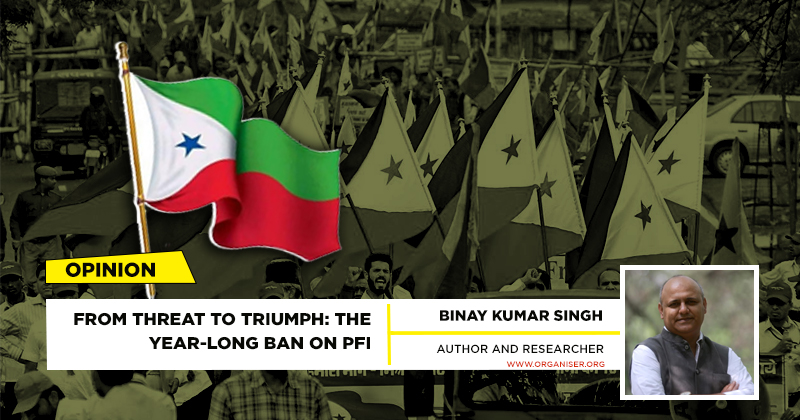
The ban on the Popular Front of India (PFI) marked a significant milestone in this endeavour, sending a strong message that the nation will not tolerate activities jeopardising its unity and peace.
In a well-coordinated operation on September 22, 2022, law enforcement agencies across India, alongside several state police departments, targeted 93 locations in 15 states, resulting in 106 arrests. This pan-India crackdown, known as “Operation Octopus,” was executed under the aegis of the Unlawful Activities Prevention Act (UAPA) of 1967, ultimately leading to the ban.
On September 28, 2022, the Indian government declared the Popular Front of India (PFI) an “unlawful association” and banned it for five years under the Unlawful Activities (Prevention) Act (UAPA) 1967. The government cited PFI’s connections with terror organisations like the Students’ Islamic Movement of India (SIMI), the Jamat-ul-Mujahideen Bangladesh (JMB), and the Islamic State (IS) of Iraq and Syria as “prejudicial to the integrity, sovereignty, and security of the country.” Furthermore, the PFI’s involvement in organising terror camps and encouraging young people to engage in terrorist activity led to the ban under anti-terror laws.
Following the ban, the PFI’s eight associate organisations, namely the Rehab India Foundation, the Campus Front of India, the All India Imams Council, the National Confederation of Human Rights Organisation, the National Women’s Front, the Junior Front, the Empower India Foundation, and the Rehab Foundation, Kerala, were also banned.
Background
The Popular Front of India (PFI) gained significant support from major terrorist organisations declared illegal between 2001 and 2010, including SIMI, LeT, and IM. These groups played pivotal roles in strengthening PFI’s presence in various regions, illustrating the depth of their collaboration.
The PFI strategically utilised violence to attract funding from sources in the Gulf, mirroring tactics employed by Communist groups in Kerala and West Bengal. This included a template of ‘crowd war tactics,’ which involved children at the forefront, followed by women, and then armed cadres.
Same wine, new bottles
Over the past century, a plethora of organisations and forums have emerged, each one giving way to the next or merging with others. It all started with the All India Muhammadan Educational Conference in 1886, followed by the Muslim League in 1906 and the Militant Muslim League Volunteer Corps in 1918. Other organisations like Tablighi Jamaát in 1926, Muslim National Guards in 1931, Jamaat-e-Islami Hind in 1948, Indian Union Muslim League in 1948, SIMI in 1977, and Islamic Seva Sangh in 1992 made their appearances before the formation of the Peoples Democratic Party (Kerala) in 1993, National Development Front in 1994, Karnataka Forum for Dignity in 2001, Manitha Neethi Pasarai in 2001, Tamil Nadu Thowheed Jamaáth in 2004, and finally, the PFI in 2006. With each new organisation, the story continues, and India is anxiously awaiting the next iteration of the PFI, which will have a more advanced format of terrorism with a new name.
Without a doubt, these organisations go by different names, but their fundamental ethos and structural components remain unchanged. It is not uncommon for the same leaders to preside over multiple entities that evolve over many years, varying only in nomenclature and external presentation.
The impact on national security
The ban on the PFI has had far-reaching positive effects on India’s national security. By dismantling the organisational structure of the PFI, the government successfully curtailed its ability to carry out disruptive activities. This move has undoubtedly enhanced the overall security landscape of the nation, safeguarding the lives and well-being of its citizens.
The ban on the PFI sent a clear message that the Indian government is unwavering in its commitment to combat extremism in all its forms. It demonstrated a proactive approach to rooting out organisations that promote hatred, intolerance, and violence. This resolute stance against extremism is a testament to the government’s dedication to fostering an inclusive and harmonious society.
India’s rich cultural tapestry thrives on communal harmony and unity in diversity. The ban on the PFI has played a crucial role in safeguarding this delicate balance. By eliminating an organization that was allegedly involved in activities that could potentially disrupt communal peace, the government has taken a significant step towards preserving the nation’s social fabric.
The ban on the PFI received widespread support from the Indian populace, who saw it as a necessary step towards safeguarding the nation’s interests. The public’s endorsement of this decision underlines the fact that the people of India stand united against any force that seeks to undermine the country’s integrity.
Fostering a culture of accountability
The ban on the PFI exemplifies the government’s commitment to holding organisations accountable for their actions. It sends a powerful message that no entity, regardless of its professed ideals, is above the law. This culture of accountability is essential for upholding the principles of justice and ensuring that all citizens are treated fairly under the law.
While many countries in the world are struggling to find ways to tackle internal terrorism, the ban on the PFI also resonated on the international stage, signalling India’s determination to combat extremism within its borders. It showcased the nation’s resolve to work collaboratively with the global community in the fight against terrorism and radicalisation. This move further solidified India’s position as a responsible and proactive member of the international community.
The type of warfare which PFI mastered is called ‘Hybrid War or the 5th Generation Warfare (5GW), which is a battle of perception and information. Social engineering blended with propaganda has been a common feature of this type of warfare. It is also a cultural and moral war, in which people are provided with a false perception about their traditions and national identity and their thinking regarding their self-hood is also distorted by different means and in place of that they are given a manipulated view and motivated to take a stance against their own state so as to destabilise the society.
As times continue to change, counter-strategies across the world must also undergo a comprehensive transformation. Popular Front of India (PFI) is a classic case to understand how the neo-terror outfit has adopted transformative changes, and imbibed and mastered the next generation modus operandi of warfare. Terrorist organisations such as PFI were difficult to decipher using traditional methods. These suave groups have acquired the skill of weaponising propaganda and are gradually mastering the art of Elastic Warfare. They can alter their appearances, size and methods based on the external pressures they encounter.
As we reflect on the past year, the ban on the Popular Front of India stands as a significant milestone in India’s ongoing battle against extremism. It exemplifies the government’s commitment to national security, communal harmony, and accountability. This decisive action has not only made India safer, but it has also sent a powerful message to the world about the nation’s unwavering resolve in the face of extremism. The ban on the PFI is a testament to the strength and resilience of a nation that stands united in its pursuit of peace, progress, and prosperity.
The ban on the Popular Front of India stands as a significant milestone in India’s ongoing battle against extremism. It exemplifies the government’s commitment to national security, communal harmony, and accountability. This decisive action has not only made India safer, but it has also sent a powerful message to the world about the nation’s unwavering resolve in the face of extremism. The ban on the PFI is a testament to the strength and resilience of a nation that stands united in its pursuit of peace, progress, and prosperity.