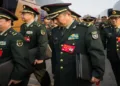
In the midst of the Chinese Civil War, the Communist Red Army (People’s Liberation Army in future) was heavily defeated by the then mighty nationalist Kuomintang (KMT) forces on many fronts, at the same time on the political front, the 28 Bolsheviks, dominated the Chinese Communist Party (CCP) with the support of the Soviets. However, their policies did not withstand the aggressive repressive policies of the KMT, and eventually under the ever-mounting pressure from the military unit of the KMT, the Red Army of the CCP had to take the famous “Long March” in October 1934.
It was during this infamous march, the communist cadres from different regions of China travelled with the defeated Red Army for the next one year to the ‘Yan’ of China’s North West Province of Shanxi.
At the midway of their journey at the Zui session of Guizhou, the party concluded that the 28 Bolshevic’s lackluster policies were the sole reason behind this crushing defeat and unanimously announced Mao Zedong as the commander of the Red Army.
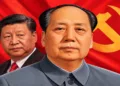
Born in 1893 Mao Zedong was said to be a nationalist in his early days. However, later he got attracted towards Marxism-Leninism while working as a librarian at a university and became a founding member of the CCP. Later on, when the newly established CCP got involved in a bloody civil war with the KMT forces Mao was one of the first to assert the need for a mighty military force to seize power and implement the party’s far-left extremist ideas. It was in the same period that at an emergency meeting of the CCP before the failed autumn uprising, the future chairman of the CCP, Mao Zedong coined that “power comes out of the barrel of the gun.”
In the years to come the kidnapping of Chiang Kai-shek and the Japanese invasion in late 1936 led to a stagnation in the bloody civil war and resulted in the formation of the Second United Front. Although this united front was short-lived and only within two to three years in the alliance, the Red Army rose like a killing force and subsequently started suppressing the military unit of the KMT.
In 1940 Mao propounded his famous theory of “New Democracy”and augmented his efforts to establish his supremacy in the party. Further in the next four years, Mao introduced a blueprint for amendments aimed at establishing his dominance in the party.
The party’s ideological principles were commuted under Mao’s leadership, paving the way to the party’s unprecedented rise in its popularity in the wartime, as a result, the party hardened its disciplinary obligations to the cadres and firmly established the foundation of a totalitarian, authoritarian system.
After the surrender of Japan in 1945, the struggle for hegemony on Chinese soil resumed. This time the KMT forces were supported by the US, however by that time the CCP and the Red Army had become a mighty force. For the next three years, the Red Army butchered the KMT forces in the campaigns that culminated in massacres and bloodshed in the war of supremacy on Chinese soil.
Finally, it was in January 1949 that the Red Army captured Beijing, and in a large gathering at Tiananmen Square, Mao officially announced the party’s rise to power. After 27 long years of bloodshed, the party had come to power in China, It was a watershed moment in the history of China where CCP’s journey from wandering into the wilderness to seizing power had been finally fulfilled.
After seizing the power Mao initiated several campaigns aimed at solidifying his position in the party as well as crushing those who had a political view other than communism. As a result, hundreds of thousands were killed under the so-called land reforms announced by Mao. It was evident that the conduct of the Chinese newly formed communist Government was no different from that of their Russian counterparts, though concurrent geo-strategic events then kept Mao entangled in the aid of his North Korean comrades for some years.
Occupation of Tibet (1959)
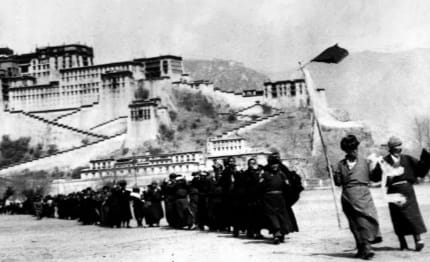
Despite the fact that the Chinese Army was involved in the Korean War, Mao was keen to occupy Tibet and it was only after five years of the Korean War, that Mao ordered the Red Army to capture Tibet. In a horrific set of events that unfolded, the Chinese military under the orders of Mao had taken the Tibetan land by storm. Thousands were brutally tortured and murdered in cold blood, It was a ruthless campaign against the peace-loving Tibetans which witnessed wide-scale bloodshed on the streets of Lhasa, Tibetan shrines were destroyed, and Eventually Tibet was placed under the Chinese dictator.
Though the occupation of Tibet alone could not have satisfied the leftist saniguary bluntness of Mao and eventually after returning from a Soviet visit, Mao decided to convert China into a staunch communist state through a series of campaigns aimed at solidifying a ruthless authoritarian Communist regime. The price of his half-baked intellect was to be paid by millions who were bound to perish in the years that followed.
Mao began his sinister campaign by inviting intellectuals from all over the country to express their independent views on the Chinese Communist Party following which he, on the basis of their political views, slyly divided them into pro-leftists and anti-nationals. it was a deceit, later on Mao while ridiculing the intellectuals confessed that the campaign was indeed a conspiracy hatched for cornering anti-left people.
The Great Leap Forward (1958-60)
To accomplish his highly ambitious far-left policies, Mao flagged off the so-called communist revolution in more than twenty thousand remotest villages in China.
Overnight the peasants were directed to act like trained and disciplined troops, separate workshops were organised for women and children, and workers were made to work tirelessly until the crippling of machinery while the state officials were directed to uplift the production at any cost.
Assuming that the drive would be a huge success, the overwhelmed dictator simultaneously ordered large-scale exports to allegedly boost the economy.
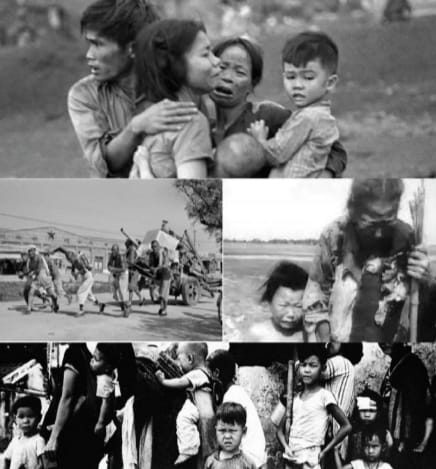
Mao was so convinced of his policy that he even rejected the severe warnings of seasoned bureaucrats and engineers working on projects. Under pressure from Mao’s expectations, the executives then started showing false figures on paper, As a result in spite of low productivity, large-scale exports continued and it was only in a year or two that the masses were battling with the worst famine of decades.
In 1960, Mao finally announced the withdrawal of his impractical policy, however by then millions of people had died of starvation. It was claimed that to hide the death toll, the CCP withheld the census for the next two decades, and it was only in 1982 that the party allowed a census that suggested millions of deaths during the sinister campaign.
The Cultural Revolution ( 1966- 1976)
Though, despite the failure, Mao was unwilling to accept the tragedy of The Great Leap Forward and the short-sightedness associated with it and only 6 years after the tragedy, Mao was ready with yet another disastrous idea to lead China into a communist nation. It was a campaign that was supposed to free the Chinese nation from its cultural roots forever.
On May 16th, 1966, Mao issued a communiqué with the title ‘May 16 notification’, in which Mao claimed that the leadership of the nation’s important ideological and scientific dimensions no longer rests in the hands of the proletariat and those who are running it are anti-communist.
In the notification, Mao made it clear that a decisive struggle should be waged against such people, he called upon teenagers and university students to lead this struggle. The children of the politicians and their friends, who had been organised in advance were to lead this so-called revolution and eventually, the Red Guards were formed to practically complement Mao’s extremist ideas.
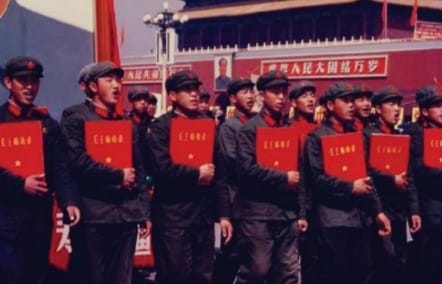
Red Guards would tie bands on their hands, put posters of Mao and arouse the atmosphere in favour of the revolution with songs, poems, and slogans. Their aim was vivid, they intended to paint the whole of China with the so-called revolutionary ideas of their leader.
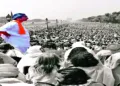
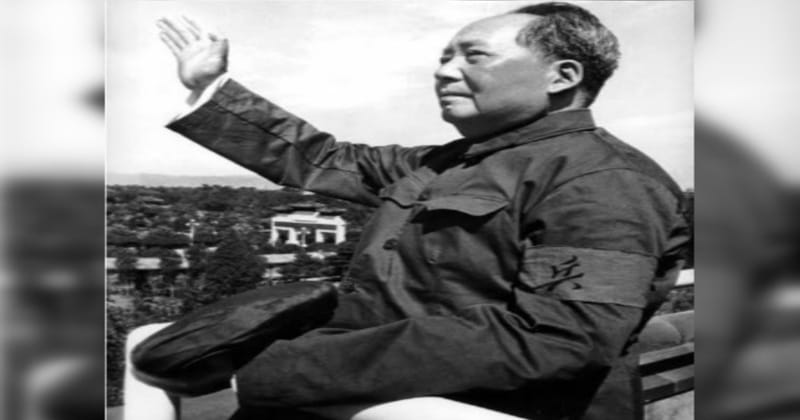
On August 18, Mao addressed thousands of Red Guards from Tiananmen Square following which violent groups of youths unleashed terror and bloodshed on the streets, libraries were set on fire, and hundreds of professors were chased and brutally murdered, such was the state of affairs that even the parents, who opposed the students’ violence were humiliated in public. The trend went on for the next two years, unleashing a regime of terror and chaos, the systematic unfolding of the events suggested that it was all planned carefully and aimed at eradicating of Chinese cultural roots to instil a new one.
By 1968, Mao knew that his objectives were accomplished so he disbanded the Red Guards in 1968. After two years of violence and bloodshed, the so-called revolution aimed at forcibly communistising Chinese society was officially withdrawn, however, unofficially, this fire of hatred ignited by Mao continued until his death in 1976. As a result, an entire generation of China was exposed to this revolution, later to be called the “lost generation of China.”
Undoubtedly, Mao would remain an unalienable figure of the 20th century who would be remembered for his madness towards implementing his far-left ideas at the cost of millions of lives. However, the irony is that despite the fact that Mao’s extremist ideas led millions to death it still inspired a number of insurgent groups across the globe including Bharat. Where the Maoists (Naxals) led by the Communist Party of India (Maoist) supported by a section of so-called intellectuals (Urban Naxals) vow to establish a similar authoritarian Communist regime by eradicating the democratic setup of Bharat.