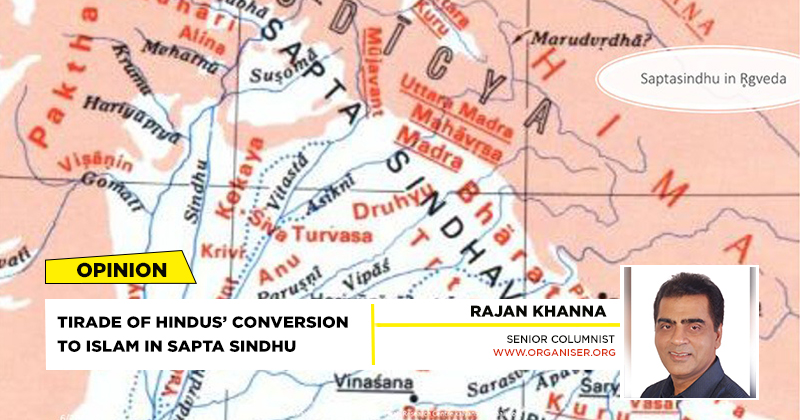
In Vedas Sapta Sindhu Pradesh has been clearly defined as area stretching from Sindhu in the north west to Saraswati ( now extinct) river in the south east. The seven rivers include Sindhu, Vitasta (Jhelum) Chandrabhaga ( Chenab), Iravati (Ravi) Vipasha (Beas), Shatadru ( Sutluj) and Saraswati. For thousands of years the said area remained the cradle of great Hindu Sanskriti and even the oldest Indus Valley civilization was local to the same geographical stretch. It has seen many foreign incursions like those of Greeks, Shakas and Huns; such was the overwhelming influence of the Hindu Sanskriti that they inextricably merged into it and lost their distinct identity.
However, with advent of Islam the demographic character of the Sapta Sindhu started changing. It is interesting to note that Arabs, who were the first Muslims to attack, did not taste much success in respect of conversion of Hindus to Islam. Arabs were successful in converting Persia, north Gandhar and parts of Central Asia very swiftly. In turn the neo-converts of Central Asia like Turks were highly instrumental in converting Hindus. North Gandhar (today’s Afghanistan) comprising the areas of Bamiyan and Mazar-e-Sharif was predominantly Buddhist when Islamic attacks from Arabs started in that area. Due to their philosophy of Ahimsa, the hapless Buddhist population became first victims of the Islamic marauders, succumbed to the sword and converted to Islam. South and central Gandhar comprising areas of Kabul, Kandahar and Jalalabad were ruled by Hindushahi kings and for more than three hundred years offered spirited resistance and did not allow Islam to penetrate that area; neither did they allow Islamic Turks to cross Khyber pass to enter the rest of Bharat. The population of that area was known as Paktas which has a mention in Rig Veda too. Today, the same Paktas are known as Pakhtuns .However, the citadel of resistance started crumbling with the incessant Turkic raids.
Final frontier collapsed when Khukrain Hindu king was defeated by the Turks in 1002 AD. The tirade of Hindus’ conversions to Islam in Sapta Sindhu started in the year 712 AD. The whole process can be categorized in four broad phases.
When Mohammed bin Kasim defeated Raja Dahir in Sindh, Hindus of Sindh were converted but the process halted in Multan, the southern tip of Punjab. Sadly, our academic history remains silent on this phase which started in 712 and ended in 1002 when Mahmud Ghazanvi crossed Khyber.
Great Hindu resistance not only stemmed conversion, many regional chiefs persistently kept on pushing back Arab invaders beyond Seistan province of present day Iran. Bappa Rawal was one such stalwart who defeated Arab armies in today’ region of Sindh, south Punjab ( Today’s Pakistan) Rajasthan and Gujarat.
Maharaja Lalitaditya Muktapida of Kashmir came down to planes of Punjab from hills to take on Arab Invasions.
The Khukrain clan in Southern Gandhar( Today’s Afghanistan) and Gakhars and Khokhars of Salt range and Pothohar region ( Today’s north Pakistani Punjab ) were in the forefront of resistance in the first phase of Islamic raids from Mohammed Bin Kasim to Mahmud Ghazanvi. Second phase of conversions started with Ghazanvi. Raja Jaipal of Hindushahi kingdom of Kabul was defeated by Mahmud Ghazanvi in the year 1002 which resulted in incessant incursions of Ghazanvi into Bharat.
However, the victory of Ghazanvi did not result into mass scale conversions due to great resistance and counter offensives. Therefore, this second phase stretching from Ghazanvi’s
victory to the defeat of Prithviraj at the hands of Mohammed Ghauri in the second battle of Tarain in 1192 remained more or less conversion free.
Had Prithviraj Chauhan not let Ghauri free in the first battle of Tarain which happened in the year 1191 AD, history of Bharat would have been completely different. The third phase of conversions started when in the second battle of Tarain in 1192 Prithviraj was defeated and territory of the entire Bharat in general and Sapta Sindhu in particular saw mass scale conversions. Islamic sultanate which was established in the wake of Ghauri’s victory adopted conversions as a state policy. Majorly five methods of conversion were adopted; to convert with coercion and issuance of death threats; to abduct Hindu women, assimilate in harems and convert; application of jizya on Hindus; offering allurements like jobs in courts and convert; finally to convert those, who couldn’t be coerced or allured, with pseudo spiritualism called Sufism.
Studying a graph of Hindus’ conversion to Islam, it can be safely established that transit from Dharma to Adharma, in a big way, was instrumentalised by Sufis. Sufis established Dargahs, started Qawwali to enlist the maximum number of Hindus. It is interesting to note that both Dargahs and Qawwali are a taboo in Islam. However, since Hindus were accustomed to going to Mandirs and performing Kirtan, the methodology became a gateway for the naive to enter Islam. Another eye-opening fact is, once converts were initiated through Sufism, they were put under tutelage of Mullahs who chained them to radical Islam.
Two pronged strategy of coercion and Sufism was applied with aplomb when Ghauri established rule and was continued by his successors. In Sapta Sindhu, Gakhar and Khokhar tribes who were resisting till then, became victims of this methodology, succumbed and became Muslim.
Sheikh Farid known as Baba Farid also was used to convert chivalrous Khokhars. Today, Sheikh Farid is known as a Sufi saint who believed in religious harmony and his role as proselytizer is completely glossed over.
It is noteworthy that Khwaja Moinuddin Chishti and Nizamuddin Auliya who are considered Sufis, and appeared in twelfth and thirteenth centuries, initiated conversions in western and northern Bharat. In Kashmir, Shah Mir had usurped power from an unsuspecting Hindu queen, Kota rani, but failed to convert the population in the year 1339. Services of so called Sufi Shah Hamdani were sought from Central Asia and tirade of conversion was unleashed on hapless Hindu Kashmiris.
The fourth phase of conversions mainly in Sapta Sindhu and the rest of Bharat started with establishment of Mughal rule. Though the speed of conversions remained constant from Ghauri to Ibrahim Lodhi, during Mughal rule it attained new dimensions. Mughals appointed Nawabs throughout the territory controlled by them for governance purpose. Nawabs competed with each other in getting the maximum number of Hindus converted to Islam and earning accolades from supreme Agra or Delhi Darbar. In Sapta Sindhu three principalities, namely Sirhind, Lahore and Multan became hotbeds of conversion.
With the advent of Aurangzeb a new reign of terror was unleashed on Hindus. He had famously issued an edict pertaining to taking away one and a quarter mounds of janeus from Hindus which could be construed as conversion of Lakhs on daily basis. Daulat Rai in his book “Sahib e kamal Guru Gobind singh” has drawn a sketch of the social condition of Hindus during Aurangzeb’s rule. He writes that if a Hindu used to win from a Muslim in Shatranj or in a bout of wrestling, he was ordered by the village Qazi either to convert or to be ready to get beheaded
because according to Sharia no Kafir (Hindu) has a right to win from a Momin (Muslim). Hindus were not allowed to ride a horse and marriage processions were routinely looted, brides abducted by the henchmen of Muslim Nawabs. That precisely is the reason, in Sapta Sindhu area marriages started to be solemnized during nights to escape attacks from the Muslim hooligans.
However, during the tyrannical regime of Aurangzeb, Hindus saw a new period of renaissance. Like in Western and southern Bharat Shivaji became instrumental in uprooting Mughal rule, in Sapta Sindhu, Dus Guru Sikh tradition shaked the foundations of the said regime. During Aurangzeb’s rule Shri Guru Gobind Singh created Khalsa which fought innumerable battles with Jihadists and re-established Hindu rule in major part of Sapta Sindhu area. The ninth Sikh Guru Shri Tegh Bahadur alongside three disciples Bhai Mati Das, Bhai Sati Das and Bhai Dayala gave supreme sacrifice to save Dharma on 11th November 1675 in Delhi. The day can very well be commemorated as Dharma Raksha diwas because from that day onwards, the demon of conversions was overpowered. A new resilience and enthusiasm gripped Hindu Samaj and centuries old slumber was thrown away.
Hindus of Sapta Sindhu had realized that in order to face, defeat aggressions from across the Khyber pass, an army was required. However, in absence of political power, which still laid with Mughal satraps, Hindus were not in position to raise an army. Another option to give remuneration to the army was to adopt Islamic formula of plundering the population and sharing the spoils with the soldiers. Looting and plundering was not in Hindu genetics. Therefore, one novel and unparalleled concept was adopted; every Hindu household will turn the elder son into Amritdhari Khalsa and offer him as a fighter to defend Dharma and Rashtra.
Today, the majority of the Sapta Sindhu area has gone to Pakistan. Our motherland got partitioned because a majority of its population in Sapta Sindhu was converted to Islam. During partition percentage of Hindus and Sikhs in the area which is known as Pakistan today was twenty three percent. This percentage remained Hindu and Sikhs because their ancestors had offered unprecedented sacrifices to protect their Dharma.
We the proud Hindus today have remained Hindus because our ancestors were courageous and offered sacrifices to protect Dharma. Surely the ancestors of most of the converts were timid and succumbed to allurements.