
‘One Nation, One Election’: Is India ready?
June 23, 2026
  • Read Ecopy
  • Circulation
  • Advertise
  • Careers
  • About Us
  • Contact Us
Android AppiPhone AppArattai
Organiser
  • ‌
  • Bharat
    • Assam
    • Bihar
    • Chhattisgarh
    • Jharkhand
    • Maharashtra
    • View All States
  • World
    • Asia
    • Europe
    • North America
    • South America
    • Africa
    • Australia
  • Editorial
  • International
  • Opinion
  • RSS @ 100
  • More
    • Op Sindoor
    • Analysis
    • Sports
    • Defence
    • Politics
    • Business
    • Economy
    • Culture
    • Special Report
    • Sci & Tech
    • Entertainment
    • G20
    • Azadi Ka Amrit Mahotsav
    • Vocal4Local
    • Web Stories
    • Education
    • Employment
    • Books
    • Interviews
    • Travel
    • Law
    • Health
    • Obituary
  • Subscribe
    • Subscribe Print Edition
    • Subscribe Ecopy
    • Read Ecopy
  • ‌
  • Bharat
    • Assam
    • Bihar
    • Chhattisgarh
    • Jharkhand
    • Maharashtra
    • View All States
  • World
    • Asia
    • Europe
    • North America
    • South America
    • Africa
    • Australia
  • Editorial
  • International
  • Opinion
  • RSS @ 100
  • More
    • Op Sindoor
    • Analysis
    • Sports
    • Defence
    • Politics
    • Business
    • Economy
    • Culture
    • Special Report
    • Sci & Tech
    • Entertainment
    • G20
    • Azadi Ka Amrit Mahotsav
    • Vocal4Local
    • Web Stories
    • Education
    • Employment
    • Books
    • Interviews
    • Travel
    • Law
    • Health
    • Obituary
  • Subscribe
    • Subscribe Print Edition
    • Subscribe Ecopy
    • Read Ecopy
Organiser
  • Home
  • Bharat
  • World
  • Operation Sindoor
  • Editorial
  • Analysis
  • Opinion
  • Culture
  • Defence
  • International Edition
  • RSS @ 100
  • Magazine
  • Read Ecopy
Home Bharat

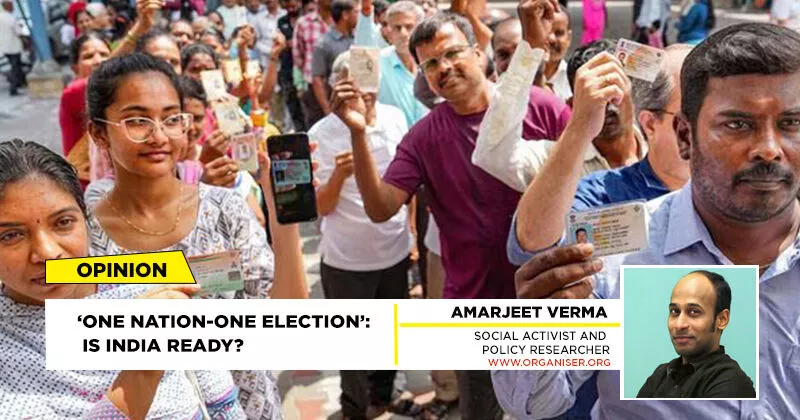
‘One Nation, One Election’: Is India ready?

The ‘One Nation - One Election’ initiative seeks to harmonise elections at the national and state levels, limiting the frequency of referendums and allowing central and state governments to focus on sustainable governance initiatives

Amarjeet VermaAmarjeet Verma
Sep 4, 2023, 08:15 pm IST
in Bharat, Opinion
Follow on Google News
Amarjeet Verma, One Nation One Election

"The concept of ‘One Nation - One Election’ in a diverse nation like India is both promising and challenging. It offers a myriad of benefits, including cost savings, better governance and greater voter engagement," writes Amarjeet Verma

FacebookTwitterWhatsAppTelegramEmail

Elections are the lifeblood of a democracy, and the manner in which they are conducted serves as a profound reflection of a nation’s democratic values. The recent formation of a Union Government panel to examine the feasibility of ‘One Nation – One Election’ has once again sparked a nationwide discourse in India. Although not entirely new, India had previously held both central and state elections simultaneously from 1951 to 1967. However, due to premature state assembly dissolutions, this practice lapsed and was gradually forgotten.

Presently, the Modi Government’s renewed support for ‘One Nation – One Election’ seeks to revive the historic electoral system. This report explores its historical context, potential benefits, challenges and impacts and highlights the need for a thoughtful and constructive debate on this major electoral reform.

A deeply diverse nation comprising 28 states and eight union territories, India remains constantly immersed in election campaigns. Every election, including those in union territories like Puducherry, is often seen as a verdict on the Government of India. This perpetual election cycle can prevent the government from addressing long-term challenges and development goals. The ‘One Nation – One Election’ initiative seeks to address this problem by harmonising elections at the national and state levels, limiting the frequency of referendums and allowing central and state governments to focus on sustainable governance initiatives.

Pros of ‘One Nation-One Election’

  • Cost savings: One of the most significant benefits of this system is the significant cost savings. Conducting elections is a costly affair, and synchronising them would result in significant savings. The 2019 general election cost India approximately 60,000 crores rupees. These funds could be redirected to essential development projects and initiatives.
  • Efficient use of resources: The system would ensure proper deployment of security forces during elections and reduce the burden on these vital resources. It would also allow for better disaster management planning as election-related disruptions would be minimised. For example, in 2019, India alone experienced seven elections in a year, which put a strain on officials.
  • Long-term governance: With synchronised elections, governments would have longer terms of office, allowing for better planning and implementation of long-term projects. Frequent elections often lead to a focus on short-term populist measures to secure votes.
  • Productivity and stability: Government employees would benefit from fewer election holidays, leading to increased productivity. Moreover, a stable government resulting from simultaneous elections would instil investor confidence and promote economic stability.
  • Better Administration: Senior Government officers would have more time to formulate policy and implement projects, leading to more efficient administration. Continuity of leadership would reduce political upheavals associated with elections driven by leadership changes.
  • Increased voter engagement: A single-election event would make it easier for citizens to exercise their right to vote, which could increase voter turnout and political participation.
  • Reduction of electoral malpractices: Simultaneous elections could help reduce the number of fraudulent voters and electoral malpractices as there would be a more efficient & strengthened process.

Cons of ‘One Nation – One Election’

  • Anti-Incumbency: ‘One Nation – One Election’ can lead to a high anti-incumbency factor, especially when both the central and state governments are from the same party or alliance. Voters may be inclined to vote against the incumbent in either election, which could lead to significant policy changes.
  • Hung Parliament/ Legislature: India’s parliamentary setup often results in hung parliaments or legislatures where no party can form a government. In such cases, frequent elections may be necessary, disrupting the ‘One Nation – One Election’ cycle.
  • Complexity of Transition: Transitioning to ‘One Nation – One Election’ would be a complex process involving legal, logistical and administrative issues. Constitutional amendments may be needed, and state governments may be reluctant to give up their power to set election schedules.
  • Political opposition: The opposition parties have not shown a unanimous willingness to discuss and implement this reform. Their concerns and reservations need to be addressed through constructive dialogue.

Challenges Ahead

The concept of ‘One Nation – One Election’ in a diverse nation like India is both promising and challenging. It offers a myriad of benefits, including cost savings, better governance and greater voter engagement. However, challenges such as transition complexity and political opposition need to be carefully considered. As India grapples with a perpetual electoral cycle, it is essential to engage in a rational and open debate on this electoral reform.

The Modi Government should not only support this initiative but also engage in constructive discussions with the opposition parties and related stakeholders. In addition, the government should take this message to the grassroots level, explaining the benefits and addressing the concerns of every citizen. This participatory approach can help bridge the gap and pave the way for meaningful electoral reforms.

Ultimately, the question remains: Can India, with its vast diversity and complex political landscape, successfully implement ‘One Nation – One Election’? While it represents a promising solution to many of the challenges associated with frequent elections, the road to achieving it will undoubtedly be fraught with obstacles. Nevertheless, it is a conversation worth having for the sake of the nation’s progress and democratic vitality.

Topics: One Nation One ElectionNarendra ModiGovernment of India
Amarjeet Verma
Amarjeet Verma
Amarjeet Verma is a remarkable, differently-abled, passionate social activist, policy researcher and thinker who exudes resilience and determination. With a distinguished background as a management graduate and corporate professional, he gracefully intertwines his expertise with his passion. Through his regular contributions to various digital news and magazine platforms, he amplifies voices that deserve to be heard, captivating hearts and minds along the way! [Read more]
Share1TweetSendShareSend
✮ Subscribe Organiser YouTube Channel. ✮
✮ Join Organiser's WhatsApp channel for Nationalist views beyond the news. ✮
Previous News

India’s G20 Presidency: A Voice of the Global South

Next News

Uttar Pradesh: Minor killed self after Shavez Rizvi shared nude clip on social media; Case registered, accused arrested

Related News

Andhra Pradesh Minister and TDP National General Secretary Nara Lokesh

Nara Lokesh dismisses rumours of TDP sabotaging Modi government, reaffirms unconditional NDA support

Delhi Chief Minister Rekha Gupta paid tribute to Bharatiya Jana Sangh founder Syama Prasad Mookerjee on his death anniversary

Article 370 abrogation was the greatest tribute to Syama Prasad Mookerjee: Delhi CM Rekha Gupta

A representative image

Organic manure adoption surges 3.5 times in Kharif 2026 as India builds fertiliser buffer against global turmoil

Prime Minister Narendra Modi and French President Emmanuel Macron

India-France 114-Rafale Deal: How New Delhi is turning defence procurement into a Make-in-India aerospace revolution

India’s first made-in-India C-295 aircraft marks a shift from state control to nation-building through public-private partnership

From Nationalisation to Nation Building: The difference between socialism and integral humanism

PM Modi’s era through the prism of strategic governance

From Gujarat Model to Global Leadership: Assessing PM Narendra Modi’s 12-year journey of strategic governance

Load More

Latest News

President Droupadi Murmu confers the Padma Shri on former civil servant R.V.S. Mani on June 23, 2026.

Former MHA official RVS Mani honoured with Padma Shri for contributions to internal security

Tamil Nadu: Temple funds only for temple property; TVK govt concedes before Madras High Court

Keralam’s former Industries Secretary, Mohammed Haneesh IAS (Right Side)

Keralam Cashew Scam: Former Industries Secretary Md Haneesh apologises before High Court after contempt proceedings

Tamil Nadu: Assembly Speaker directs all bureaucrats to strictly follow warrant of precedence after Mayor-MLA row

Kamakhya Mandir

Kamakhya Mandir’s Ambubachi Mela: The ancient tradition that honours the menstruation of mother Earth

Amazon in dock for mocking Hindu Gods

Amazon File: From Ganesha to Aryabhata-Has Amazon India become a platform for Anti-Hindu narratives?

The West Bengal Budget 2026–27 aims to drive growth through infrastructure, industry, innovation and welfare

Reimagining Bengal: How the West Bengal Budget 2026–27 seeks to balance growth, welfare & economic transformation

Pratiraksha is Gujarat Police's Aadhaar-based verification platform designed to identify illegal workers and prevent identity fraud in industrial sectors

Pratiraksha: How Gujarat police uses Aadhaar verification to secure industrial workforce against identity fraud

Israel-Iran crisis has highlighted not only shifting dynamics of West Asia but also growing confidence of India's foreign policy

India, Israel and the rise of strategic autonomy in an era of global geopolitical realignment

Saleem and Jaleel arrested in forced religious conversion case

Karnataka Conversion Case: Forced conversion of Hindu woman and minor son sparks outrage; Saleem and Jaleel arrested

Load More
  • Privacy
  • Terms
  • Cookie Policy
  • Refund and Cancellation
  • Delivery and Shipping

© Bharat Prakashan (Delhi) Limited.
Tech-enabled by Ananthapuri Technologies

  • Home
  • Search Organiser
  • Bharat
    • Assam
    • Bihar
    • Chhattisgarh
    • Jharkhand
    • Maharashtra
    • View All States
  • World
    • Asia
    • Africa
    • North America
    • South America
    • Europe
    • Australia
  • Editorial
  • Operation Sindoor
  • Opinion
  • Analysis
  • Defence
  • Culture
  • Sports
  • Business
  • RSS @ 100
  • Entertainment
  • More ..
    • Sci & Tech
    • Vocal4Local
    • Special Report
    • Education
    • Employment
    • Books
    • Interviews
    • Travel
    • Health
    • Politics
    • Law
    • Economy
    • Obituary
  • Subscribe Magazine
  • Read Ecopy
  • Advertise
  • Circulation
  • Careers
  • About Us
  • Contact Us
  • Policies & Terms
    • Privacy Policy
    • Cookie Policy
    • Refund and Cancellation
    • Terms of Use

© Bharat Prakashan (Delhi) Limited.
Tech-enabled by Ananthapuri Technologies