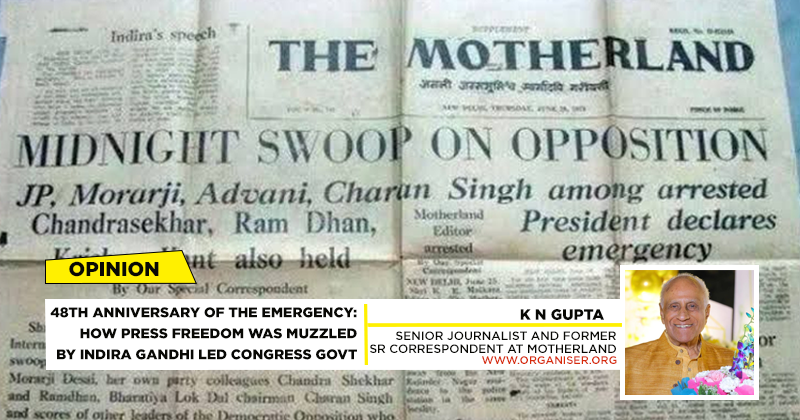
As India celebrates 76 years of Independence, it is imperative that we once again highlight the horrors of the infamous Internal Emergency imposed by then Prime Minister Indira Gandhi on June 25 night in 1975, and how it had throttled media completely and extinguished press freedom. That 21-month long period was the grimmest period in India’s postcolonial history. Not only did the ‘Emergency’ entail the abrogation of democratic freedom, the suspension of Civil liberties and the censorship of the press, but also gutted habeas corpus and judicial review.
There was no doubt that, until then, the Indian media had contributed significantly to ensure a vibrant democracy by creating a legacy of setting the highest professional standards for journalists by enhancing their role and contribution to society.
All of a sudden, on June 12, 1975, when a verdict of the Allahabad High Court convicted Prime Minister Indira Gandhi in a case of electoral malpractices and debarred her from holding any elected post, she reacted by imposing an Internal Emergency and slapping Censorship on media to save herself from being arrested. She suspended all fundamental rights, pushed Opposition leaders in jails, and imposed complete censorship on media. Power supplies of all printing presses located on India’s Fleet Street, called Bahadur Shah Zafar Marg, were snapped, so that no news of the atrocities and countrywide arrests of Opposition leaders may reach the common masses. Interestingly, and luckily, the government authorities forgot that an important mouthpiece of the right wing Opposition known as ‘The Motherland’ had its printing press in Jhandewalan, and not BSZ Marg!
Though the Editor of The Motherland, Late K. R. Malkani, was the first journalist to be arrested from his home on the very first day of Emergency, Malkani immediately informed us in the core team of his arrest and authorised his second-in-command Daya Nand Singh to take over the newspaper and continue the struggle against the authoritarian regime. Singh and I rushed early morning to our office at The Motherland, informed the staff of Malkani’s and other Opposition leaders; arrests, and started collecting more information by contacting and meeting their families. I spoke to several Opposition leaders; families and confirmed the news of their arrests. It had been a midnight knock at the doors of senior leaders belonging to Jayaprakash Narayan’ s movement, the Rashtriya Swayamsewak Sangh (RSS) and the erstwhile Bharatiya Jana Sangh. The police had not given any time to the detainees to speak to any outsider – friend, relative or party colleague. The police had intimidated the families and arrested the senior political leaders and journalists inside their very homes, handcuffed them and whisked them away.
Since we knew that the Government would soon shut down our office too, we quickly swung into action and published a special supplement of The Motherland that contained all available information on arrests and curbs that had been imposed on Freedom of Speech and Expression. The Motherland was the only newspaper in the country that printed that night and informed the nation about the arrests and the suspension of civil liberties.
The Motherland ‘Special Supplement on Emergency’ got sold out in no time! Our office had very little newsprint stock and we had to borrow from another media house to reprint. We urged our Manager Brij Bhushan to rush the special emergency supplement to railway stations in Delhi so that trains leaving for different destinations could carry it across the country. In his book, Indira’s media advisor Sharda Prasad’s son writes how he waited for a newspaper on the morning of June 26 and the only newspaper he received at 6 am was The Motherland flashing news about the imposition of Emergency and complete suspension of civil liberties.
As was obvious, the authorities came to know about our supplement that had violated their draconian pre-censorship laws that were being brutally imposed on the media. The local police swooped down on The Motherland office, seized all printing materials, threatened us for violating Government instructions and sealed the premises. At that time, we did not realise that this would be the last day that our Motherland office would ever function. Alas, after the seizure and raids that took place on June 25, 1975, The Motherland office never reopened and the newspaper was never published again, even after the Emergency and Press curbs were lifted. Most of The Motherland staff suffered immensely. They remained unemployed for a long time and also did not get any compensation. I belong to a reputed family that has a history of having lived in the present Old Delhi area for over 350 years, from the time when it was called Shahjahanabad. Mine was a pure business family, with all my brothers engaged in the family’s traditional trading and other businesses.
Since I had myself chosen journalism as a profession, nothing could deter me, not even unemployment and hardships during Emergency period. I entered the profession, first joining the vernacular news agency, Hindusthan Samachar. Then, I went on to work with the Indian Express and later The Times of India, before finally joining The Motherland.
I had joined The Motherland from its inception days, and had been a part and parcel of putting together its editorial team and formulating its editorial policy. I was naturally very down and depressed after its closure. Emergency also threw our personal families and commitments out of gear. I had to look after my wife and three small children. Fortunately, my wife was working as a teacher.
That period of unemployment played havoc, and my family had to bear the brunt of it. I was left without choice and had to take the first job that came my way. Despite already a long innings in the profession, circumstances forced me to join The Economic Times at a very low position which was extremely humiliating for me. This was an era of complete authoritarianism.
The Government controlled the flow of information to the masses. The diktat and every action was simply to propagate the propaganda that “India is Indira, and Indira is India.” The Government resorted to using arbitrary and intimidatory measures to ensure its total diktat.
Some journalists who had been living in Government accommodation were evicted overnight and the MRTP Act was misused to force newspapers to print lesser copies to limit their reach and audience.
In the meanwhile, the entire world was reporting the autocratic fashion in which media was being suppressed in India. Reporters of The Washington Post the Los Angeles Times were expelled from India. The Guardian and The Economists correspondents flew back to the United Kingdom after receiving threats. Mark Tully, the voice of BBC, was also withdrawn.
At that very time, the National Broadcasting Corporation (NBC) of America approached me for a television interview about the impact of the Emergency on Indian media. Foreign media wished to help inform the world about the situation in India.
NBC crew flew into Delhi and interviewed me at my home in Gulmohar Park, a journalists’ colony. I spoke in detail about how journalists, including editors, were being harassed by Censor Officers in Press Information Bureau (PIB) to place the complete edition before them for approval, about how they were subjected to humiliation and made to stand for hours before the Censor Officers would allow the edition could be released. I told them that despite the fear psychosis prevailing in the country, there was no dearth of those who were coming to the forefront to oppose the Emergency and overthrow Indira. I said this kind of diktat cannot last long. NBC staff even interviewed my wife and little children.
My wife spoke of the unprecedented negativity prevailing across the country. My children were 11, 9 and 6 and they spoke about how editorial pages of all newspapers were being left blank in protest.
NBC camera crew followed me for two full days to capture the plight of an Indian journalist during Emergency, taking shots of how I travelled to my closed office, the sealed office of The Motherland, the padlocks and chains on the printing press and then my visit to PIB, having no opportunity to write and publish anything. After two consecutive days; of shoot,
NBC flashed my interview all over America and elsewhere. It was titled “Emergency in India and the Plight of Media”. The interview had a huge impact. After the interview was repeatedly played a couple of times by NBC, it resulted in a big chaos as the then Indian High Commissioner to the UK who was also the former Indian Ambassador to the US, B K Nehru, brought it to the notice of the newly appointed Information and Broadcasting Minister Vidya Charan Shukla. The interview had quite obviously brought out the horrors of Emergency. Shukla immediately passed an order that all foreign correspondents stationed in India also need to adhere to censorship. I remember that BBC Chief Correspondent Mark. Tully told Shukla that he would rather quit than succumb to pre-censorship! I regret to add that after Shukla passed the order, the entire PIB go after me saying I should not have spoken to a foreign channel and that all of them would have to face the consequences. Some overzealous and pro-Emergency media persons and the ruling Congress Party leaders also tried to get me arrested.
Unlike many others, I didn’t surrender my PIB accreditation card, hoping to get it transferred to the new media house I may join. I suffered acute harassment those days, but it did not deter me. I continued writing in some small publications till I joined the Economic Times desk. Luckily, ET was dominated by CPI-M staff that opposed the Emergency.
Quite aptly, L K Advani said that the India media was asked to bend but it started crawling. Some of our senior correspondent colleagues reported only those who praised the Emergency and blanked out the other version completely.
However, there were still enough conscientious ones at the editorial desk who tried to remove such sycophancy while editing their copies, but the overall atmosphere was one of fear and subjugation.
Majority of the Indian media (with the exception of The Statesman and The Indian Express and Nikhil Chakravarty’s Mainstream) turned more loyal than the king. It was a pity!
Some of the editors and correspondents were happy to pander to the extra-constitutional authority of Prime Minister’s younger son, Sanjay Gandhi. However, even in the midst of all this torture, eminent editors like Kuldeep Nayyar fought valiantly and opposed the Emergency at an open meeting held at the Press Club of India. He was later arrested. I am equally proud to have been associated with the National Union of Journalists (India). It was the only professional media organisation that stood up and spoke boldly and took on Prime Minister Indira Gandhi, lashing out against the infamous Emergency. NUJ-I was led then by the great visionary journalist leader Late Prithvish Chakravarty who went to the extent of calling on Indira and telling her to her face that NUJ-I will officially and openly oppose the Emergency and press censorship.
On the other hand, the Indian Federation of Working Journalists (IFWJ), controlled by the pro-Emergency Communist Party of India, completely surrendered to Press censorship. I have to point out that raising the voice through an organised forum like NUJ-I emboldened at least some of our young journalists.
The media was fully controlled, so much so that the four news agencies – PTI, UNI, Hindusthan Samachar and Samachar Bharti – were merged into a single entity called ‘Samachar’. Eminent editors like S. Mulgaonkar, V. B. Verghese, Sardar Nihal Singh and Arun Shourie were forced to retire. Hindustan Times owner K K Birla was made Chairman of Express Group. Sanjay Gandhi appointed his own guys on the boards of media houses. Amar Nath Chawla, Congress MP, was appointed to the Times of India Board and Kamal Nath to the Express group.
I was living in a colony of journalists called Gulmohar Park. Along with senior journalists like the Editor of Eastern Economist Late Bala Subrahmanyam and Times of India’s Late B K Bhalla and many Economic Times staffers, I called a ‘solidarity meeting’ which was widely attended. We all resolved to raise our voices despite the curbs. Some newspapers protested tooth and nail against censorship during the Emergency besides many smaller, independent newspapers and journals like Panchjanya, Organiser, Motherland, Tarun Bharat, Vivek, Vikram, Rashtradharm, Yugdharm, Himmat, Janata, Frontier, Sadhana and Swarajya.
The Indian Express, The Statesman and Mainstream fought courageously against Indira’s dictum. I recall Financial Express reproduced Rabindranath Tagore’s poem “Where the mind is without fear and the head held is high”.
In conclusion, I can add a line from Thomas Jefferson – Eternal vigilance is the price of Liberty! Press across the world needs to be alert, not only uphold press freedom but to ensure greater ethical standards, only then can you face such onslaughts