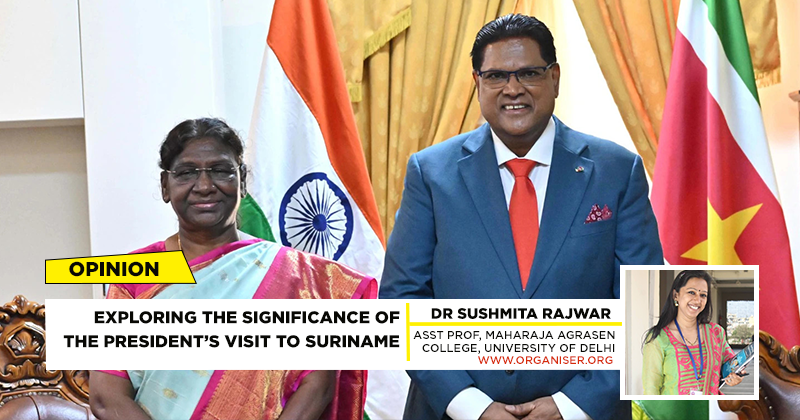
President Droupadi Murmu embarked on a significant journey to Suriname on June 4, marking her inaugural visit since assuming office in July of the previous year. The primary objective behind this visit was to strengthen India’s bilateral ties with the South American nation, thereby enhancing the level of engagement between the two countries.
During her time in Suriname, President Murmu engaged in constructive discussions with the nation’s prominent leaders and also had the opportunity to meet with a diverse representation of the Indian diaspora.
The Indo-Surinamese community constitutes the largest ethnic group in Suriname, comprising approximately 37 per cent of the total population. It is worth noting that the current President of Suriname, Chan Santokhi, is of Indo-Surinamese heritage, further exemplifying the significant influence and representation of the Indo-Surinamese population in the country.
President Droupadi Murmu also declared that India has chosen to expand the eligibility criteria for obtaining an Overseas Citizen of India (OCI) card for individuals of Indian origin residing in Suriname. Previously, a restriction existed that limited the issuance of Overseas Citizen of India (OCI) cards to only the first four generations of the original forefathers who migrated from India to Suriname. As a result, numerous younger individuals from the community, belonging to the fifth and subsequent generations, could not avail themselves of this privilege. Since Suriname is a nation encompassing the ‘old diaspora’, this announcement is being seen as a positive change in the diaspora policy of the Government of India. President Murmu announced on June 5 during her address at Independence Square. She, along with the President of Suriname, Mr Chandrikapersad Santokhi, was attending a cultural event commemorating the 150th anniversary of the arrival of Indians in Suriname.
Under the British Raj, many Indians were dispatched to various British colonies as a labour force. Following the abolition of slavery in the Dutch colony of Suriname, the Dutch government entered into a treaty with the United Kingdom to recruit contract workers.
Consequently, starting in 1873, Indians migrated to Suriname from what was then British India, serving as indentured labourers. The majority hailed from present-day Indian states like Uttar Pradesh, with smaller numbers originating from Bihar, Haryana, Punjab, and Tamil Nadu.
The first vessel carrying Indian indentured labourers, known as the “Lalla Rookh”, reached Fort Nieuw Amsterdam in Paramaribo, Suriname’s capital, on June 5, 1873. Between 1873 and 1916, approximately 34,304 indentured labourers were transported from British India to Suriname.
These labourers were recruited under contractual agreements, known as indenture contracts, which specified their terms of work, wages, and other conditions. The arrival of the Indian workers in Suriname was seen as an extension of the previous slave trade, highlighting the belief that the underlying power dynamics remained unchanged. This system was even termed as a “New system of slavery”. Indentured labour or ‘Coolies’ were also called ‘Girmitiyas’, from the English word Girmit (Agreement).
The agreement explicitly outlined the working conditions, remuneration, and repatriation provisions for the labourers upon completing their contract. As Brij V Lal suggests, regardless of the name bestowed upon them, they were regarded as individuals from an impoverished land dressed modestly, adhering to distinct customs and traditions. They were recognised as indentured labourers who sought escape from dire circumstances back home, opting for migration to distant lands brimming with promising prospects like the Chini Tapu (Trinidad), Miritch Dwip (Mauritius) and Sriram Desh (Suriname).
Indentured labourers endured harsh conditions on the plantations, similar to those experienced by enslaved people. They worked long hours, lived in poor housing conditions, and faced various forms of exploitation.
Despite the challenging circumstances, many indentured labourers managed to preserve their cultural practices, traditions, and languages, contributing to the vibrant Indo-Surinamese community in Suriname today. After Suriname gained independence on November 25, 1975, many Indo-Surinamese individuals migrated to the Netherlands. By doing so, they could retain their Dutch passports, ensuring continued ties with the Netherlands. This migration of the Indo-Surinamese population to the Netherlands marked a significant demographic shift and further strengthened the cultural and historical connections between Suriname and the Netherlands.
The Indian diaspora in Suriname significantly strengthens the relationship between India and Suriname through various avenues. The Indian diaspora actively promotes Indian culture in Suriname, organising cultural events, festivals, and religious ceremonies. These activities help to preserve Indian traditions while also providing opportunities for Surinamese people to learn about and engage with Indian customs. For instance, Diwali, the Festival of Lights, is celebrated with great enthusiasm by the Indian diaspora in Suriname, allowing the Surinamese community to experience and appreciate Indian cultural practices. The Indian diaspora brings valuable knowledge, skills, and expertise from various fields to Suriname. They contribute to academia, research, and technical fields, sharing expertise and fostering knowledge exchange. Many diaspora members have become influential figures in Suriname’s political landscape, contributing to bilateral dialogue and cooperation. Their involvement in fostering people-to-people connections and cultural diplomacy helps deepen the friendship and understanding between the two nations.
Situated at the very spot where Indians disembarked from ships in Suriname, known as the ‘Coolie depot’, stands the monument called “Baba en Mai” (Father and Mother). This significant structure symbolises the hardships and challenges endured by the countless Indians who left their native lands in search of improved prospects and embraced Suriname as their new home. While embracing the local culture, the Indian diaspora in Suriname wholeheartedly preserved and perpetuated their traditions, rituals, cuisine, language, folklore, and more. Across generations, they have passed down these invaluable cultural elements, making a substantial contribution to the sustainable development of Suriname in various spheres. During this visit, the President of Suriname emphasised their commitment to reinforcing the 47-year-long relationship between Suriname and India, particularly in enhancing cultural and social-religious ties.