NCERT: From Half-Truth to History
June 25, 2026
  • Read Ecopy
  • Circulation
  • Advertise
  • Careers
  • About Us
  • Contact Us
Android AppiPhone AppArattai
Organiser
  • ‌
  • Bharat
    • Assam
    • Bihar
    • Chhattisgarh
    • Jharkhand
    • Maharashtra
    • View All States
  • World
    • Asia
    • Europe
    • North America
    • South America
    • Africa
    • Australia
  • Editorial
  • International
  • Opinion
  • RSS @ 100
  • More
    • Op Sindoor
    • Analysis
    • Sports
    • Defence
    • Politics
    • Business
    • Economy
    • Culture
    • Special Report
    • Sci & Tech
    • Entertainment
    • G20
    • Azadi Ka Amrit Mahotsav
    • Vocal4Local
    • Web Stories
    • Education
    • Employment
    • Books
    • Interviews
    • Travel
    • Law
    • Health
    • Obituary
  • Subscribe
    • Subscribe Print Edition
    • Subscribe Ecopy
    • Read Ecopy
  • ‌
  • Bharat
    • Assam
    • Bihar
    • Chhattisgarh
    • Jharkhand
    • Maharashtra
    • View All States
  • World
    • Asia
    • Europe
    • North America
    • South America
    • Africa
    • Australia
  • Editorial
  • International
  • Opinion
  • RSS @ 100
  • More
    • Op Sindoor
    • Analysis
    • Sports
    • Defence
    • Politics
    • Business
    • Economy
    • Culture
    • Special Report
    • Sci & Tech
    • Entertainment
    • G20
    • Azadi Ka Amrit Mahotsav
    • Vocal4Local
    • Web Stories
    • Education
    • Employment
    • Books
    • Interviews
    • Travel
    • Law
    • Health
    • Obituary
  • Subscribe
    • Subscribe Print Edition
    • Subscribe Ecopy
    • Read Ecopy
Organiser
  • Home
  • Bharat
  • World
  • Operation Sindoor
  • Editorial
  • Analysis
  • Opinion
  • Culture
  • Defence
  • International Edition
  • RSS @ 100
  • Magazine
  • Read Ecopy
Home Opinion

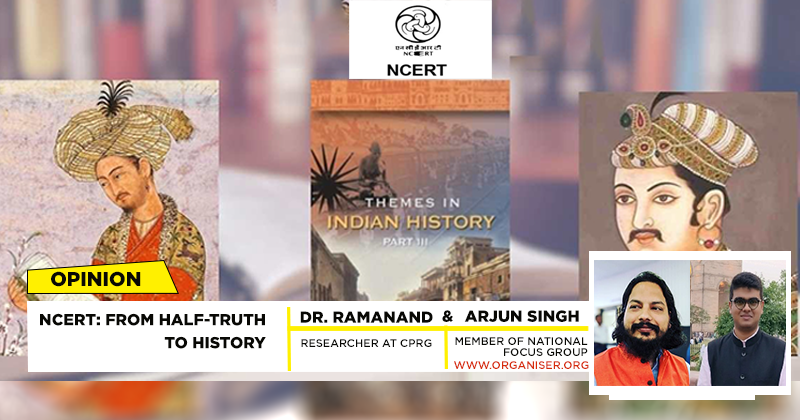
NCERT: From Half-Truth to History

In History textbooks, stories need to be narrated honestly. Under the Congress regime, our society suffered due to half-truths. Now, NCERT must make sure that our society is aware of its past mistakes

Dr Ramanand & Arjun SinghDr Ramanand & Arjun Singh
Jun 5, 2023, 03:15 pm IST
in Opinion, Education
Follow on Google News
FacebookTwitterWhatsAppTelegramEmail

Every middle school student studying History through the National Council of Educational Research and Training (NCERT) textbook wonders why his book reads “Our Past”. Gradually, he learns to accept the different pasts (truths) as equally valid and important. This needs to be understood against the background of the recent development relating to the NCERT textbooks. The rationalisation of the content of these textbooks makes the central questions of studying our pasts and the definition of its scope more prominent.

One wonders whether the past can even be fully known and subsequently, whether we are aware of the kind of past we want to explore. There is a need to understand the pasts differently and patience is needed to better understand the ramifications of the syllabus rationalisation’s effect on learning outcomes. These two questions form the background of the recent controversy related to the NCERT History textbooks. The answer to the first question of fully knowing the past is as clear. When we have many versions of any event of the present, how can we be sure that the past will have only one version? The past cannot be known accurately, we can only assume or indicate past incidents.

Recontextualising the Past 

The first edition of the NCERT book also faced a similar question. However, it highlighted one version over the others. While any process of History writing has ideological tones, yet, after Independence, one version dominated the others. This version of History writing was institutionalised by the regime in 1981 to supposedly promote ‘national integration’ and a process of revision of History writing followed at the Centre and State levels. There was a lack of interest to know the pasts as they were, but rather to make them convenient to fit the present. Similar efforts were seen in 1989 in West Bengal when the History textbooks were ‘cleansed’ through strategic omission of facts. Thus, when the Janata Party (1977-79) and the NDA Government (1999-2004) came to power, they tried to make changes as per their understanding of the past. The pursuit to define the accurate past continued with the UPA Government committing itself to undo the changes made by the previous Governments. These revisions define the Indian past through prisms to advance a particular outlook – an accurate image of a singular past rather than a bundle of shared pasts.

Telling Truth, Not Twisting Facts

Second, there seems to be a limited understanding of even the past that is being promoted for academic and public exploration. Amidst narratives and counter-narratives, half-truths become routine. There are many things which could have been said plainly without any if and but. However, it has been twisted in the way so it did not affect the present- the story of Partition was with many people who came to India from Pakistan who lost their everything in the transition but this could not tell as per the experience of survival. There are many stories which should be told honestly so society can remain conscious of their past mistakes but correcting ‘past’ as per the requirements of ‘present’ has done great disservice not only to textbooks but to society too.

These iterative loops and intellectual tussles question the real nature of History textbooks used in our schools. Indian History textbooks at the school level continue to be fixated on ideological bends. At one level, there is a fixation on the large and shiny empires, with the Mughal Empire being the perfect example. However, the pages dedicated to the Mughals come in exchange for a focus on other equally significant empires like that of Cholas. There is also a fixation on Delhi, ignoring other parts or peripheries of the country. The Ahoms continue to live in their relative invisibility. There are also fixations around other themes such as men and urban areas, at the cost of several marginalised communities and regions. Our textbooks were never truly representative of the different parts of our culturally diverse land.

The revision of History textbooks, therefore, raises three basic questions. First, what is the correct approach to teach History? Second, who defines the correct approach to teaching History? Third, for whom do we want to correct our approach?

Academic exploration, as done in schools, should focus on the critical skill of reading the past. The pursuit of differently interpreting the same historical events and processes, unfortunately, turned into the issue of defining a correct past. The pursuit of the depiction of one ideal past precludes the inclusion of the educational and development goals of the study of our pasts. The pursuit of the study of all our pasts is needed to let the learners interpret the different pasts in the way they choose. It will then represent the diverse and rich pasts that the subcontinent witnessed over the centuries. Finding objectivity in a subject like History is futile.

As NCERT has clarified, the current exercise of syllabus rationalisation comes after the pandemic to reduce the burden on students and to meet the goals of NEP 2020. We need to also give them space to better understand the move’s implementation and achievement of intended outcomes. We need to wait for the final update from NCERT, which has been pending since 2006. The national curriculum is a sensitive matter, holding great cultural and political significance, and must be engaged with utmost deftness by educationists and policymakers.
Topics: HistoryNDA governmentUPA governmentNCERT booksNCERT textbooksHistory textbooksOur PastJanata PartyMughal EmpireNCERTMughals
Share1TweetSendShareSend
✮ Subscribe Organiser YouTube Channel. ✮
✮ Join Organiser's WhatsApp channel for Nationalist views beyond the news. ✮
Previous News

After Iran, 80 Afghan girls hospitalised after being poisoned at schools

Next News

Money Laundering Case: Delhi High Court denies bail to AAP leader Manish Sisodia, says ‘allegations extremely serious’

Related News

Tribute to Rani Durgawati on her Martyrdom Day

Rani Durgavati Martyrdom Day: Immortal Warrior rani, defender of Tribal Pride, national honour & Sanatan values

Prime Minister Narendra Modi

Viksit Bharat: PM Modi slams Congress — ‘Blocks development, claims credit’

NCERT orders replacing correct image of Mohenjo-Daro dancing girl

NCERT orders immediate correction of modified Mohenjo-Daro ‘Dancing Girl’ illustration

Prime Minister Narendra Modi addressing the NDA leaders meeting, marking his becoming India’s longest-serving elected prime minister and the completion of 12 years of the NDA government, at
Bharat Mandapam, in New Delhi

12 years of Modi Government: Golden chapter of stability, continuity and decisive leadership

PM Modi’s era through the prism of strategic governance

From Gujarat Model to Global Leadership: Assessing PM Narendra Modi’s 12-year journey of strategic governance

12 years of Modi Govt: Meaningful philosophy or manufactured phenomenon; Bharat’s tryst with democracy

Load More

Latest News

Andhra Pradesh Chief Minister N. Chandrababu Naidu inaugurates the Jonnagiri Gold Mining Project in Kurnool district

Andhra Pradesh: CM Chandrababu Naidu lunches first major gold mining project in Kurnool district

AI-generated image for representation

Tamil Nadu: School teacher faces action over alleged humiliation of menstruating student

Cochin Shipyard (File Photo)

Keralam: ‘I Love Pakistan’ inscription found inside vessel at Cochin Shipyard; Central agencies launch probe

BJP national spokesperson Pradeep Bhandari

Karnataka: BJP accuses Kharge family of illegally acquiring government land worth over Rs 100 crore

Elomi Global Worship Centre in Omalloor, Pathanamthitta district ; Pastor Binu Vazhakkuttom (Left to Right)

Keralam: Child abuse allegations at Pentecostal worship centre in Pathanamthitta; locals demand Pastor Binu’s arrest

Modi Govt’s Tourism Revolution: 183 projects, Rs 9,225 crore investment & rise of India’s cultural & spiritual circuits

Padma Awards 2026: Tamil Nadu’s distinguished achievers receive national honours

India’s history is not merely a tale of foreign domination but also a remarkable story of resilience, resistance & civilisational continuity

Indian History: Not just foreign rule, but a timeless story of resistance, self-respect and civilisational resilience

From $10 Billion to $190 Billion: Indian Bioeconomy Touches New Heights in 12 Years

From $10 Billion to $190 Billion: India’s Bioeconomy leads a 12-Year science revolution

Nagpur | Acceptance of Bharatiya civilisational values is steadily increasing worldwide: Shanta Kumari

Load More
  • Privacy
  • Terms
  • Cookie Policy
  • Refund and Cancellation
  • Delivery and Shipping

© Bharat Prakashan (Delhi) Limited.
Tech-enabled by Ananthapuri Technologies

  • Home
  • Search Organiser
  • Bharat
    • Assam
    • Bihar
    • Chhattisgarh
    • Jharkhand
    • Maharashtra
    • View All States
  • World
    • Asia
    • Africa
    • North America
    • South America
    • Europe
    • Australia
  • Editorial
  • Operation Sindoor
  • Opinion
  • Analysis
  • Defence
  • Culture
  • Sports
  • Business
  • RSS @ 100
  • Entertainment
  • More ..
    • Sci & Tech
    • Vocal4Local
    • Special Report
    • Education
    • Employment
    • Books
    • Interviews
    • Travel
    • Health
    • Politics
    • Law
    • Economy
    • Obituary
  • Subscribe Magazine
  • Read Ecopy
  • Advertise
  • Circulation
  • Careers
  • About Us
  • Contact Us
  • Policies & Terms
    • Privacy Policy
    • Cookie Policy
    • Refund and Cancellation
    • Terms of Use

© Bharat Prakashan (Delhi) Limited.
Tech-enabled by Ananthapuri Technologies