Emergency under Indira Gandhi saw freedom of speech being suppressed like never before. India slipped in global index for freedom of press. Censorship was the order of the day and every piece of news that was to be published was to be scrutinised by the government before going to print. A few facts about the complete curtailing of freedom of speech in the country lays bare the authoritarian regime that the government under Indira Gandhi and Congress had become during emergency.
- According to a survey conducted by the Freedom House globally, the place in the freedom of the press of India, which was third in the beginning of the seventies, was reduced to 34th in 1975 – 1977. The New York Times wrote in a report on December 28, 1975 that due to the harsh curb on the press in India, there is a big blow to the democratic society.
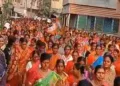
- In the month of March 1975 countrywide movement and revolt started to take place against the policies of government. On June 5, a mass protest was organised in Kolkata under the leadership of Jaiprakash Narayan. The movement saw the support from press, though a communist mouthpiece Janshakti was against this national movement and agitation. (Rakesh Sinha, Aapatkaal Mein Patrakarita, p. 105)
- On June 25, 1975 a mass rally was organised in Ramlila Maidan. Jaiprakash Narayan condemned the oppression against the peaceful agitators and termed it as unethical and illegal. He further said you (Police)should not consider anyone’s wrong order, it is written in the Army and police act that abiding by illegal, inappropriate and unethical orders is a punishable offense. By making this part the basis of his speech, the government imposed Emergency on the country.(Shailendra Nath Srivastava,Loknayak Jayprakash Narayan, p. 158)
- Smaller magazines and papers which were representing independent thoughts had to face the wrath of the state and were closed during emergency.W.H Morris Jones writes, “The Indian press suffered the major setback during emergency.”(See, attachment 1)
- As a result of the censorship order, it was prohibited to publish news, feedback, rumours or any report related to internal security laws or any action taken under M.I.S.A, without the permission of the official. Under the different rules, no news, report or response related to the location and status of the prisoners and family planning cannot be published under emergency.(Soli Sorabjee, The Emergency, censorship and Press In India, p.9)
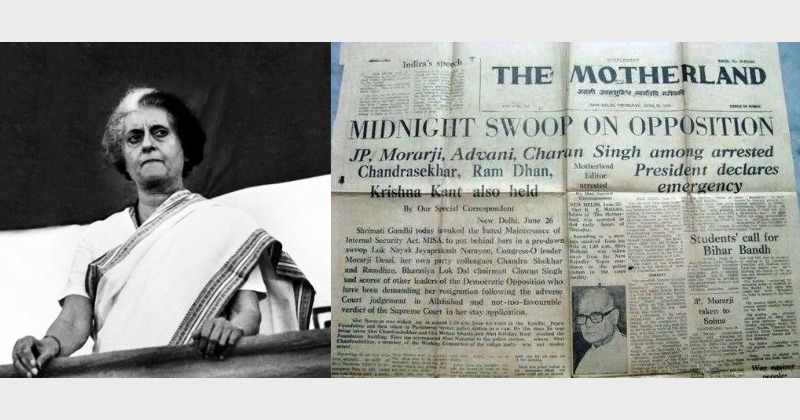
- RSS inspired newspapers and magazines played a major role during emergency. This was the reasons many such magazines and newspapers had to face the wrath of the government. Few of such titles are Panchajanya, Organiser, Motherland, Tarun Bharat, Vivek, Vikram, Rashtradharm,Yugdharm. The editor of Motherland and Organiser K.R Malkani was the first reporter arrested during emergency and remained in jail till the end of emergency.(Rakesh Sinha,Raajneetik Patrakarita, p. 108)
- Malkani writes, “Motherland was the only newspaper in the country which in its edition published on June 26 not only informed people about emergency but also about arrest and protest at national level against emergency. He further writes that the electricity of the motherland office situated at Jhansi road, Jhandewalan, New Delhi, was cut though there was light at neighbouring office ‘Janyug’,the communist mouthpiece. (K.R Malkani, The midnight Knock, p. 1)
- Total 253 reporters were sent to jail under M.I.S.A. (Rakesh Sinha, Raajneetik Patrakarita, p. 109)
Drawing false equivalence of few isolated incidents in recent times to emergency is a great disservice to the memory of those who sacrificed themselves during emergency to uphold true freedom of speech and expression.
KR Malkani, Kuldip Nayyar, Khushwant Singh, Ramnath Goenka and others protesting against the Rajiv Gandhi government’s `infamous’ defamation bill.
The Shah Commission Report on ‘The working of the Media of Information under the Information and Broadcasting Ministry during the emergency’ lays bare the pathetic condition of the Press, censorship which it was forced to adhere and the various pressures from the government it had to endure. Below are few extracts from the Shah Commission Report that lays bare the status of the press during Emergency.
Shah Commission Report on Censorship
- During the two or three days when the censorship apparatus was being set up, power supply to the newspaper offices in Delhi remained disrepute. (Para 6.10)
- The guidelines issued by chief Censor exceeded the scope of the rule 48 of Defence and Internal Security of India Rules in so far as they prevented editors leaving editorial columns blank or filling them with quotations from great works of literature or from National leaders like Mahatma Gandhi, or Rabindranath Tagore. The information and Broadcasting Ministry did not attempt to find whether these guidelines were within the scope of defence and Internal Security of Indian Rules or not. (Para 6.14)
- Parliament and court proceedings were also subject to censorship. (Para 6.17)
- Not merely publication of court judgments was censored, but directions were also given as to how judgments should be published. (Para 6.23)
- The actual work of censorship on day to day basis went even beyond the scope of the guidelines. Orders were arbitrary in nature, capricious and were usually issued orally without any relation to the provisions of Rule 48. (Para 6.29)
- In practice censorship was utilized for suppressing news unfavourable to the Government, to play up news favourable to the Government and to suppress news unfavourable to the supporters of the Congress Party. (Para 6.3O)
- In one instance at least, that of the magazine ‘Mainstream’, pre-censorship orders were issued particularly because of its critical attitude towards Shri. Sanjay Gandhi. (Para 6.31)
- Even after the elections were announced and censorship was relaxed, the Government tried to pressurize the Press by giving informally ‘of the record’ warnings by veiled threats of what would: happen to them after the elections if they did not comply with the directions of the Government. (Para 6.37)
During emergency, legislation was enacted to make censorship part of the ordinary law of land. Thus the Prevention of Publication of Objectionable Matter Act was passed, the Press Council of India was abolished by an Ordinance and a Bill repeating the Parliamentary Proceedings (Protection of Publication) Act, 1956 was passed. (Para 6.45)
Other pressures on the Press during Emergency
- Shri Shukla at a Coordination Committee meeting held on June 29, 1976, had asked the Principal Information Officer to prepare a list of newspapers which were to be categorized as friendly, neutral and hostile. (Para 6.47)
- The grading of friendly, neutral and hostile given to a particular newspaper was related to its views on a particular political party. (Para 6.48)
- Political consideration was one of the criteria for giving advertisements. (Para 6.54)
- Contrary to the policy enunciated the government on the floor of Parliament, political considerations were taken into account while releasing advertisements. (Para 6.57)
- The Government during this period utilized its advertising policy as a source of financial assistance to newspapers or denial of financial assistance etc. in complete variance with the policy which it had enunciated on the Floor of the Parliament. (Para 6.58)
- The functioning of Samachar during the emergency both administratively and editorially was supervised by Government. (Para 6.75)
- Accreditation of a number of correspondents was terminated and a bulk or these decisions was taken as a part of review. (Para 6.79)
- Shri K. N. Prasad also admitted to having character and antecedents of a number of journalists verified the Intelligence Bureau at the instance of the Minister. (Para 6.81)
Functioning of Government media units
- The Government media units had two main functions during the emergency. They were at once a source of patronage and also they were used for building up the image of political party and a few of its leaders. (Para 6.84)
- The D.A.V.P. was used on a large scale for giving advertisements to support the various souvenirs brought out by the Congress Party. Opposition parties were denied any such patronage. (Para 6.85)
- Not merely the Congress Party was given extensive advertising support, but there was an instance when rates per page for souvenirs were increased after they had been agreed upon and the souvenirs printed. (Para 6.86)
- The slant against the Opposition was so obvious that in December 1976, A.I.R. bulletins devoted 2,207 lines to the spokesmen of the Congress Party as against 34 lines to the Opposition. (Para 6.9O)
- After the change of criteria three part-time Correspondents were appointed to ATR, all of whom were often bearers of the Congress Party. (Para 6.96)
- A number of films were produced by the Films Division to project the image of Shri. Sanjay Gandhi not only as a Youth leader, but as a leader in his own right. (Para 6.101)
- A number of multi-media campaigns were launched during the emergency to coincide with important milestone in Smt. Gandhi’s careers (Para 6.105)
- The Publications Division was directed to boost the sales of Smt. Gandhi’s books and to publish informative and interesting sketches with photographs of Smt. Gandhi in various journals and periodicals. (Para 6.105)