In the previous article, we have broadly mapped the nature of this ‘Aryan Migration or Invasion’ theory (AIT / AMT) proposed by the Westerners and the nature of its refutation by Indian scholars. From now on, we will try to probe in the nature of each of these aspects in more detail in the coming articles.
The original meaning of the word ‘Arya’
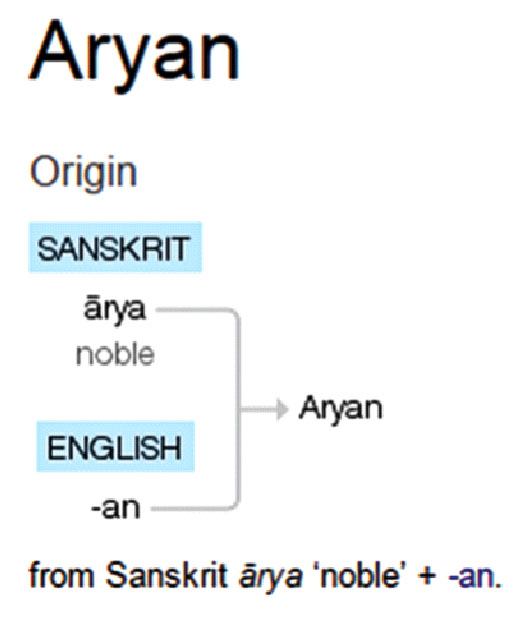
The futility of this debate is crystal clear to understand, once the exact meaning of the word ‘Arya’ (the English adaptation of it is ‘Aryan’) in the Sanskrit lexicon is understood. Let us see what the word ‘Arya’ means gradually. A dictionary, known as Namalinganushasan or Amarkosh, compiled by a scholar named Amar Singh around the 4th century AD. According to this wordbook, the word ‘Arya’ means (1) born in a noble clan (Mahakul) (2) patrician (3) good-natured or civilised (4) gentleman (5) saint. The dictionary Shabdaratnavali (seventeenth century AD) written by a scholar named Mathuresh also gives the meanings like (6) venerable, (7) outstanding, (8) Buddha (enlightened). Later, in the nineteenth century AD, in the dictionary, Shabdakalpadrum compiled by King Radhakantdev Bahadur, additional meanings of the word ‘Arya’ have been mentioned as (9) accepted by the people, (10) of grand character (liberal) (11) poised (12) One who follows the path of justice (Nyayapathavlambi) (13) One who behaves in a manner prevalent/ accepted by the people (prakrutacharsheel) (14) one who is always dutiful (satatkartavyakarmanusthata), (15), religious/pious (16) appropriate or of the right kind. Around the same time, in the late nineteenth century, Taranath Bhattacharya also edited a large dictionary called Vachaspatyam. This word repository further illustrates few more meanings of the word ‘Arya’ including: (17) owner (swamin), (18) mentor or guru (19) friend (suhruda) (20) citizen(jana) (21) father-in-law(shwashur.)Apart from this, interested scholarscan explore other dictionaries created before the twentieth century for further elaboration in this regard.
Distortion of meaning
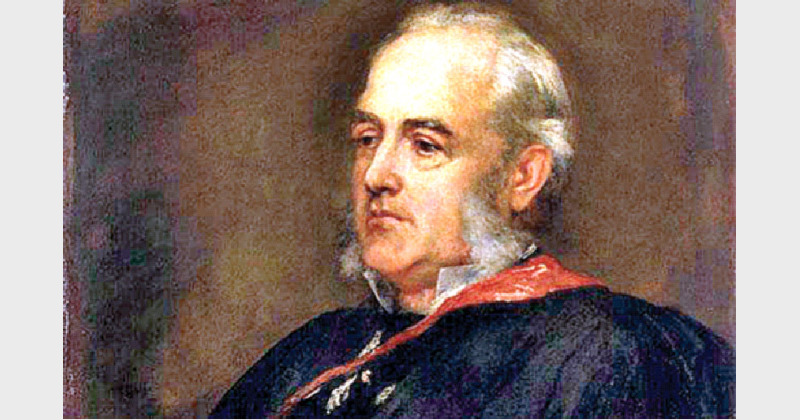
Thus, Dear Readers, considering the variety of meanings given by all the above-mentioned dictionaries and repositories, how does the word ‘Arya’ emerge? By what means can one call it as ‘genealogical’ or even ‘racial’? The word ‘Arya’ is not genetic, but it describes ‘virtues possessed by an individual’. All of the above meanings inform more about the qualities that a person endowed with. They definitely do not describe the race to which the person belongs. It is matter of great astonishment that how the scholars like Sir William Jones and Max Muller could ascribe meanings (stated in article no.2) like ‘fair, tall, and hefty, with dark eyes and sharp noses, mastered in warfare and aggressive in nature’ to this word ‘Arya.’
In the coming articles, we will consider the origin of these meanings that have been waywardly ascribed to the word ‘Arya’. Naturally, we (Indians) are more equipped to decide the usage of a particular linguistic item. Why should foreigners tell us about it by writing down some thesis of their convenience? This mischievous manipulation of semantics for one’s own convenience has begun very quietly but tactfully in India from the nineteenth century onwards. It is said that one rotten apple spoils the barrel, but here entire barrel seems to be contaminated. Our ancient heritage is genuinely prosperous, but why does it appear as ‘chaff’ in current times? We must immediately get rid of these tainted foreign glasses, to filter our vision!
In fact, it is not an uncommon event in world history where foreigners have made unsolicited interference in the affairs of natives. But what is more saddening is that the Indian scholars of the time did not raise counter-voice against it or did not seem to have refuted such unwanted foreign indulgence unanimously all over the country! Of course, there are a few notable exceptions. For example, let us ponder upon a statement of Swami Vivekananda in this regard. In a letter to AlasingaPerumal, a follower of Swamiji from New York, in December 1895, he says, “In translating the Suktas, pay special attention to the Bhashyakaras(Indian commentators) and pay no attention whatever to the Orientalists. They do not understand a single thing about our Shastras. …… Explain according to our Sages and not according to the so-called European Scholars. What do they know?” Swamiji here is clearly warning Indians when translating verses from our Ancient texts. He clearly advises Indians not to look at Western scholars. Rather take a closer look at what our commentators are saying.
To sum up, let’s analyse what our great sages-philosophers say and don’t follow an inch of what these European pundits claim. What do they get out of it? (Refer to The Complete Works of Swami Vivekananda, 1989: Letter No. 5.1.55. It would be really a golden day when Indian academicians and scholars will get convinced by Swami Vivekananda’s suggestion.
If one wants to get the feel of the manipulation of the meaning done by Westerners, let us look at an example that is ‘ignored’ in the common world but found only in Sanskrit dictionaries. The Practical Sanskrit-English Dictionary, edited by late Mr Vaman Shivram Apte and published in 1890, has a repute of the standard dictionary in the world of Sanskrit literature today. Other Western institutions have also developed some online versions of the same dictionary. One such version is a joint venture between Columbia University in the United States and the University of Chicago. (https://dsal.uchicago.edu/dictionaries/apte/). In the above image, the meaning of the word ‘Arya’ in its original printed version can be seen at the left side, and the meaning provided in its web-version is given at the right side.
In the original printed version of Apte’s dictionary, ‘Arya’ means ‘Aryan- worthy of Arya, respectable, noble, high etc.’ In the web version on the right, however, its publishers inserted another additional meaning. Very first meaning it gives is, “?ryan, an inhabitant of Aryavarta, -of the race migrated into India in Vedic times.” Now, this connotation is absolutely absent in Apte’s original printed version. That is the additional meaning that the publishers of this web-version later infiltrated own their own! And that too at the first place in the entire chronology! So, dear readers, what would you call this malicious rudeness of the West?
(To be continued…)
(The writer is a scholar of the ancient history, culture, art, literature, philosophy of India – i.e. Bharatvidya or Indology from Pune, Maharashtra (Translated by Dr. Pranavkumar Ratnaparkhi, an assistant professor of English at HPT Arts & RYK Science College, Nasik, Maharashtra)