When an economist resorts to religious disparagement to score a political point, you know he’s lost to economics, may enter politics, and will continue to spite religion. When that religion is Hinduism—ridiculing which is a zero-risk, high-return game because its followers are all-accepting and tolerant—he can spit on it from the safe confines the Hindus give him.
By reverting to policy name-calling and linking a slow growth rate to Hinduism, Raghuram Rajan is exposing the rotting core beneath a scintillating career and strong credentials—former Reserve Bank of India Governor, former Chief Economic Advisor, former Economic Counsellor and Director of Research of International Monetary Fund, former Vice Chairman of the Board at Bank for International Settlements, and serving Katherine Dusak Miller Distinguished Service Professor of Finance at Chicago Booth. These are also underlined by solid educational credentials—B. Tech from IIT Delhi, MBA from IIM Ahmedabad, and PhD from MIT. In his rant on Hinduism, Rajan raises questions that converge around economics, politics, and religion. Apart from being out of line on the religious assault, he is out of tune with the changed economics.
This essay goes under the skin of the dead horse that Rajan has just snorted to life: “This is dangerously close to our old Hindu rate of growth! We must do better.” He is referring not to a demographic rise of Hindus; he is talking about the growth in India’s December 2022 quarter GDP numbers. There are several problems with this idea, which get compounded when they come from an economist of repute.
Hinduism is bad, we need growth rates of another religion
The first is the manner in which low growth rates have been linked to Hinduism. The term was first coined by BPR Vithal, under a pseudonym ‘Najin Yanupi’ in February 1973, while writing about India’s per capita growth rates: “A 5 plus per cent rate of growth would in per capita terms result in a 3 plus per cent rate of growth. The actual achievement despite these targets has been 3.7 to 3.8 per cent in the past two decades, which would give a growth of per capita income of roughly 1 plus per cent during this period. Thus, we have a situation where the rate of growth of per capita income varies between an actual of 1 per cent and a target of about 3 per cent. This range is not fortuitous. This is the range within which alone the Hindu view of life will hold.” The numbers are right, the religious analogy repugnant.
This was later given economic legitimacy by Raj Krishna, five years later in 1978, who shifted the platform of growth from per capita to real. As a teacher in India’s top economics school, the Delhi School of Economics, Krishna’s legitimisation, irrespective of him blaming Socialist policies for it in the same breadth, has sadly—for him and for Indian economics—remained his sole lasting legacy. For an economist who has been proved wrong several times over, his Hinduphobic legacy lingers on and powers anti-Hindu narratives today. The idea is to take a selective statistic or a stray incident and turn it into a Hindu-bashing club, even as worse data (see the inflation and GDP rates in EU) and anti-Hindu incidents (see the plight of Hindus in Pakistan and Bangladesh, as also in Canada and the UK) happen everywhere.
Over-extrapolated conclusions from an acutely short-term statistic
Second, Rajan’s rant displays not merely a religious contempt of Hindus; he is equally an unthinking intellectual victim or a motivated accomplice of those narratives. His statement on the Hindu rate of growth is based on one—just one—quarter of GDP growth rate of 4.4 percent. On that count, Table 1 showcases the growth rates of countries where religions are in majority. This classification is based on the dominant religion in the country with the largest number of religious population of a significant size. Sadly for him, his narratives and his politics, the Hindu rate of growth comes on top. Instead of bemoaning the Hindu rate of growth, he should be advising other religions to convert to Hinduism.
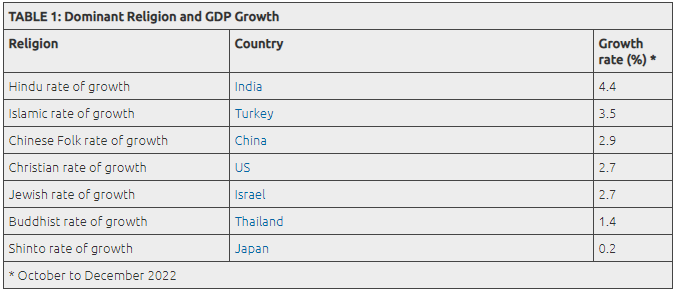
Of course, as we all know, nobody holds an opinion on a country’s GDP growth based on one quarter. And if one is forced to, say in the case of Black Swans such as the Made in China COVID-19, one does so in a global context in a relative manner. This is not to give an economics lesson to Rajan—he knows his economics—this is to call out his narrative building.
Rates of growth in religious contexts
Third, the Hindu rate of growth has dominated the shame-India-by-shaming-Hindus narrative for half a century. This noxious and contemptuous term was born in 1973 and is being kept on life support, not only by Rajan but by several other economists, mostly Indian of Indian origin. In fact, the slow rates of growth of the 1970s and 1980s are on account of the policies of former prime ministers Jawaharlal Nehru and his daughter Indira Gandhi, both of whom launched policy attacks on entrepreneurs and ensured that India remained behind the rest of the world (See Reform Nation). The remains of their economic excesses show up today through compliances that power India’s Inspector Raj.
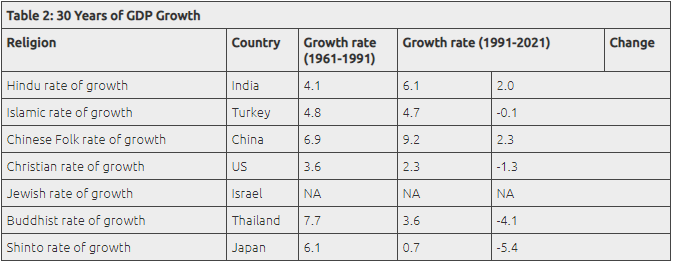
The average real annual rate of GDP growth of India between 1961 and 1991 was 4.1 percent (data from World Bank begins from 1961, not 1947). These were the years of economic repression under three prime ministers, who systematically bound wealth creators in chains, which narrative writers are giving a cover fire to by calling it the Hindu rate of growth. It should be termed the Nehru-Gandhi rate of growth. Or, if family loyalty runs high, you won’t be wrong in calling it the Socialist rate of growth, or the Marxist rate of growth, or the Commanding Heights rate of growth. Apart from Prime Minister Rajiv Gandhi, who oversaw a higher growth rate of 5.2 percent, the time between 1984 and 1991 was a period when Socialist policies collapsed, with prime ministers Viswanath Pratap Singh and Chandra Shekhar bringing the economy to the edge of an economic abyss.
The 30 years of economic reforms unleashed by Prime Minister PV Narasimha Rao in 1991 and carried forward by successive five prime ministers (Atal Bihari Vajpayee, HD Deve Gowda, Inder Kumar Gujral, Manmohan Singh and Narendra Modi) across eight governments have taken India’s average economic annual growth rate to 6.1 percent. So, between 3.8 percent, 5.2 percent, and 6.1 percent, which is the real Hindu rate of growth?
As Hinduphobic economists search for answers, here are some related statistics. When India was being repressed under the Nehru-Gandhi years (between 1961 and 1991 for which World Bank data is available), and the average annual growth rate was 4.2 percent, the average annual growth rate in the US was 3.6 percent (the Christian rate of growth); in Turkey 4.8 percent (the Muslim rate of growth); in Thailand 7.7 percent (the Buddhist rate of growth); in China 6.9 percent (the Chinese Folk religions’ rate of growth); in Japan 6.1 percent (the Shinto rate of growth); the data for Israel is missing.
Now, shift the data gaze to the next 30 years, between 1991 and 2021. The Hindu rate of average annual GDP growth suddenly jumps to 6.1 percent. What was being seen as the Hindu rate of growth, and which Rajan and his cohorts are poohpoohing, has shifted base to the country where he teaches economics, the US (it grew by 2.3 percent per annum in this period). In the same period, Thailand grew by 3.6 percent per annum, Turkey by 4.8 percent, and Japan by 0.7 percent. If we take Rajan’s rant forward, it would seem that Christians, Buddhists, Muslims and Shinto converted to Hinduism—we wait for a new paper on this. In all these years, the China economic miracle is clearly visible: from 6.9 percent between 1961 and 1991, the average annual growth rate of those following the Chinese Folk religion jumped to 9.2 percent over the next 30 years, displaying an atheistic-agnostic proposition around economics. Table 2 shows these changes.
The future remains Hinduphobic
And fourth, it is clear that Rajan and his anti-India, anti-Hindu cohort is suffering from stretchable myopia—the data is stretched to suit their political (against the current elected government), ideological (reaping the fruits of prosperity outside while pushing an agenda of poverty in India) and physical safety vision (Hindus, they know, will not behead them). To accuse them of living in the past would be a generous acceptance of some semblance of intellectual honesty. Facts as discussed above and forecasts below prove otherwise.
Looking ahead, by 2060, India is expected to be the world’s second-largest economy. According to a forecast by OECD, India’s GDP is likely to cross US $42 trillion in 2060, second only to China’s US $62 trillion, with the US at US $36 trillion, and the EU at US $23 trillion. Such numbers—to put it in context, India’s GDP will comprise about a fifth of G20’s, and 17.6 percent of the global GDP—cannot come without a high rate of growth. Whether the religion of that growth rate will be Hindu or some other, only Rajan will be able to let us know.
Raghuram Rajan is right on three counts and wrong on one. He is right because first, he is seen to be handsome and outspoken; second, teaches at a top economics university in the US; and third, he is living in a sublime past that his ideologues and echo chambers celebrate. But he is wrong about one thing—India, where the new political slogan could well be “garv se kaho hamari Hindu rate of growth hai” (be proud of the Hindu rate of growth).
(The writer is the Vice President of Observer Research Foundation. This article originally appeared on the ORF website https://www.orfonline.org/expert-speak/hinduphobia-infects-economics-again/ )