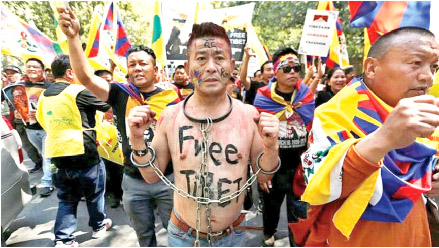
On February13, this year, the 14th Dalai Lama and his fellow Tibetans, living in exile since 1959, will observe the 110th anniversary of a ‘free’ and ‘independent’ Tibet. It was on this day in 1913 when the 13th Dalai Lama made the historic ‘Declaration of Independence’ from a two-year-long occupation of Tibet’s capital Lhasa by the Manchu army, which itself was on its last legs after a 296-year-long rule over China.
Tibetans and their supporters across the world have made it a tradition in the last seven decades to hold demonstrations outside Chinese embassies and call for world support to rehabilitate Tibet as an ‘independent’ country. At Dharamshala in India, the Tibetan refugees celebrate the historic day with colourful Tibetan dance and music while their government-in-exile issues formal statements to the world community for support.
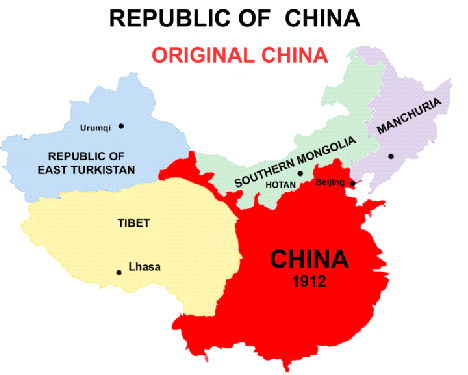
In many parts of the world, especially at the Capitol Hill in Washington DC and the European Parliament, voices in support of Tibet too are surely going to be raised. The Beijing government too is expected to issue strong objections to these events and warn the US Congress and some EU MPs against interfering in the ‘internal matters’ of China. Beijing is sure to assert once again that Tibet is “an inalienable part of China” with the argument that “Tibet has been always a part of China in history”. This annual war of words may not shake the world but it surely calls for a relook at the reality behind China’s loud claims, especially its claims of Tibet, Xinjiang, Southern Mongolia and Hong Kong as its ‘internal matters’ or its insistence over ‘One China’ policy.
Reality Behind China’s claims
China’s ultra-sensitivity about its colonies, namely Tibet (occupied: 1951), East Turkistan (renamed as ‘Xinjiang’ and occupied in 1949), Southern Mongolia (termed as ‘Inner Mongolia’ by Beijing and occupied in 1919) and Hong Kong (prematurely overwhelmed with the Chinese communist constitution in 2020 instead of 2047 as promised to Britain and the people of Hong Kong) is itself an indication of Beijing’s guilt conscience. It is interesting to note that in Manchuria, the fifth colony of China (occupied in 1945) the original Manchu race has been so effectively overwhelmed, dissolved and digested into the Han Chinese’ identity that there is hardly anyone left now to raise their national voice unlike the Tibetans, Uyighurs, Mongols and the Hong Kongers who still have the capacity to make noise and win international attention.
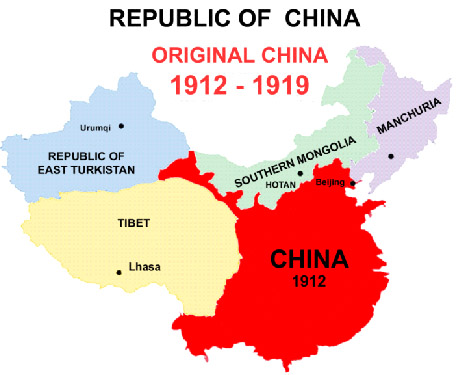
The official demographic statistics of People’s Republic of China (PRC) also reflect this enormous digestive power and the expansionist skills of its Han population, which happens to be the real ‘Chinese’ race. In today’s China, which presents itself proudly as a ‘family of 56 sister nationalities’, the Hans account for about 92 per cent of PRC’s population while the rest ’55 sisters’ have been gradually and collectively reduced to just about 8 per cent over decades since the ‘Republic of China’ came into existence since 1912. What is amazing is that despite the near total annihilation of its colonial subjects, the communist regime of today’s China starts throwing tantrums and demonstrates its ultra-sensitivity even when microscopic sections of its subjects try to assert their independent identity.
Boycotting Beijing
This ‘culpa-mia’ nature of Beijing took a comic dimension (literally) in May 2001, when a Chinese government’s sponsored publisher released the world famous comic book Tintin In Tibet in Beijing. Fanny Rodwell, the widow of Tintin’s Belgian creator Herge, simply boycotted the release ceremony in Beijing because the Chinese edition bore a new title “Tintin in China’s Tibet.” Louis Michel, a loud champion of democracy and the Foreign Minister of Belgium who had especially flown to Beijing to hog the limelight, too had to raise his hands in despair when international media challenged him to justify the blatant politicisation of an already internationally famous literary work. The only defence he could dish out to hide his embarrassment was that “I am not a translator or publisher and I don’t speak Chinese”. However, the Chinese government and the publisher wondered over this ‘uncalled for sensitivity,’ demonstrated by their critics, and decided to go ahead with the book.
In today’s China, which presents itself proudly as a ‘family of 56 sister nationalities’, the Hans account for about 92 per cent of PRC’s population while the rest ’55 sisters’ have been gradually and collectively reduced to just about 8 per cent
Appropriating Genghis Khan
In a demonstration of the true communist art of appropriating history, just to support its immediate goals, the Chinese government released an ambitious 40-episode long epic TV series Genghis Khan in 2004 on its CCTV national network of television. The main purpose behind this entire exercise was to appropriate Genghis Khan as a ‘Great son of China’ who had founded the vast Mongol Empire in the 13th century (1206) and his dynasty had ruled over China for more than 300 years. Beijing tried to persuade other governments to run this epic on their national TV networks but could not succeed beyond its two willing friends North Korea (KBS network) and the Turkish state (TRT). Genghis Khan and his descendants ruled over the erstwhile China along with many other countries of larger Asia. It was the Qing dynasty of Manchuria which later replaced the Mongols to subjugate the Ming Empire of the Han China. This makes a 706-year-long history of subjugation and foreign occupation of China.
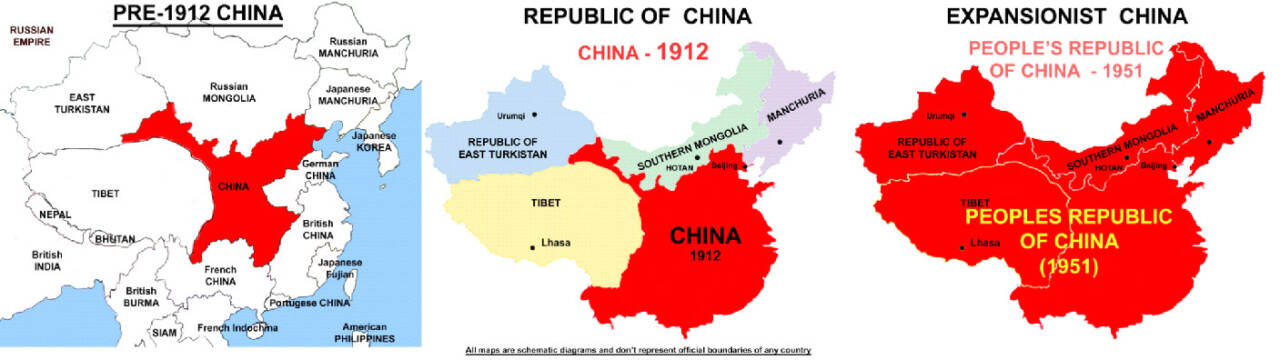
Interestingly, China’s communist historian rewriters are now on an overdrive to establish that, like the Ming Empire the Mongol Empire, and the Manchu Empire too were ‘Chinese’ Empires and that the present day PRC is a product of ‘seamless transition of history’. The real purpose of Xi Jinping’s new army of Chinese historians is to prepare a logical ground to finally assert that all areas, ruled by the Mongols and the Manchus over past eight centuries, legitimately belong to today’s China. The immediate goal of this Chinese narrative is to let the world forget that it was not China which was ruled by these empires, but it was China who ruled over vast areas of Asia and adjoining regions through these ‘great sons of China’. Once established, this narrative is surely going to give a historic base to not only legitimise its colonial occupation of Tibet, East Turkistan and a part of Mongolia but it will also open doors for establishing China’s claims over many parts of Russia, Europe and many countries of Central and South-East Asia.
It’s evident that if the newly emerging superpower, under President Xi and his communist party, succeeds in imposing its new narrative on the world community, it can open a new Pandora’s box for other countries too. Then India could easily claim Australia as a ‘part of India’ or even New Zealand too could claim India as its own ‘inalienable part’ because all of them were once occupied and ruled by Great Britain.