Due to British colonial rule, India’s technology status was virtually nil in all sectors. Even after 1947, screwdrivers and spanners were made in the UK and imported. Due to “License Raj” and “Command Economy”, India lagged behind woefully struck in the “Second Industrial Revolution until 1980s whereas Europe and the USA had raced ahead to the “Fourth Industrial Revolution”. India remains backward in the Research and Development (R & D) of Generation (GEN) 4 or 5 or 6 technologies. De facto, India stands at 22nd place in the patents recognised in 2021 at 1,058 and 546 in 2022 till date.
ISRO’s Budget Vs NASA
Certainly, the global ranking in patents mercilessly reflects the poor state of affairs. Insignificant budget allocations in comparison with other nations due to lack of political leaders foresight and will was a constraint. Today, ISRO’s budgetary allocation is only $.1, 831 billions which is insignificant in comparison with NASA (United States) $. 22,629 billions, CNSA (China) $.11,000 billions, ESA (Europe) $. 7,430 billions, CNES (France) $.3, 384 billions and Roscommon (Russia) $.1, 922 billions. Understanding the fundamentals, to include the meaning of technology and the breakthroughs in the “Four Industrial Revolutions”, is considered vital to gain a balanced perspective. The term “technology” is all-encompassing: “the application of scientific knowledge to the practical aims of human life or, to the change and manipulation of the human environment.
Fascinating Journey of ISRO
Space is of critical importance both in strategic and commercial terms. Satellite launch vehicles overlap considerably with missile launch technology. De facto, Indian Space Research Organisation (ISRO) has made commendable progress despite insignificant budgetary allocations with world’s largest constellation of remote-sensing satellites and the GAGAN and NAVIC satellite navigation systems. It has sent two missions to the Moon and one to Mars. Similarly, there are achievements in R & D of missiles, Unarmed Aircraft Systems (UAS), nuclear technology fields and semiconductor fields, besides others. The ability to re-use rockets calls for additional sets of capabilities.
After India signed the nuclear deal with the US in 2008, the path was cleared for India’s membership of Missile Technology Control Regime (MTCR) that regulated access to critical technologies. India can access technology and even invite foreign investment in space ventures. Satellites are being put to ever greater use across the world, for an ever-expanding number of purposes, including military and non-military uses. Satellites are not just about launch capability. These involve complex technologies in signalling, materials, miniaturisation of already tiny electronics, power generation and management systems, sophisticated radars, telescopes, and many more things. Rocket engines need steady improvement. Most importantly, geo location services depend on satellites.
Turning off or corrupting geo location during complex military manoeuvres and the ability to thwart it could mean the difference between defeat and victory in battle. Other than telecommunications, spotting methane emissions, using ground-penetrating radar to spot underground formations, crop maturity and cropped area are some of the uses. It is vital for India to develop capability across the range of technologies that go into the space economy. It is impossible for the state sector alone to produce all the innovations India’s strategic capability and economy would need from the space sector.
Role of Private Players
So far, private companies’ role in the space programme has been limited to making parts and systems for ISRO. When start-ups take up the technological and business challenges thrown up by a growing and diversifying space economy, it would create thousands of high-skill, high-value jobs, produce technologies that would have diverse applications far removed from space — ‘staycool’ undergarments that make use of ‘phase change’ materials developed to regulate the temperature inside space suits are just one example — in civilian and defence sectors.
The Indian Space Saga
To understand design, development and production of Space Technologies, we need to know key milestones of ISRO: The Indian National Committee for Space Research (INCOSPAR) was set up by founding scientist-vikram sarabhai in 1962- January 1965 – Space Science and Technology Centre (SSTC) was established in Thumba, Kerala; 1969 – became ISRO within DAE.
Another Feather in ISRO’s Cap
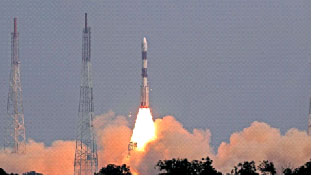
Indian Space Research Organisation (ISRO) successfully launched on December 3, 2022 PSLV-C54 rocket carrying EOS-06, also known as Oceansat-3, and 8 nanosatellites from Satish Dhawan Space Centre in Andhra Pradesh’s Sriharikota. PSLV-C54 was launched from First Launch Pad (FLP) Sriharikota spaceport at 11.56 am in a two-hour multi-orbit launch mission. The primary payload onboard PSLV-C54 was the EOS-06. “Subsequently, Orbit change is planned by using two Orbit ChangeThrusters (OCTs) introduced in the Propulsion Bay Ring of the PSLV-C54 Vehicle. The Passenger Payloads (PPLs) will be separated in Orbit-2,” read a statement by ISRO.
As of 2022, of 77 different Government space agencies in existence, ISRO is one among the six government space agencies to have full launch capabilities (ability to launch and recover multiple satellites, develop and deploy cryogenic rocket engines and operate space probes) and extraterrestrial landing capabilities. Only three nations – USA; Russia; and China – have human spaceflight capability. China is the only country with extraterrestrial landing capability. Furthermore, the programme run by ISRO from the beginning is focused on developing capabilities in three distinct fields: ‘Satellites for Communication and Remote Sensing’, ‘Space Transportation System’ and ‘Application Programmes’. Satellites are deployed in GSO (Geosynchronous Orbit), GTO (Geosynchronous Transfer Orbit), LEO (Low Earth Orbit), and SSPO (Sun Synchronous Polar Orbit) for “Earth Observation, Communication, Experimental, Disaster Management System and other purposes”.
As of October 23, 2022, India has launched 381 satellites for 34 different countries. Also as of July 01, 2022, the PSLV has made 55 launches, with 52 successfully reaching their planned orbits, two outright failures and one partial failure, yielding a success rate of 94 per cent. GSLV was used in 14 launches from 2001 to 2021 resulting in 8 successes, four failures, and two partial failures. GSLV (Mark III) is ISRO’s third generation rocket that has a gross lift-off weight of 640 tones. ISRO has renamed GSLV Mark III to Launch Vehicle Mark III or LVM III because of its successful mission to place the satellites in Low Earth Orbit. Low Earth Orbit’s satellites are usually placed less than 1,000 kms above the earth’s surface, while satellites in Geostationary Equatorial Orbit are placed 35,000 km above the surface. The GSLV LVM III rocket’s powerful cryogenic stage enables it to place heavy payloads into Low Earth Orbits of 600 km altitude. It is capable of placing the 4 tones class satellites – launch geostationary communication satellites (GSAT series) – into Geosynchronous Transfer Orbits. GSLV MkIII-M1, successfully launched Chandrayaan-2 spacecraft on July 22, 2019 into its planned orbit with a pedigree (nearest point to Earth) of 169.7 km and an apogee (farthest point to Earth) of 45,475 km. ISRO is developing a Next-Gen Launch Vehicle (NGLV) to replace operational systems like the PSLV. In NGLV, ISRO is looking at a cost-efficient, three-stage to orbit, reusable heavy-lift vehicle with a payload capability of ten tones to Geostationary Transfer Orbit (GTO). It will feature semi-cryogenic propulsion (refined kerosene as fuel with liquid oxygen (LOX) as oxidizer) for the booster stages. Potential uses will be in launching communication satellites, deep space missions, future human spaceflight and cargo missions.
GSLV series launches include
- 2014 – launched Mars Orbiter mission (MOM) or Mangalyaan and also GSLV Mk-III, the first experimental flight of ISRO’s heaviest and upgraded rocket vehicle
- 2015 – India’s 4th navigation satellite launched
- 2016 – launched INSAT-3DR, an advanced weather satellite, weighing 2211 kg into a GTO, GSAT-18 was inducted into the INSAT/GSAT system 2017 – launched 104 satellites using a single rocket, South Asia Satellite, GSAT-19 Satellites, and GSAT-17 Communication Satellite
- 2018- launches GSAT-6A Satellite, GSAT-11, GSLV MkIII-D2 successfully launched GSAT-29, and GSAT – 7A
- 2019 – launched Chandrayaan-2 Moon Mission.
ISRO’s GSLV Mark 3 mission is important because of commercial agreement between New Space India Ltd, a space PSU, and UK-based OneWeb Ltd. The launch by ISRO and NSIL successfully deploying 36 satellites on 23 October 2022 is one of the biggest commercial orders by India’s premier space organisation, and the first using the LVM3 rocket. The successful demonstration of LVM 3 rocket’s ability to carry heavier payloads will boost revenues from each launch. The same rocket is currently being human-rated to carry astronauts to space under Gaganyan mission. Among others, in 2016, the first experimental mission of ISRO’s Scramjet Engine towards the realisation of an Air Breathing Propulsion System was successfully conducted. Also, successfully flight tested RLV-TD. The ISRO is set for the first runway landing experiment (RLV-LEX) of its made-in-India Reusable Launch Vehicle – Technology Demonstrator (RLV-TD) from aeronautical test range in Karnataka’s Chitradurga district.
Mission Accomplished
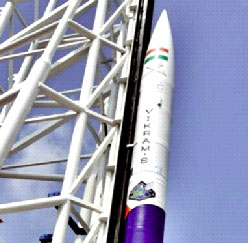
Vikram-S, India’s first-ever privately developed rocket successfully lifted off from the Sriharikota spaceport on December 2, 2022. . The lift-off of the Vikram Suborbital rocket took place at 11:30 am from the Satish Dhawan Space Centre at Sriharikota. “Mission Prarambh is successfully accomplished. Congratulations” tweeted the Indian Space Research Organisation ISRO and tagged @SkyrootA Congratulations India! @INSPACeIND The ‘Prarambh’ mission and the Vikram-S rocket have been developed by Skyroot Aerospace start up in Hyderabad with support from ISRO and IN-SPACe (Indian National Space Promotion and Authorisation Centre). The rocket is carrying payloads of two Indian and one international customer into space. “89.5 Kms peak altitude achieved. Vikram-S rocket meets all flight parameters. It’s history in the making for India. n
According to ISRO officials, RLV wing body will be carried using a helicopter to an altitude of three to five km and released at a distance of about four to five km ahead of the runway with a horizontal velocity. After the release, the RLV will glide, navigate towards the runway and land autonomously with a landing gear in the defense airfield near Chitradurga. ISRO has set up the Indian National Space Promotion and Authorisation Centre (IN-SPACE) in 2020 to actively involve the private sector in India’s space programme. So far, private companies’ role in the space programme has been limited to manufacturing parts and systems for the ISRO. With the recent successful launch of satellites into low-earth orbits by Hyderabad-based start-up Skyroot of Vikram-S (Mission Prarambh), a rocket that has put three microsatellites into space at an an altitude of 89.5 km and a range of 121.2 km as planned, India’s state-run space programme will evolve into a proper space economy with private sector participation. Two satellites belong to domestic customers – Chennai-based start-up SpaceKidz, Andhra Pradesh-based N-SpaceTech – and one from a foreign client- Armenian BazoomQ Space Research Lab.
Now, India has dozens of start-ups in space, building satellites, launch vehicles, propulsion systems and improved designs. Chennai IIT-based Agnikul Cosmos is waiting in the wings, with its own rockets and satellite launch business plans. DRDO and ISRO have agreed to collaborate in India’s crewed orbital spacecraft project called Gaganyaan during which DRDOs various laboratories will tailor their defence capabilities to suit the needs of ISRO’s human space mission with critical human-centric systems and technologies like space grade food, crew healthcare, radiation measurement and protection, parachutes for the safe recovery of the crew module and fire suppression system etc. Goals in near future include expanding satellite fleet, landing a rover on Moon, sending humans into space, development of a semi-cryogenic engine, sending more unmanned missions to the Moon, Mars, Venus and Sun and deployment of more space telescopes in orbit to observe cosmic phenomena and outer space beyond the Solar System. Long-term plans include development of reusable launchers, heavy and super heavy launch vehicles, deploying a space station, sending exploration missions to external planets like Jupiter, Uranus, Neptune and asteroids and manned missions to moons. In the backdrop of lack of political foresight and will, miniscule budgetary allocations during the first 4 decades after the establishment of the ISRO in 1962, we have to acknowledge contribution of to scientists and the successive Chairman & Secretaries from Vikram Sarabhai onwards who headed the organisation for projecting ISRO as one among the six countries with full launch capabilities (ability to launch and recover multiple satellites, develop and deploy cryogenic rocket engines and operate space probes) and extraterrestrial landing capabilities. However, to catch up with three nations – USA, Russia and China – that have human spaceflight capability and China that is the only country with extraterrestrial landing capability, ISRO scientists can do it provided adequate financial allocations are made in time by political decision-makers.