These are the days of ”Navratris”. It would be prudent to debate the significance of the Navratris in a historical and cultural context. Indian subcontinent comprising the areas from Kandhar and Kabul to Dacca and Rangoon and from Tibet to Sri Lanka is a hub of the greatest and richest civilisation in the world. It is invariably a unique chunk of land that has its own existence, history and geography. While its history dates back to around ten thousand years, there are more than five thousand years of documented and written history of this civilisation.
Bharat has been the centre of the civilisational and cultural flow of the whole subcontinent from the times immemorial. Besides the documented history, the tradition and customs form a significant part of the cultural and civilisational aspects of the history of the land. In this context, the people’s usage of the almanac (calendar) plays an important and significant role.
India has one of the oldest calendars (almanac) in the world. It is called the Yugabd Samvat and was started immediately after the Mahabharata war. It commensurates the change of era (Yug-Parivartan, i.e. the start of Kaliyug). On 2nd April, Yugabd Samvat-5124 began. However, in Kashmir valley, the scholars and rishis of the land found an indigenous almanac 26 years post the Yugabd Samvat. This almanac is known as the Saptrishi Samvat, and it is 26 years younger than the Yugabd Samvat. On the same day, the 2nd April 2022, the Saptrishi Samvat-5098 also began. These two Samvats (Yugabd Samvat and Saptrishi Samvat) are the oldest contemporary almanacs globally. This narration of facts also recognises the importance of Kashmir as the centre of knowledge, culture, civilisation, astronomy and tradition.
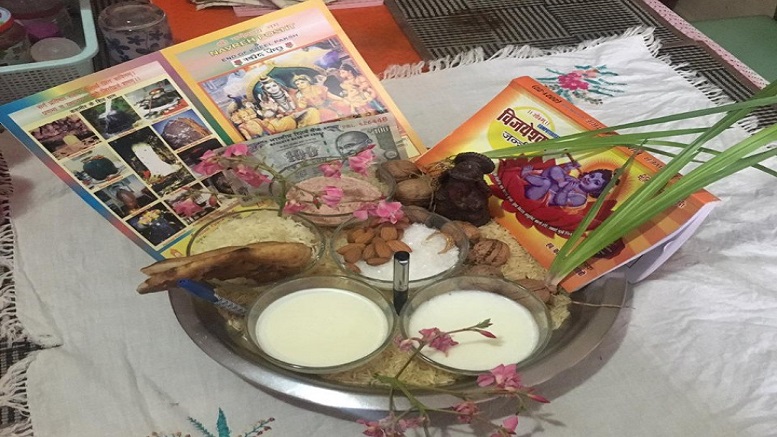
Besides the two oldest almanacs that have been in vogue for the last five thousand years, two other functional almanacs are also in use. They are the Vikrami Samvat and the Shalivahan-Shaka Samvat. The first day of the year of all these almanacs is called the first Navratri. In Kashmir, the first Navratri is called Navreh (the new flame). Kashmir has a very distinct tradition of Navreh, and it is celebrated with the pious sight (darshan) of “Thaal” early in the morning.
The Hindus of Kashmir (Kashmiri Pandits) have a unique and wonderful tradition of thousands of years of “Thaal-Barun” that they observe on the last day of the year (both the Solar and the Lunar year). The next morning is the first day of the new year (both solar and lunar). The first thing they do is have the ‘Darshan’ of the ‘THAAL’. It is considered auspicious and is also deeply connected with our day-to-day life requirements and obligations.
The preparation for this “Thaal” is called “Thaalbarun”, which is done one day prior to Navreh in the late evening so that it is ready for ‘darshan’ on the next morning. All important things used in daily life are symbolically decorated on a ‘thali’ filled with rice. In fact, this “Thaalbarun” is done on two occasions, so it is important to understand the correlation of Thaalbarun on these two occasions, i.e., “Navreh” & “Sonth”.
Sonth is the first day of the new year (Hindu calender-Solar), starting from the 1st of Chaitra month. It used to be the 1st day of the new year officially and administratively as well up to the Maharaja’s regime in the Jammu and Kashmir state and even after that up to 1957. The first day of the solar calendar month is also known as Sankrant (Sankranti). So, 14th March 2022 was the “Sonth” this year.
Navreh is the 1st day of the new year (Hindu calendar-Lunar) which starts from ‘Nav-varsh Pratipada’, that is Chaitra Shukla-Pratipada. Kashmiri Pandits, in particular, observe this day also as 1st Vasant Navratri. We already know that this year Navreh (Nav-varsh Pratipada) fell on 2nd April 2022. Therefore, the Navratris also began the same day. During the Navratris (nine-day festival of the Goddess of supreme energy) starting from Navreh, people observe complete vegetarian life followed by fasts during the Navratris and feasts in the end.
The Indian subcontinent has fifty-two Shakti-sthal (centres of supreme divine energy), and all are dedicated to the Goddess Shakti. They are like Kamakhya in Assam, Hinglaj Mata in Baluchistan, Jwala Devi in Himachal, Dacceyshwari in Dacca, etc. These centres of the Goddess Shakti in various manifestations are the places where various physical parts of the Goddess Sati fell. There is one such divine centre in Jammu and Kashmir as well. It is called Chichi-Mata and is situated on a small hillock in district Samba.
However, Kashmir valley had its own Shakti-sthals (seats of divine energy), which are perceived as sacred, pious, full of divinity and great spiritual satisfaction. All these temples and shrines have a great devotional aura attached to them. The main Shakti-sthals of Kashmir valley comprise the following:
Hari Parbat, Srinagar
Kheerbhawani, Tullamulla
Jwala Devi, Khrew
Bala Tripursundari, Balahama
Shailputri, Baramulla
Jeshtha Devi, Zabarwan
Kheerbhawani, Taekkar
Kulvageyshwari, Kulgam
Bhadrakali, Kupwara
Bargshakha, Mattan
Kheerbhawani, Devsar, Khanabaran
Bhuvneshwari, Chandpura, Srinagar
Mahakali, Gainkhan, Srinagar
Umanagri, Brariangan, Anantnag
Durga, Durganag, Srinagar
Kheerbhawani, Manzgam
Raginya Bhagwati, Logripura
Shiva Bhagwati, Akingam
Navratris are dedicated to the nine manifestations of Maha-Durga. The Nine manifestations of the Goddess worshipped on each nine-day of Navaratri are nine incarnations of Goddess Shakti. The nine goddesses worshipped are Shailaputri, Brahmacharini, Chandraghanta, Kushmanda, Skanda Mata, Katyayani, Kala Ratri (Kaalratri), Maha Gouri and Siddhidayini (Sidhadatri). Each of these goddesses has her own seat in the Kashmir valley. The first manifestation, Shailputri, is seated on the banks of river Vitasta (Jehlum) in Baramulla and is considered a very high seat of divine energy. For a number of reasons, this shrine is in a dilapidated condition nowadays. Thanks to the management of the shrine and the government support, renovation work has started and is also being monitored very well.
Mata Raginya (Kheer Bhawani) has a very special place among the Kashmiri Pandit community, and so are her shrines and temples all over the Kashmir valley, Tullamulla being the main seat of the Goddess. The Sharika Mandir on the Hari Parbat also has a great significance among the Shakti-sthals of Kashmir valley. All families of Kashmiri Pandits are especially attached and dedicated to one of the following Isht-Devis among the Shakti-sthals of Kashmir valley. These are Sharika Mata-Hari Parbat, Jwala Mata-Khrew, Raginya Mata-Tullamulla and Bala Devi Mata of Balahama. It needs to be mentioned here that Bala Devi Mata, Balahama, has a very special significance among the Kshatriya-Rajputs of Jammu and Kashmir since it has also been the Isht-Devi of their clan for the last thousands of years. Unfortunately, most of them lost their connection with the shrine after 1947.
The ‘Vasant-Navratris’ that are being observed currently conclude on the ninth Navratri, which is also the Ram-Navmi. This year it falls on 10th April. People conclude their nine-day fast, spiritual penance, worship of the Goddess and other religio-cultural usages and customs with the “Nav-Durga pujan”, which is also called the “Kanya-pujan”. On this occasion, nine small virgin girls (as the nine incarnations of the Goddess) are specially worshipped and offered garlands, flowers, towels, Channey-Halwa-Puri and some coins of money, fruits and items of cosmetics. Thereafter, the festivities and feasts are organised to celebrate the conclusion of the whole “Navratri” festival of nine days that stands inaugurated on Navreh-the first Navratri.
(The author is a senior BJP and KP leader and Incharge, Deptt of Political Feedback, BJP-J&K and can be reached at [email protected])