NEP’s emphasis on Indian Languages and Multilinguism
-Varada Sambhus
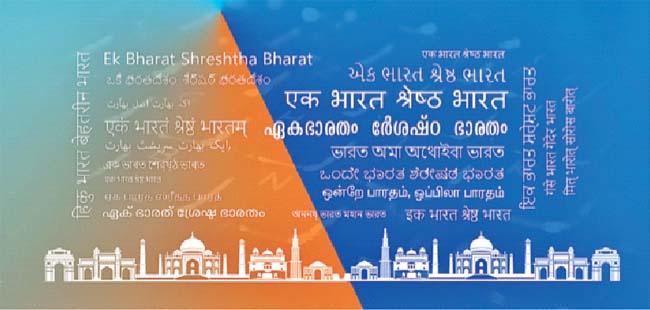
A few years ago imagining a student in the remote village of Bihar reading Tamil poems and a Manipuri Jalsa being organised in Rajasthan could have been utopia, but the New Education Policy 2020 (NEP) has turned this utopia into a possibility. The NEP extensively focuses on the Indian languages at all levels of education and aims at promoting multilingual approach. It clearly points out that one of the core principles of the NEP that will guide both the education system at large, as well as the individual institutions is “promoting multilingualism and the power of language in teaching and learning”.
What does NEP say about Language?
One of the most discussed aspects of the NEP since its release has been the question of language. In a 66 page long document released by MHRD, the term language appears more than 200 times. This indicates that a great deal of emphasis is put on language learning as well as medium of instruction. NEP provides that the medium of instruction until at least Grade 5, but preferably till Grade 8 and beyond, will be the home language/ mother tongue /local language/regional language in the public as well as private schools. Sanskrit will be offered at all levels of school and higher education as an important, enriching option for students, including as an option in the three-language formula. Other classical languages and literatures of India, including Tamil, Telugu, Kannada, Malayalam, Odia, Pali, Persian, and Prakrit, will also be widely available in schools as options for students. Foreign languages, such as Korean, Japanese, Thai, French, German, Spanish, Portuguese, and Russian, will also be offered at the secondary level. It also provides that more programmes in higher education will use the mother tongue/local language as a medium of instruction, and/or offer programmes bilingually to promote the strength, usage, and vibrancy of all Indian languages.
Three language formula continues
The policy clearly mentions that the three-language formula will continue to be implemented while keeping in mind the constitutional provisions, aspirations of the people, regions, and the Union, and the need to promote multilingualism as well as promote national unity. However, it provides to bring in greater flexibility in the three-language formula. The policy clearly mentions, “no language will be imposed on any State. The three languages learned by children will be the choices of States, regions, and of course the students themselves, so long as at least two of the three languages are native to India.What is important to note is that the thrust on multiliguism does not compromise students’ as well as parents’ to make choice regarding the language education.
The policy goes on to highlight the close association between mother tongue/home/regional language and cognitive abilities of students. Several educationists have recorded their observations that students learning in their mother tongue or home language develop better conceptual clarity and this indeed lay the foundation for future studies. This is grounding of knowledge in the language that a child is most comfortable with. The policy on the medium of instruction is based on the understanding that language is not merely a means of communication but it indeed plays a great role in shaping individual’s personality, belief systems and values.
Similarly, at the level of society, languages are closely intertwined with the cultural ethos. There is no difference of opinion among the scholars that any culture is primarily shaped by its language. In a country like India with vast diversity of languages, rich literature and a variety of folk practices, it is an imperative for the education system to make students aware of the rich knowledge available in regional and local languages. This shall help in imbibing pride of one’s own language. At the same time, celebrate linguistic and cultural diversity on the one hand and appreciate the common cultural thread running across India on the other. The policy paves the way for national cohesion without harming the diversity.
De-colonizing Education
It was no wonder that the colonial rulers wanted to create ‘Babus’ to perpetuate their agenda of “civilizing the uncivilized” by teaching them English. With systematic and systemic efforts of the colonizers and later with the force of globalization English is seen as the language of knowledge and well as transaction. English, in fact, emerged as the language of masses and was closely associated with democratization in Britain. But in India it has always remained the language of the rulers and the elites. But unfortunately, the language agenda of the British continued even after independence,perpetuating the ‘Babu’ mentality.The NEPseems to make an effort to widely open the access to knowledge and break the monopoly of English speaking-writing elites. And as expected, the ‘intelligentsia’ who dominated the discourse for over seven decades after independence is protesting against this.
But this is not for the first time that dissemination of knowledge in people’s language is opposed. The sixteenth century Marathi Sant Eknath asked “Sanskrit BhashaDeve Keli! Prakrut Kay Chorapasunijhali?” meaning,“if Sanskrit is made by Gods, is Prakrit born of a thief?” The hierarchies of power were maintained through restricted access to knowledge production. Those who feared to lose their monopoly over the knowledge domain vehemently opposed transmission of knowledge in the language that common people spoke. The employment of people’s language to transmit spiritual knowledge the Sants of bhakti tradition from North to South and from East to West was a deliberate choice, shaking the monopoly of Sanskrit pundits.And in their times they too faced opposition by the orthodox forces. Not much has changed today. If it was Sanskrit then, its English today. The opposition to the multilingual approach of the NEP comes from some elite circles who have dominated the systems of knowledge production like media and academia and now are fearful of losing their control over the discourse setting. It should be noted that the NEP does not rule out teaching and learning English language, but simply tried to dismantle knowledge power hierarchies revolving around English, opening up equal opportunities.The policy focuses on the ‘India centric approach’ and it is a welcome move to de-colonize education in India.
The major challenge in front of the policy is in terms of its implementation. The very scale and diversity of the Indian education sector poses a major challenge in its quick and effective implementation. Cooperation from the state governments as well as from the bureaucracy will play a major role in its implementation. It is time for the political parties which came into existence to protect the regional interests and linguistic pride to join the efforts in grounding knowledge in local languages.
Since the colonial rule, many generations have suffered the language complex. Even today in our university campuses, colleges we come across students who relentlessly struggle to express themselves in ‘correct English’. In some circles its ‘cool’ not being able to communicate in mother tongue or in local language which also carries the false aura of being cosmopolitan. However, a large section of student community still undergoes a lot of stress to meet the artificially created standards of knowledge judged by being conversant in English. With the NEP, there is a hope that our campuses will be free of language hierarchies, embracing the multilingual culture of India.
(The Writer is an Assistant Professor at Maharashtra National Law University Mumbai)