Amalgamation of four categories of ‘Yoga’ is central to building a Civilization.
– Aniket Pingley, Ph. D
We tend to often use the words nation, country, culture, and civilization interchangeably. Given the previous statement, it must be amply clear that I want to emphasize they have different meanings. I will let you Google the meaning and definitions of the first three and focus all my attention on the fourth, i.e. Civilization. Why so? For the simple reason that it is straightforward to look up its meaning but arduous to fathom, assimilate, or explain. Take this definition for example — “the stage of human social and cultural development and organization that is considered most advanced.” Now try to elaborate this to yourself or someone else. I have found myself digress into talking about country or culture while doing that exercise.
The biggest challenge is that all these terms in some ways overlap or become orthogonal to each other, thus making it confusing to be succinct and articulate. Colloquially speaking, civilization means something that people who belong together have built, developed, nurtured and protected for an unspecified period. As you can see, even this explanation is far too abstract to pin-point the the salient aspects of the term. Okay! enough of beating around the bushes — let’s delve into something … say, un-handwaving. Worry not! I have kept it short and informative.
I believe that India today is a civilization-state that has a very long history. The documented and verifiable history perhaps involves a much shorter period, nonetheless even that dates backs around four thousand years. For example, Indians built Uttarapath (northern road) and Dakshinapath (southern road) that met each other at the city of Varanasi. Both these highways existed much before the Common Era began. Now, one may argue, and I strongly disagree (but later on that), that the idea of India did not exist before 1947. However, both these roads spanned across multiple kingdoms and facilitated exchange of trade, ideas and travel, thus providing a civilizational sense to the endeavor. Most importantly, these highways are not antiquated. Even today India’s national highways are built on their footprints, thus deepening their impact on current national life¹. India’s history is replete with such examples.
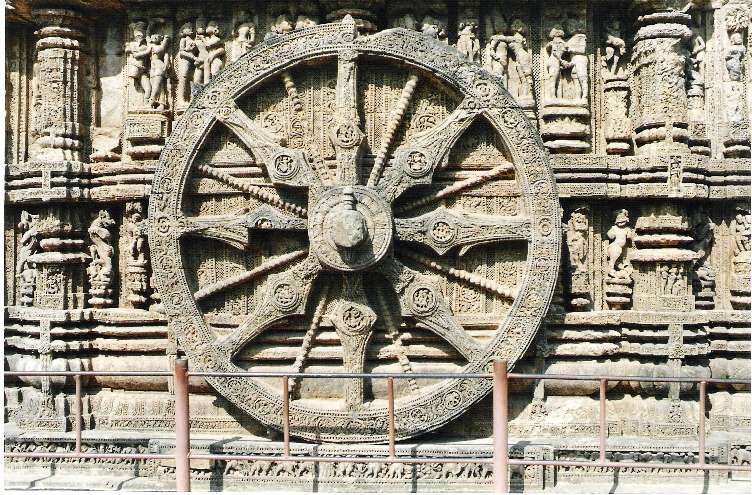
The history and the concepts of Yoga have the most powerful yet subtle subtext for Civilization.
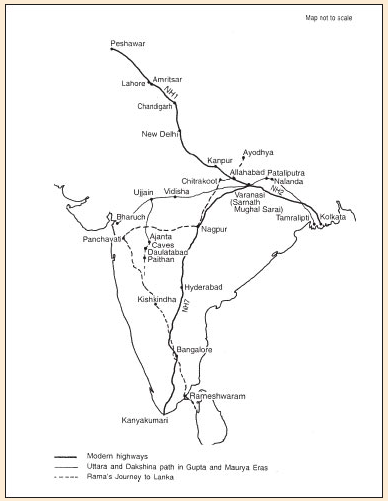
(Pic credit — Land of Seven Rivers: History of India’s Geography by Dr. Sanjeev Sanyal)
Let us now make a trip even further back in time. The word Yoga is no news. In Sanskrit, it simply means union, i.e., coming together. In my understanding, the history and the concepts of Yoga have the most powerful yet subtle subtext for Civilization. The true meaning of Yoga has been extensively explored in the ‘Bhagavad-Gita’. At a broad level, there are four types of Yoga:
Karma Yoga — pursuit of work without attachment to its outcome
Jnana Yoga — pursuit of knowledge that leads to self-realization
Bhakti Yoga — pursuit of devotion towards a deity with ultimate focus on Ishwar
Raja Yoga — pursuit of inner discipline and peace, which includes the currently popular practice of Ashtanga Yoga that consists of different Asanas
It must be noted here that the word ‘Marga’, meaning path, is also used instead of ‘Yoga’ in the aforesaid. The city of Varanasi is where the Uttarapath and Dakshinapath meet to epitomize the sense of civilization. Likewise, it is the practice and convening of the four ‘Margas’/Yoga by the people, which facilitates and sustains the process of building a civilization.
Let us delve even further. The construction of roads, temples, edifices etc. fall in the realm of Karma, and so does agriculture, trade, labour etc. The framework of ‘Varnashrama’ is based on Karma. The scholarship in the great universities of Takshashila (Taxila) and Nalanda denote Jnana Marga. The authoring of Vedas, Puranas, Upanishads, Tattvarthasurta, Sangam literature, Sushruta Samhita, Bhumi Sukta, Aryabhatiya, Surya Sidhhanta etc. perhaps is the greatest embodiment of Jnana Yoga. The prayers offered in temples, bhajans sung in the praise of deities, chanting of Vishnusahastranama, performing variety of pujas, abhishekam of Shivlinga denotes Bhakti Marga. The practice of Patanjali’s Yoga Sutras, meditative activities like paintings by Raja Ravi Verma, sculpting by Amarshilpi Jakanachari etc. fall in the domain of Raja Yoga. Take away the endeavors belonging to any one of the Marga and the story of India Civilization feels sketchy.
Let us circle back to the definition of civilization mentioned earlier to check if it now appears more concrete — “the stage of human social and cultural development and organization that is considered most advanced.” Given the aforesaid examples, it becomes simpler to cohere that the practice of all four Marga or Yoga furthers social and cultural development of humans as well as the organization of a society. Take another definition from Wikipedia — “A civilization or civilisation is any complex society characterized by urban development, social stratification imposed by a cultural elite, symbolic systems of communication (for example, writing systems), and a perceived separation from and domination over the natural environment.” Although there is no strict 1:1 mapping to Yogas, a silhouette can be drawn. Karma Yoga achieves urban development (e.g., Varanasi) and social stratification (e.g., Varnashrama). Jnana Yoga and Bhakti Yoga facilitates systems of communication (e.g., Vedas and Vishnusahastranama, respectively). Raja Yoga aids domination over natural environment, (e.g., one’s own disquiet or violent mind). Thus, it is apt to say that the Great Indian Civilization that is alive and evolving since several thousand years is a symbiotic process of amalgamation of four Yogas.
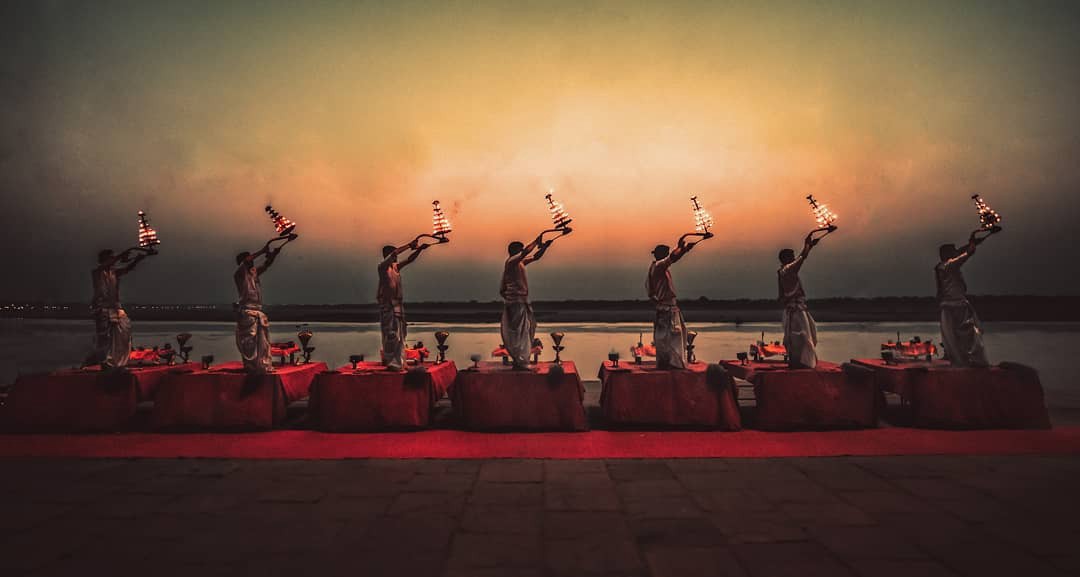
An immediate question that would have risen in your mind — “Amalgamation of Yogas! Do you care to elaborate?” We will take a simple example. The notion of ‘Yatra’ or pilgrimage has existed in India for at least two thousand years. Many Indians often have had life-goals to visit the Char-Dham, Jyotirlingas, Shakti Peeths etc., that are spread across the landscape of India. ‘Yatra’ is essentially an activity in the domain of ‘Bhakti Marga’. Let’s focus our attention on the Yatra of six temples belonging to Bhagwaan Sastha, also known as Swami Ayyappa of Sabarimala in Kerala. These six temples are based on the six ‘Chakras’²³ in human body, where each temple is consecrated to energize a specific Chakra². The study of Chakra and human body falls in the realm of ‘Jnana Yoga’ as well as ‘Raja Yoga’. With this example, the amalgamation of Bhakti, Jnana and Raja Yoga can be clearly established.
It is a scientific fact that an alloy is stronger than any of the consisting individual metals. Indian Civilization is an ‘alloy’ made from the four Yogas. Not just that, it also coalesces four Yugas. A great mind once said that as long as the ‘banks’ of Dharma and Moksha exist, the ‘river’ of Artha and Kama will flow perennially, otherwise the ‘water’ will spread in directionless manner and get wasted. Indian Civilization has a solid underpinning of the Hindu philosophical framework, which has had a great ability of absorbing a multitude of ideas and refining them. India has only recently woken up from a ‘deep slumber’ of mental-slavery. To witness it unshackle itself will be the greatest privilege of my lifetime.
I must mention here that ‘Dhairya’, i.e. composure, ‘Saiyam’, i.e. moderation or restraint, ‘Anubhuti’, i.e. self-experience, are the subtle but defining characteristics of the evolution of the Indian Civilization. Rome was not built in a day, and neither were Varanasi, Pataliputra or Madurai. The story of Indian Civilization is akin to a marathon that involves a relay and not an individual 100 meter sprint.
(The article was first published here. Republished with permission)