How can we Summarise the Sabarimala Movement?
July 16, 2026
  • Read Ecopy
  • Circulation
  • Advertise
  • Careers
  • About Us
  • Contact Us
Android AppiPhone AppArattai
Organiser
  • ‌
  • Bharat
    • Assam
    • Bihar
    • Chhattisgarh
    • Jharkhand
    • Maharashtra
    • View All States
  • World
    • Asia
    • Europe
    • North America
    • South America
    • Africa
    • Australia
  • Editorial
  • International
  • Opinion
  • RSS @ 100
  • More
    • Op Sindoor
    • Analysis
    • Sports
    • Defence
    • Politics
    • Business
    • Economy
    • Culture
    • Special Report
    • Sci & Tech
    • Entertainment
    • G20
    • Azadi Ka Amrit Mahotsav
    • Vocal4Local
    • Web Stories
    • Education
    • Employment
    • Books
    • Interviews
    • Travel
    • Law
    • Health
    • Obituary
  • Subscribe
    • Subscribe Print Edition
    • Subscribe Ecopy
    • Read Ecopy
  • ‌
  • Bharat
    • Assam
    • Bihar
    • Chhattisgarh
    • Jharkhand
    • Maharashtra
    • View All States
  • World
    • Asia
    • Europe
    • North America
    • South America
    • Africa
    • Australia
  • Editorial
  • International
  • Opinion
  • RSS @ 100
  • More
    • Op Sindoor
    • Analysis
    • Sports
    • Defence
    • Politics
    • Business
    • Economy
    • Culture
    • Special Report
    • Sci & Tech
    • Entertainment
    • G20
    • Azadi Ka Amrit Mahotsav
    • Vocal4Local
    • Web Stories
    • Education
    • Employment
    • Books
    • Interviews
    • Travel
    • Law
    • Health
    • Obituary
  • Subscribe
    • Subscribe Print Edition
    • Subscribe Ecopy
    • Read Ecopy
Organiser
  • Home
  • Bharat
  • World
  • Operation Sindoor
  • Editorial
  • Analysis
  • Opinion
  • Culture
  • Defence
  • International Edition
  • RSS @ 100
  • Magazine
  • Read Ecopy
Home Bharat

How can we Summarise the Sabarimala Movement?

To narrow down Sabarimala in Constitutional debates and issues of Feminism would be unjust, without addressing the on-going cultural and social fabric of tradition of Bharat-Nithin Sridhar In the aftermath of the Supreme Court judgment allowing women of all ages to enter Sabarimala temple on the grounds of equality and women’s rights, thousands of women in Kerala have taken to the street to protest against the judgment and have given a call for the protection of Hindu traditions.  Keral

Archive ManagerArchive Manager
Oct 30, 2018, 08:00 am IST
in Bharat
Follow on Google News
FacebookTwitterWhatsAppTelegramEmail
To narrow down Sabarimala in Constitutional debates and issues of Feminism would be unjust, without addressing the on-going cultural and social fabric of tradition of Bharat
-Nithin Sridhar
 
In the aftermath of the Supreme Court judgment allowing women of all ages to enter Sabarimala temple on the grounds of equality and women’s rights, thousands of women in Kerala have taken to the street to protest against the judgment and have given a call for the protection of Hindu traditions.
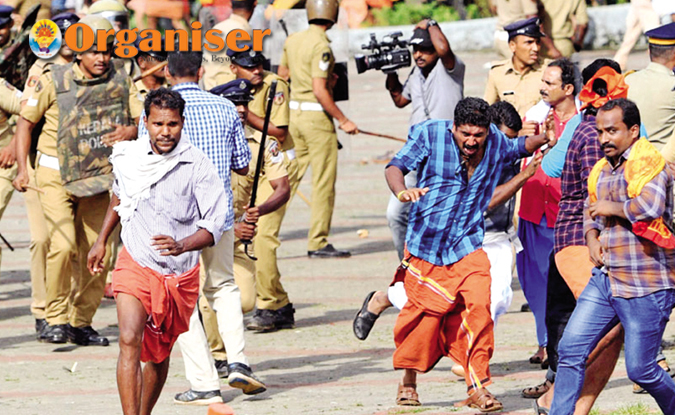
 
 
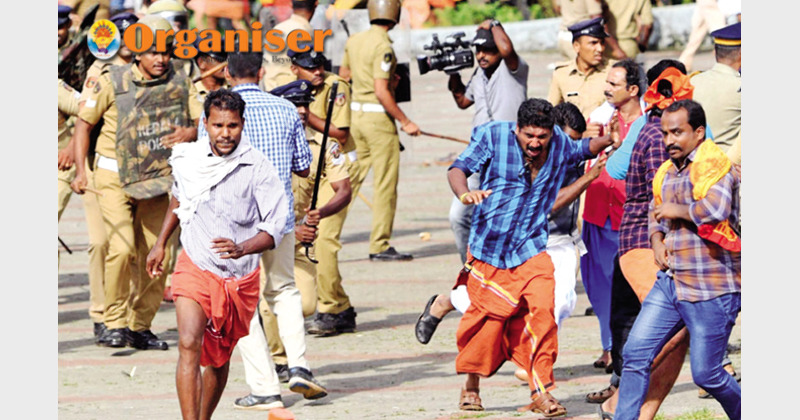
Kerala police brutally attacked Sri Ayappa’s devotees at Sabarimala 
 
In the light of this protest, it is natural to ask if the prohibitions on the entry of women of reproductive age between 10 & 50 were discriminatory and an infringement of women’s rights, why have women across Kerala taken to streets to protest the removal of the prohibitions?
 
Equality
The discourse of equality and egalitarianism was developed in the west as a response to inequalities promoted by the Abrahamic religious culture prevalent there. Being a western solution to a western problem, the equality discourse is fully rooted in Abrahamism, and thus, deriving key assumptions and principles from Abrahamic religious worldview. When implemented on the ground, equality discourse seeks to destroy diversity and promote sameness, and hence, will prove disastrous when applied to non-Abrahamic religious traditions like Hindutva, whose worldview is rooted in harmony, diversity, and spirituality.
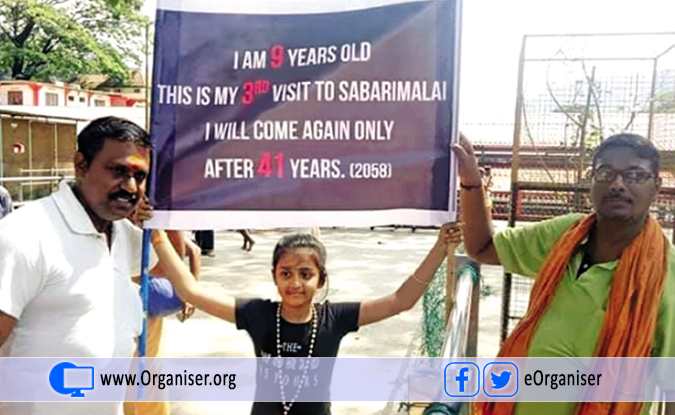
 
 
A young Malikappuram (female Ayyappa devotee) with a banner at Sabarimala Temple 
 
In the case of Sabarimala, this translates into a unique temple having unique characteristics, with unique criteria for admittance of devotees. In Kerala itself, there are temples and festivals, where women alone participate and men are prohibited. Moreover, the deity Ayyappa or Dharmashasta has other temples at Kulathupuzha, Aryankavu, and Achankovil, where He exists as a child, as a married person with a wife and as an ascetic, respectively, and none of these temples has any kind of prohibitions for the entry of women. Further, even in Sabarimala, there is no prohibition on entry of women before menarche or after menopause.
There is no gender-based discrimination in Sabarimala, and the application of equality discourse into the issue is quite frankly misleading  In short, there is no gender-based discrimination in Sabarimala, and the application of equality discourse into the issue is quite frankly misleading.
 
Menstruation
One of the confusion that is prevalent in the current discourse about Sabarimala is that the prohibition is placed upon the women due to menstruation. The confusion has arisen because; the prohibition is placed upon women between menarche and menopause, i.e. on women of reproductive age.
 
While in all Hindu temples, it is generally expected of women to not enter the temples during their monthly period owing to considerations of being in a heightened Rajasic condition during the time, the blanket prohibition on all women in reproductive age is not because of menstruation as such.
 
A temple is not merely a place of congregation for prayers as in the case of a church or a mosque. A temple built according to Agamic stipulations is an energy centre, where a deity has been invoked and established. In other words, a temple is an abode of the deity, wherein the deity lives, with the whole place being enlivened with the specific kind of energy associated with that deity.
 
In the case of Sabarimala, the deity Ayyapan is present in the form of Naishtika Brahmachari, the one who eternally practices Brahmacharya (or celibacy). According to the rules of Naishtika Brahmacharya, the one who practices it must not only maintain celibacy, but, must maintain absolute restraint over all his senses, and hence, it is prescribed for him to maintain non-contact with women, especially of reproductive age. Since, in Sabarimala, it is the deity, who is practising Naishtika Brahmachari, women of reproductive age are prohibited from entering the temple not to violate the vow of Brahmacharya taken by the deity. Further, since, the energy of the temple is the energy that promotes Brahmacharya, and the repeated and prolonged visits by women of reproductive age can cause an imbalance in their reproductive biology, the restrictions on their entry has been placed.
 
In short, the prohibition of entry of women of reproductive age in Sabarimala has nothing to do with menstruation. It is a practice which has been stipulated owing to the unique nature of the deity and the energy present in the temple, and to ensure that the vow of Brahmacharya of the deity is not violated.
 
What is at stake?
Hindutva is an ecosystem built upon diversity of spiritual practices, each catering to different groups of people having different temperaments and competencies. Sabarimala is one such unique spiritual tradition, which is now under threat by the forces that want to destroy diversity and promote homogeneity. If the wishes of the deity are not respected, if the traditions of the temples are violated, then we would forever lose this tradition and the access to the deity of Ayyapan in the form of Naishtika Brahmacharya. It will be a great loss to Hindu civilisation, and more importantly to the male and female devotees of Ayyapa Swami.
(The writer is the Editor of IndiaFacts)

ShareTweetSendShareSend
✮ Subscribe Organiser YouTube Channel. ✮
✮ Join Organiser's WhatsApp channel for Nationalist views beyond the news. ✮
Previous News

In Sabarimala Struggle, First Round goes to Devotees

Next News

Repeat of Nirbhaya Horror in Mamata?s Bengal; ST Woman Brutally Raped

Related News

Supreme Court of India

Supreme Court pulls up Patna High Court over ruling that attempting to remove woman’s salwar was not attempt to rape

Jagannath Rath Yatra

Jagannath Rath Yatra 2026: President Murmu, PM Modi extend greetings as Puri prepares for the grand chariot festival

West Bengal: TMC MLA Madan Mitra joins rebel camp

West Bengal: Fresh blow to Mamata Banerjee as senior TMC leader Madan Mitra joins Ritabrata Banerjee’s rebel camp

Weapons, explosives and Maoist-related materials recovered by security forces in Kanker

Chhattisgarh: Security forces unearth Maoist arms, explosives in major anti-insurgency operations in Kanker

Taslima Nasrin to Visit Kolkata After Nearly 20 Years

Taslima Nasreen set to return to Kolkata: A reminder of how liberals & Islamists united against an uncomfortable voice

UP Govt takes back Azam Khan's Jauhar University land

UP: Bulldozer action looms over Azam Khan’s Jauhar University as authority orders demolition of 38 ‘Illegal’ buildings

Load More

Latest News

Supreme Court of India

Supreme Court pulls up Patna High Court over ruling that attempting to remove woman’s salwar was not attempt to rape

Jagannath Rath Yatra

Jagannath Rath Yatra 2026: President Murmu, PM Modi extend greetings as Puri prepares for the grand chariot festival

West Bengal: TMC MLA Madan Mitra joins rebel camp

West Bengal: Fresh blow to Mamata Banerjee as senior TMC leader Madan Mitra joins Ritabrata Banerjee’s rebel camp

Weapons, explosives and Maoist-related materials recovered by security forces in Kanker

Chhattisgarh: Security forces unearth Maoist arms, explosives in major anti-insurgency operations in Kanker

Taslima Nasrin to Visit Kolkata After Nearly 20 Years

Taslima Nasreen set to return to Kolkata: A reminder of how liberals & Islamists united against an uncomfortable voice

UP Govt takes back Azam Khan's Jauhar University land

UP: Bulldozer action looms over Azam Khan’s Jauhar University as authority orders demolition of 38 ‘Illegal’ buildings

A representative image

IRCTC launches new website with faster ticket booking, easier checkout and improved user experience

Chenab Riverbank

J&K: Salal, Baglihar reservoirs to be de-silted in coming days, advisory issued for people living on banks

Representative Image

Tamil Nadu Police detain 73 illegal Bangladeshis in Hosur; Hindu Munnani calls for deportation

Accused Ismail

Davanagere Horror: Gym trainer Ismail booked on charges of rape, blackmail after woman alleges secret recordings

Load More
  • Privacy
  • Terms
  • Cookie Policy
  • Refund and Cancellation
  • Delivery and Shipping

© Bharat Prakashan (Delhi) Limited.
Tech-enabled by Ananthapuri Technologies

  • Home
  • Search Organiser
  • Bharat
    • Assam
    • Bihar
    • Chhattisgarh
    • Jharkhand
    • Maharashtra
    • View All States
  • World
    • Asia
    • Africa
    • North America
    • South America
    • Europe
    • Australia
  • Editorial
  • Operation Sindoor
  • Opinion
  • Analysis
  • Defence
  • Culture
  • Sports
  • Business
  • RSS @ 100
  • Entertainment
  • More ..
    • Sci & Tech
    • Vocal4Local
    • Special Report
    • Education
    • Employment
    • Books
    • Interviews
    • Travel
    • Health
    • Politics
    • Law
    • Economy
    • Obituary
  • Subscribe Magazine
  • Read Ecopy
  • Advertise
  • Circulation
  • Careers
  • About Us
  • Contact Us
  • Policies & Terms
    • Privacy Policy
    • Cookie Policy
    • Refund and Cancellation
    • Terms of Use

© Bharat Prakashan (Delhi) Limited.
Tech-enabled by Ananthapuri Technologies