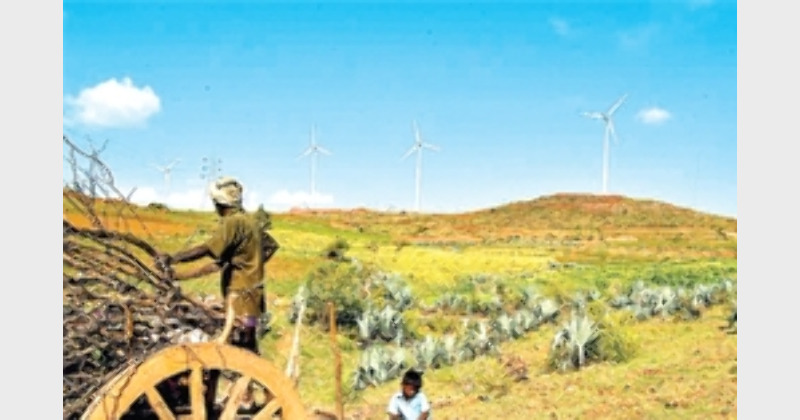
The growing environmental concerns and renewable energy sector have become India’s Sunrise Sector. To energise India, promoting clean and green energy with cost effective innovations is inevitable to realise future developmental potential needs. It will not only boost our power self-sufficiency through solar, wind and hydro power, but will also ensure energy security by reducing dependence on fossil fuels. The achievements of 2014-15 are already showing positive trends. The change in mindset and making technology socially viable is important aspect in making renewable energy affordable. On this background, Organiser brings out a
special issue with experiments, experiences, analysis and opinions of practitioners and policy makers with special focus on Renewable Energy.
More than 80 crore people in India still live in villages where access to and use of electricity is very poor. Main fuel used by the villagers is biomass like cow dung, crop and plant refuse, burning of which causes pollution, blindness and an estimated 3 to 4 lakh deaths per year due to carbon monoxide poisoning. For lighting, they still use the kerosene lamp. So there is very little home work after dark. Since they don't have electrical appliances, life of villagers is very different from that of city dwellers. It is particularly hard for the housewives. Since most businesses and services run on electricity there is very little economic activity in the villages outside agriculture.
 Shortage of electricity in the towns causes huge losses as factories and offices can't run. Shutdown of sewerage treatment plants and use of diesel generators add to pollution. Discomfort comes from the inability to run the appliances. If India has to develop fast, it must improve its energy generation. We produced 962 Trillion Watt Hours (TWH) of energy between April14 to February 15, and may exceed 1,050 TWH for the whole year, from total installed capacity of 258.7 Giga Watts (GW). If there were no losses the production would have been 2,234 TWH i.e. 2.2 times the installed capacity. But our Plant Load Factor (PLF) i.e. the capacity factor has been falling consistently and over all is now 65.8 per cent. Average Technical and Commercial losses (AT & C) are 27 per cent including transmission and distribution losses of 23 per cent and pilferage and theft for the rest. Farmers are not ready to pay even the highly subsidised tariff as pump sets below 10hp are not metered. Average cost per unit is Rs 3.78 against which over all realisation is Rs 3.01. In agriculture it is Rs 1.15. Utilities are running into loss while government is providing huge subsidy.
Another Cover Story :Future Perspective for Renewable Energy
There is considerable scope to improve the position even without any addition to the generating capacity. Generation this year is 30 per cent more than last year. Capacity factor for instance is lower in the case of states than Centre and private utilities. On an average it has been falling. The reasons may depend upon the plant design and type of fuel used. Plants may be for base load i.e. continuous supply over the minimum or for the peak load in which case they don't work continuously.
Plants are shut down for regular maintenance as well as repairs. Hydro power plants depend upon the level of water and thus rain in the catchment area. PLF of nuclear and gas fired plants is more. That of hydro power plants are 35-40 per cent. Peaking plants are therefore generally gas fired.
Other than improvement in PLF, we need to bring down the AT&C losses where politics comes into full play. Farmers gladly pay more to buy diesel to run pump sets but would rather not pay for even highly subsidised electricity. There is no metering there and supervision is lax. Although hours of supply are limited but they tend to overdraw both water as well electricity, just because it is State owned. The grid itself is weak and susceptible to frequent breakdown. We urgently need to upgrade it. Smart grid can reduce all these losses.
So far we have been favouring power generation at the sites of fuel availability. Given the high capital cost as also losses of transmission and distribution, ease in transporting fuel and convenience of installing solar systems on the rooftops and vacant lands, this is now changing to distributed generation. Each city for instance can generate power for its own need and connect to the grid for meeting any shortage as also for selling the surplus. The grid thus works like storage of energy. Distributed generation also suits to remote areas and larger villages where it will be far more economical to go in for solar, wind, micro hydel or some such other systems. We can meet the requirement of irrigation pumps without putting pressure on the grid and saving some money of the farmers. Still another innovation can be to use the idle capacity of the batteries in parked cars and other vehicles to generate and feed energy to the grid-V2G.
Rapid industrialisation under ‘Make in India’ initiative and rural indutrialisation through micro and small industries as well as increasing use of electricity in agriculture and railways to replace diesel consumption, will increase our demand to 300 GW. For this we will need to install capacity of at least 400 GW assuming improvement in AT&C losses and plant load factor.
The 12th Plan target is to add 88.5 GW. Another 40 GW or so will be added over the next two years. We may be adding another 700 to 1200 GW generation capacity over the next decade which is a long time for significant technical changes. Minister for Power has mentioned about investments totalling $250 billion including $100 billion for renewable energy, $50 billion for improvement in transmission and distribution, $60-70 billion for generation etc. This should enable us to reach the goal of power to all by 2019.
JP Dubey (The writer is a senior columnist and having expertise on developmental issues)
(July 19, 2015 Page : 8-10)