Debobrat Ghose
CASE 1: A recent news on Muzaffarnagar in UP mentioned that global terrorist outfit Lashkar-e-Toiba (LeT) operatives allegedly met some of the riot victims in the shelter camps and asked them to join the outfit.
CASE 2: A 22-year old Dheeraj Sao was arrested in Raipur (Chhattisgarh) on December 25 for allegedly raising funds for the banned outfits Students’ Islamic Movement of India (SIMI) and Indian Mujahideen (IM).
CASE 3: The alleged Naxal couriers caught while carrying explosives for Maoists at Raipur’s posh locality of Shankar Nagar on August 25, have made stunning revelations based on which the police is planning to strike on more Naxal ‘city sleeper cells’.
The above three cases that recently made headlines are just the tip of an iceberg. These incidents were in news not as a result of some major ambush or terrorist attack, but for silent and covert functioning of an individual or a group related to banned terror outfits within the boundaries of India. Usually, the news of terrorist attacks, Maoist killing innocents and serial bomb blasts devastating the lives of hundreds of common men make headlines in newspapers and breaking news on television channels. But, often these kind of silent operations go unnoticed; which not only is dangerous but poses a serious threat to the nation’s internal security.
The sleeper cells across the country – whether in the Red Corridor of the Maoists or in any insurgency-hit zone or within the home-grown Indian Mujahideen (IM) network, have been spreading tentacles at an alarming rate. In fact, these sleeper cells play a major role in giving final shape to the unleashing of terror activities.
A sleeper cell is a dormant unit in a clandestine cell system, where the members of the cell usually do not get actively involved in unleashing terror activities or ambushes, but provide logistical and other kind of support – from information to lodging and boarding to terrorists, or acting as couriers.
Recently, the states of Chhattisgarh and Jharkhand, where Maoists have a considerable influence, have witnessed activities of sleeper cells. But, it is not the Maoists alone; the rise of SIMI and IM activities in these states has emerged as a matter of concern and threat for the police and security personnel. It’s not the ‘Red Terror’ alone, but a deadly cocktail of Maoism and Islamic terrorism under the umbrella of al-Qaeda, Lashkar-e-Toiba (LeT) and Indian Mujahideen (IM) combine that is the new terror order.
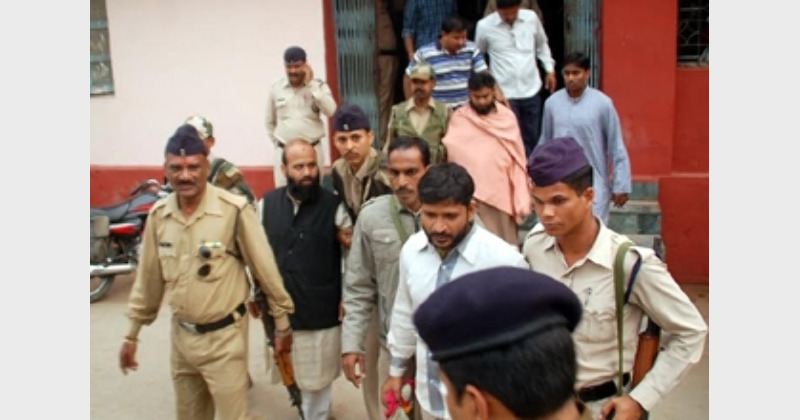
On December 25, 2013, the Chhattisgarh Anti-Terrorism Squad (ATS) nabbed a 22-year old Dheeraj Sao, a native of Bihar, who was running a roadside eatery (Dhaba) in Transport Nagar area in Raipur, for allegedly raising funds for the banned outfits Students’ Islamic Movement (SIMI) and IM. No one would have suspected the accused for his alleged role as a sleeper cell member of IM given his religious identity. But, his bank transactions and hefty deposits raised doubts and alerted the intelligence agency.
According to the Inspector General of Police, Raipur Range, GP Singh, Sao allegedly acted as a mediator to send cash to SIMI and IM terrorists, which he admitted during interrogation. The accused came in touch with one Khalid from Pakistan in 2011 and since then he had received huge amounts from different bank accounts, which were later deposited in the accounts of IM operatives in Mangalore, through his own account, in lieu of commission. The investigation revealed that more than Rs 1 crore had been deposited in different bank accounts held by Sao.
Prior to this incident, the arrests of 16 SIMI members allegedly linked to IM at domestic level and indirectly with the al-Qaeda, in November and December 2013 in Raipur revealed the active functioning and support of sleeper cells in various districts of Chhattisgarh. The arrests and busting of sleeper cell also revealed that four alleged IM operatives suspected to be involved in the Bodh Gaya and Patna blasts on July 7 and October 27, 2013 respectively — Haidar Ali alias Abdullah, Numan Ansari, Taufeeq Ansari and Mojibullah were provided shelter in Raipur for over a fortnight immediately after the incident by the members of the cell. It also revealed an unsuccessful terror attack plot on BJP’s prime ministerial candidate and Gujarat chief minister Narendra Modi in Raipur.
No one in the heart of Raipur city had ever imagined that under the garb of a teacher or a property dealer or a mechanic, their next door neighbours would engage in such a silent game of terror. “It’s a classic example of the functioning of a sleeper cell. Since Chhattisgarh is a state with communal harmony, the IM operatives found Chhattisgarh a safe haven to hide and continue with their activities silently,” said Chhattisgarh-based social economist Vivek Joglekar.
The director of The Centre for Land Warfare Studies, Maj Gen Dhruv C Katoch feels that to crack these sleeper cells, local police can prove more effective than any central agency or security force.
The unendurable suffering of riot victims in the shelter camps in Muzaffarnagar (UP) without any basic facilities is a case in point, which could be a breeding ground of future terrorists. The veracity of the news is yet to be confirmed, but it made headline recently claiming that global terrorist outfit Lashkar-e-Toiba (LeT) operatives had allegedly met some of the riot victims in the shelter camps and asked them to join the outfit.
“On one hand, there is huge corruption at local level and on the other, the Indian government has failed to have a proper justice delivery mechanism in 60 years,” added Katoch.
In the case of Naxalite operations, the activities of these sleeper cells are not restricted to Maoist-infested areas anymore, but have extended their reach to urban centres as well. Like, on August 25, 2013 Chhattisgarh police arrested Naxal couriers while they were carrying explosives for Maoists from Raipur’s posh Shankar Nagar. “The arrested members made stunning revelations on city’s sleeper cells and on how these members had been carrying on operations for the past 7-8 years,” a senior police official said.
Similarly, in May 2011, the Maharashtra ATS had cracked a sleeper cell network of Naxalites and arrested five members from Pune, allegedly Maoist sympathizers. The ATS claimed that these members were taking advantage of the aggrieved farmers, who had lost their land to an upcoming special economic zone, and were forming an area committee in western Maharashtra.
Retired chief of Border Security Force, Prakash Singh attributes the rise of ultra-Left extremism to basic socio-economic causes arising due to violation of rights of tribals, grabbing of farmers’ land, faulty development paradigm since independence, lack of redressal of grievances of the poor, inequitable distribution of wealth, poor governance and policy confusion at central level.
“Tribals have a feeling of exhaustion and nowhere to go, and Naxals offer them an alternative. Whereas, the government of India has no strategic plan to deal with the problem,” said Singh during a session on ‘Dialogue on Defence’ held in New Delhi on December 26, 2013.
The role and activities of sleeper cells in a terror network can be understood from a recent US report – ‘Jihadist Violence: The Indian Threat’ by the Woodrow Wilson International Centre for Scholars. It underlines that the “Indian jihadist movement constitutes an internal security issue with an external dimension and stated IM not as a formal organization but a relatively amorphous network populated by jihadist elements from the fringes of SIMI and the criminal underworld. The IM connects to and sometimes attempts to absorb smaller cells and self-organising clusters of would-be militants”.
(The writer is a Delhi-based journalist, who writes on various issues related to Madhya Pradesh and Chhattisgarh. He can be reached on [email protected])