Increasing Naxal Menace
June 6, 2026
  • Read Ecopy
  • Circulation
  • Advertise
  • Careers
  • About Us
  • Contact Us
Android AppiPhone AppArattai
Organiser
  • ‌
  • Bharat
    • Assam
    • Bihar
    • Chhattisgarh
    • Jharkhand
    • Maharashtra
    • View All States
  • World
    • Asia
    • Europe
    • North America
    • South America
    • Africa
    • Australia
  • Editorial
  • International
  • Opinion
  • RSS @ 100
  • More
    • Op Sindoor
    • Analysis
    • Sports
    • Defence
    • Politics
    • Business
    • Economy
    • Culture
    • Special Report
    • Sci & Tech
    • Entertainment
    • G20
    • Azadi Ka Amrit Mahotsav
    • Vocal4Local
    • Web Stories
    • Education
    • Employment
    • Books
    • Interviews
    • Travel
    • Law
    • Health
    • Obituary
  • Subscribe
    • Subscribe Print Edition
    • Subscribe Ecopy
    • Read Ecopy
  • ‌
  • Bharat
    • Assam
    • Bihar
    • Chhattisgarh
    • Jharkhand
    • Maharashtra
    • View All States
  • World
    • Asia
    • Europe
    • North America
    • South America
    • Africa
    • Australia
  • Editorial
  • International
  • Opinion
  • RSS @ 100
  • More
    • Op Sindoor
    • Analysis
    • Sports
    • Defence
    • Politics
    • Business
    • Economy
    • Culture
    • Special Report
    • Sci & Tech
    • Entertainment
    • G20
    • Azadi Ka Amrit Mahotsav
    • Vocal4Local
    • Web Stories
    • Education
    • Employment
    • Books
    • Interviews
    • Travel
    • Law
    • Health
    • Obituary
  • Subscribe
    • Subscribe Print Edition
    • Subscribe Ecopy
    • Read Ecopy
Organiser
  • Home
  • Bharat
  • World
  • Operation Sindoor
  • Editorial
  • Analysis
  • Opinion
  • Culture
  • Defence
  • International Edition
  • RSS @ 100
  • Magazine
  • Read Ecopy
Home General

Increasing Naxal Menace

Archive ManagerArchive Manager
Jan 25, 2014, 12:00 am IST
in General
Follow on Google News
FacebookTwitterWhatsAppTelegramEmail

Pramod Mujumdar

The country today is encircled with internal and external security problems. The continued infiltration of Bangladeshis, incursions by the Chinese along the Arunachal border, intrusion by terrorists in the Kashmir valley from Pakistan, and growing terrorist violence in the country can be cited as external threats while the increase in naxalite activities in the region extended from Pashupati in Nepal to Tirupati in Andhra Pradesh has threatened the internal security. The threat to security posed by naxalite needs to be dealt with firm resolve. It is no longer limited to any special area or state but has emerged as a major threat to national security.

This movement has its origin in the 1960s when some of the CPM leaders started a movement to rid the farmers of exploitation of landlords in the Naxalbari area of West Bengal. The movement led by Charu Mazumdar and Kanu Sanyal however, did not get support from the CPM as they did not subscribe to their ideology of violence. The naxalites based their ideology and programs on the philosophy of Chinese communist leader Mao and initially its impact was limited to West Bengal and Kerala.

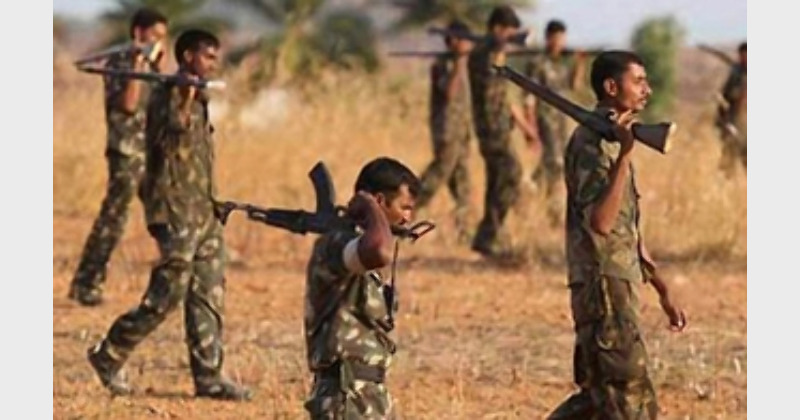
In the early 70s, the then Prime Minister Indira Gandhi used all possible means to curb this violent movement with an iron hand and as a result this movement was dispersed into various fractions. Those who survived the iron hand of the government took shelters in the forests of Andhra Pradesh and started regrouping the adivasis under the new name of People’s War Group (PWG). Those who studied this movement are of the view that they got the training in arms from the members of the LTTE of Sri Lanka. Similar type of organisations started coming up in Bihar and slowly all these naxalites started surfacing in various parts of the country. Today, their network has spreaded in 40 per cent of the Indian landmass covering the states of Odisha, Chhattisgarh, Andhra Pradesh, Maharashtra, Jharkhand, Bihar, Uttar Pradesh and West Bengal.

Though the Centre and States have taken steps to update the Police force to tackle the naxal movements, the CRPF, BSF and state police could not do much in containing them.  On the other hand the conflict with the naxalites is becoming fierce with every new day. It is observed that they get the arms and ammunition from Nepal communist party. These people have penetrated the urban and educated class of the society of late and set up their network in cities like Delhi, Kolkata, Mumbai, Pune and Bengaluru where they are finding many new takers to their ideology.

The failure to control the naxalite activities can be attributed to the lack of coordination between the Central and State governments and their Police forces. This is true that the naxalites will never be supporters of India as they draw their sustenance from the alien ideology and philosophy.  That is why they are found involved in anti-national activities always. It is beyond doubt that the naxalites got over and cover support from the communist government of West Bengal and progressive intellectuals.

According to Major (Retd) Dhruv Katoch implementation of the provisions of the Constitution in naxal dominated areas would lessen the impact of the naxal movement. They could not be wiped out by use of force but will have to be finished on the ideological plane. Senior Police Officer Prakash Singh is of the opinion that there is no national policy to deal effectively with the naxalites. The naxal movement is not confined to any specific state or region, it is assuming national dimension these days and as such there should be a national level policy to deal with this menace. He feels that the roots of this movement are very much in our country but the lack of proper coordination and planning on part of the governments both Central and the State this movement is growing in numbers and influence. Another official thinks that the naxal movement has now spreaded to the cities and the intellectuals have come under its influence in major cities. He also feels that the naxals have established good relations with Indian Mujahideen which should be anyway cause of concern for the governments.

The Central Government of UPAII under Manmohan Singh has failed miserably on the front of curbing these growing activities. Prime Minister Manmohan Singh has set up a ministerial level group to deal with this threat but no concrete results are visible. The Congress-ruled states like Maharashtra and Andhra get full support in men and material to deal with the naxal movement but this is not the case with non-Congress ruled states like Chhattisgarh and Madhya Pradesh or Odisha and Bihar.

The Central Government has admitted in the Supreme Court that the support these naxalites get from the intellectuals and CPM leaders cannot be overruled and is more dangerous that the armed rebels. The naxalites have expanded their support bases in cities and urban areas against the government.

The State Governments have also failed in taking development to the backward areas where these naxalites take advantage of backwardness and simplicity of the people. The police too, sometimes act against these simple adivasis and punish them thus providing a cannon fodder for the naxalites. Thus the adivasis do not believe in police and security men.

The social and voluntary organisations have a role to play in resolving this major issue. Vanvasi Kalyan Ashram is working in the difficult terrain of Bastar in Chhattisgarh, Ramakrishna Mission is working in some tribal areas and providing them succor. With the help of these social organisations an atmosphere against these naxalites could be created and positive steps could be taken to contain this security menace. This positive attitude of the social organisation would bring forth the positive results in curbing naxal activities in these strategic areas.


ShareTweetSendShareSend
✮ Subscribe Organiser YouTube Channel. ✮
✮ Join Organiser's WhatsApp channel for Nationalist views beyond the news. ✮
Previous News

Rise of sleeper cells pose serious threat to nation’s internal security

Next News

Maoists threat in India and likely States' response

Related News

The Vedic age saw remarkable women sages, known as Rishikas, who composed hymns and shaped India's spiritual and philosophical heritage

Rishikas of Vedic Age: How Gargi, Maitreyi & other women shaped ancient India’s spiritual and philosophical tradition

Police in AAP-Ruled state of Punjab lathi charge sit-in protesters

Punjab: ITI candidates seeking jobs lathi-charged outside PSPCL HQ; opposition slams AAP Govt over police action

From constables to DGP, India's police system follows a structured chain of command that governs law enforcement across the country

From Constable to DGP: Understanding India’s police hierarchy, powers & recruitment system

The terracotta dice that challenges historical assumptions and highlights India's millennia-old civilisational heritage

How a 4,500-year-old terracotta dice is reviving the debate on India’s civilisational continuity & Vedic heritage

The Porumamilla inscription and the ancient science behind a reservoir that survived 650 years

India’s 655-Year-Old Water Policy: The Porumamilla inscription that turned stone into a manual of hydrology

India’s Permanent Representative to the United Nations Ambassador Harish Parvathaneni

India slams Pakistan at UNSC for peddling false narratives on Jammu & Kashmir

Load More

Latest News

The Vedic age saw remarkable women sages, known as Rishikas, who composed hymns and shaped India's spiritual and philosophical heritage

Rishikas of Vedic Age: How Gargi, Maitreyi & other women shaped ancient India’s spiritual and philosophical tradition

Police in AAP-Ruled state of Punjab lathi charge sit-in protesters

Punjab: ITI candidates seeking jobs lathi-charged outside PSPCL HQ; opposition slams AAP Govt over police action

From constables to DGP, India's police system follows a structured chain of command that governs law enforcement across the country

From Constable to DGP: Understanding India’s police hierarchy, powers & recruitment system

The terracotta dice that challenges historical assumptions and highlights India's millennia-old civilisational heritage

How a 4,500-year-old terracotta dice is reviving the debate on India’s civilisational continuity & Vedic heritage

The Porumamilla inscription and the ancient science behind a reservoir that survived 650 years

India’s 655-Year-Old Water Policy: The Porumamilla inscription that turned stone into a manual of hydrology

India’s Permanent Representative to the United Nations Ambassador Harish Parvathaneni

India slams Pakistan at UNSC for peddling false narratives on Jammu & Kashmir

Keralam: Pathanamthitta temple property occupied beyond lease period reclaimed by devotees

A series of high-level engagements signals New Delhi's growing focus on building interoperable security networks across the Indo-Pacific

India strengthens Indo-Pacific security architecture with new defence and maritime partnerships

Prime Minister Narendra Modi

“Makes every Indian proud”: PM Modi hails India’s 7.7 per cent GDP growth in FY 2025-26

Once known for maoist violence, Minpa now leads healthcare revolution with telemedicine services in Sukma

From Maoist Stronghold to Healthcare Hub: How Chhattisgarh’s Minpa is transforming through telemedicine & development

Load More
  • Privacy
  • Terms
  • Cookie Policy
  • Refund and Cancellation
  • Delivery and Shipping

© Bharat Prakashan (Delhi) Limited.
Tech-enabled by Ananthapuri Technologies

  • Home
  • Search Organiser
  • Bharat
    • Assam
    • Bihar
    • Chhattisgarh
    • Jharkhand
    • Maharashtra
    • View All States
  • World
    • Asia
    • Africa
    • North America
    • South America
    • Europe
    • Australia
  • Editorial
  • Operation Sindoor
  • Opinion
  • Analysis
  • Defence
  • Culture
  • Sports
  • Business
  • RSS @ 100
  • Entertainment
  • More ..
    • Sci & Tech
    • Vocal4Local
    • Special Report
    • Education
    • Employment
    • Books
    • Interviews
    • Travel
    • Health
    • Politics
    • Law
    • Economy
    • Obituary
  • Subscribe Magazine
  • Read Ecopy
  • Advertise
  • Circulation
  • Careers
  • About Us
  • Contact Us
  • Policies & Terms
    • Privacy Policy
    • Cookie Policy
    • Refund and Cancellation
    • Terms of Use

© Bharat Prakashan (Delhi) Limited.
Tech-enabled by Ananthapuri Technologies