
Cartoons narrate grass roots problems?
Nilanjan Mukhopadhyay?
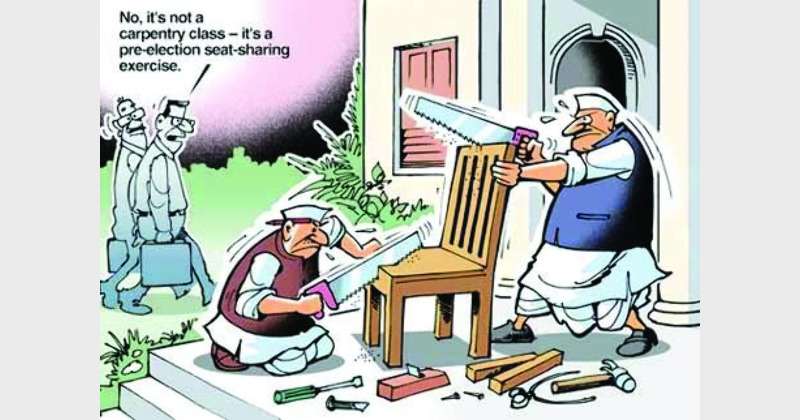
 This story should ideally begin sometime in the early 1980s after Smt Indira Gandhi’s triumphant return to power, and when the term authoritarian was becoming synonymous with her. It was a typical strip cartoon of the one and only RK Laxman in which small cartoons were neatly arranged within a bigger box cartoon and with a single narrative. The first visual had a nose-high-up Smt Gandhi walking past a virtual guard of honour of Congressmen standing in rapt attention. The second visual had her stop in front of one of the leaders. If memory serves me right, it also had a third visual of her pointing with her index finger in his direction. The caption below said it all: “Hey you out there, come here. You are the next chief minister…What’s your name?”
Academicians who have studied the causative factors behind the emergence of Telegu Desam founder NT Rama Rao in Andhra Pradesh, often cite the issue of Telugu pride as the single largest reason why the Congress was voted out in 1983. The issue of Telugu pride came up because between 1978 and 1982 the Congress party appointed four Chief Ministers – all of whom had questionable regional following. The people of Andhra Pradesh felt slighted at the Congress High Command selecting leaders with no or little mass support and felt that since Smt Gandhi had usurped the right of the people to select their leaders, the election provided an apt occasion to regain this power – which they did by voting in 219 ‘Independent’ MLAs in a House of 294. The people were not concerned that these Independents did not have a common symbol because Telugu Desam was not yet a political party that the Election Commission recognised and thereby was not eligible for an election symbol.
Andhra Pradesh was not the only state where the writ of the Congress High Command ran large when it came to selecting Chief Ministers. Uttar Pradesh also had a relatively political lightweight Chief Minister in Sripati Mishra after the tenure of VP Singh in the early 1980s. Laxman’s cartoon in fact mirrored the trend of that time and such handpicking of Chief Ministers was one of the reasons for public sentiment to begin turning against Indira Gandhi in her lifetime. In fact, it is one of the many situations that analysts have often grappled with when looking at the ‘what if’ picture: what would have been the verdict of the Lok Sabha that was any way due in a few months if Smt Gandhi had not been assassinated?
In a discussion on federalism with the basic questions being asked if our nation State is unitary or federal and what is the state of Centre-State relations in the country at the moment, where does the Laxman cartoon fit in? Or for that matter, why are we talking about this dangerous trend started by Smt Gandhi which also to a great extent led to her political downfall?
There is one peculiarity in Indian politics. We may be the largest democracy in the world but barring the ideologically antagonistic Bharatiya Janata Party and the four communist parties, no other parties has modicum of internal democracy. Virtually every other political party is run as a dynastic organisation or are anarchic collectives where the writ of the most powerful chieftain dominates over the others. Be it the Bahujan Samaj Party, the Samajwadi Party, the two Dravidian parties, Nationalist Congress Party or others, leaders of all these parties control the governments they run and the organisation with an iron hand.
This has led to a peculiar situation where political parties and their leaders pay lip service to democratic functioning without practicing it within their political parties. When we talk of federalism, it also means that political parties must also have a federal character. In practice this means that political parties should have transparency on the basic issue of membership and internal elections need to be held in a pyramidal structure. For parties that are regional – in the sense that they have political presence either in just one state or in a few states, the basic principle of federalism has to be applied in a sub-regional manner. In practice it means that parties like the SP need to look at different cultural regions of Uttar Pradesh as contributors of units and leaders to the party’s state level leadership. Not just for the SP, but other parties also must have transparent elections from district levels – or may be even from smaller units. When political parties talk about electoral reforms, this is one aspect which needs to be kept in mind and unless this is addressed, all adherence to a federal outlook will turn out to be pyrrhic.
To understand the reasons behind this obvious lacuna in Indian politics we have to revisit the evolution of the Indian political party system. By and large after Independence, the Congress party neatly made a transition from being the national movement to becoming the principal political party. This has also been the case in most countries that went through a period of colonial rule. After having emerged as the single largest political party in 1952 and getting virtually identified with the nation, the Congress faced its first real challenge in 1967 during the fourth general election.
The verdict of the general elections in 1967 was actually a stunning setback to the Congress party. It returned to power at the Centre – but with a wafer thin majority in Parliament. But more importantly, the Congress party did not get a majority in several states. The elections in 1967 did not generate a one-off verdict – but was a part of a bigger story, that of a peridiof transition in Indian politics. This began the first real wave of coalition governments and prepared the country of what was to come. But the coalition government that were formed in several states did not last for long because of both ideological reasons and also because of personal ambitions of leaders involved. The main stumbling block arose due to three divergent ideological streams in the United Front governments – those led by Swatantra Party, the Bharatiya Jana Sangh and the Lohiaites.
This was also the period when the Congress system of an organisation collapsed as Smt Gandhi decided to form a ginger group of personal loyalists as distinct from the regional leaders who had initially ensured her victory in the contest with Morarji Desai in January 1966 after the untimely death of Lal Bahadur Shastri. The Congress system that had been so assiduously developed – first by Mahatma Gandhi in the 1920s and later developed further by Jawaharlal Nehru – paid emphasis on strong regional leaders propping up an equally strong Centre. Smt Gandhi clashed with the satraps over several issues most importantly on whether she would remain the gungi gudiya or not.
By the time Smt Gandhi ironed out Congress party to her liking and secured the mandate of 1971, the federal character of the Congress party was distant history. The Janata Party in the two years that it was in office partially revived federalism as a dominant political culture of political parties but the discord on personal matters and the differences over dual-membership issue resulted in Smt Gandhi being able to convince the electorate that democratic functioning within parties negatively impacts governance. Smt Gandhi’s main electoral slogan for the 1980 election was a pointer in this direction: chuniye unhe jo sarkar chala sakein.
The character of the Congress party did not undergo any basic change during the Rajiv-era. But as opposition to the government mounted from April 1987 onwards, the opposition coalesced in the form of Janata Dal with support from the BJP and the Left. At this time there were indications of revival of internal democracy in the new party. But from the election of the leader of the parliamentary party to the manner in which the VP Singh government decided to implement the Mandal Commission award, it became evident that the system of political parties was reverting back to the old order.
PV Narasimha Rao was the last leader to be Prime Minister as the head of single party government. Since then, every government-head has presided over coalitions that have rarely run smoothly for a long period. Part of the reason is that systems of managing a coalition have not been established. Be it the crisis that has gripped the United Progressive Alliance government time and again or the hiccups faced by the National Democratic Alliance between 1998 and 2004, the art of managing a coalition eludes parties. The tragedy of Indian politics is that every leader wants a federal character for the nation while pursuing a unitary system of party. Whether is the Congress self-goal in Uttarakhand or the continuing hara-kiri of the BJP in Karnataka, Laxman’s cartoon still has a degree of relevance.
(The author is a senior print & TV journalist. He is also an author, writer and anchors the weekly show – A Page From History on Lok Sabha TV)?