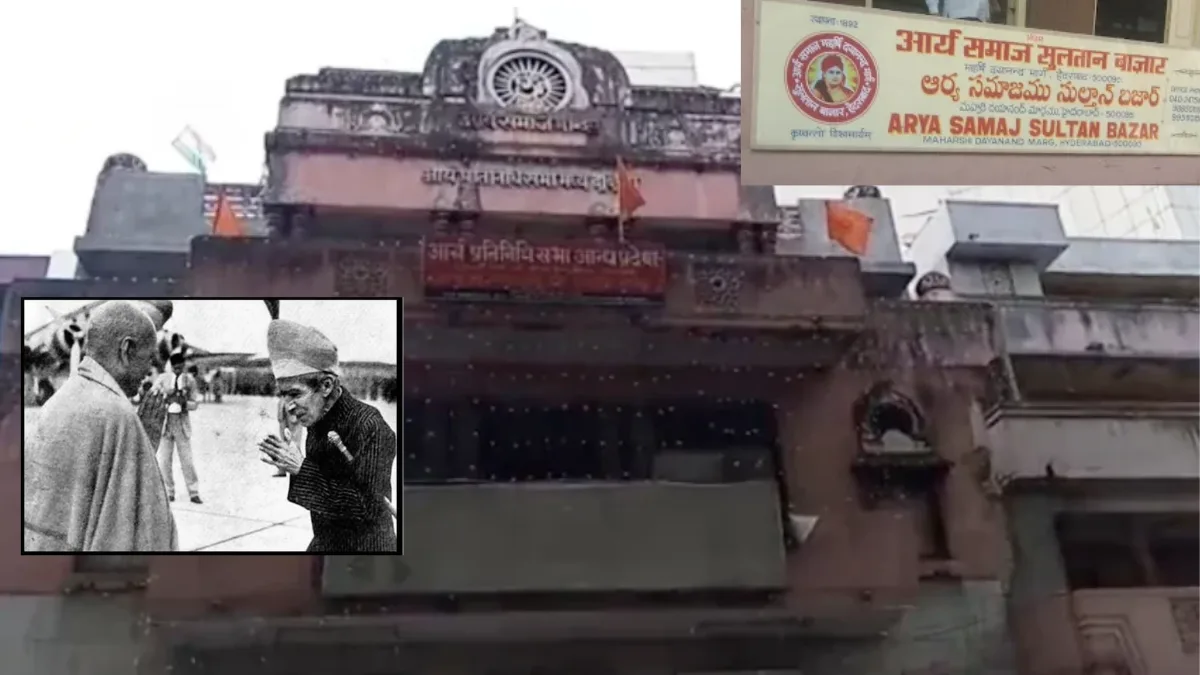
Erstwhile Hyderabad state comprising of Telangana, Parts of Maharashtra and Karnataka did not become free merely because soldiers entered Hyderabad for five days in September 1948. While Operation Polo successfully dismantled the ruling Asaf Jahi dynasty, it was the pre-existing, indomitable courage of Hindus that had already rendered the last Muslim monarchy vulnerable, with danger bells knocking at its doors. That courage was built slowly, over many years, in villages, mandirs, gymnasiums, libraries and secret workshops. Ordinary men and women fought for swadharma and swarajya at a time when both were under severe pressure. At the centre of this long preparation stood the Arya Samaj.
The commonly told story is neat and convenient: the Nizam refused accession, the Razakars unleashed violence, the Indian Army marched in, and Hyderabad joined India. But history is rarely so tidy. The last Nizam, Mir Osman Ali Khan, ruled over a Hindu-majority state with a Muslim court, Urdu administration and a political culture that grew harder after the collapse of the Ottoman Caliphate. From the 1920s, Hyderabad became part of a larger current of Muslim political assertion. Bahadur Yar Jung’s Majlis-e-Ittehadul Muslimeen and the Tabligh machinery used conversion and intimidation as political instruments. Circulars and firmans followed. Gasti Nishan 53, issued in the late 1930s, struck directly at Hindu public life: Arya Samaj havans, assemblies and civil rights were restricted. This was not a routine municipal order. It was an attempt to shrink Hindu religious and civic space inside a princely autocracy.
Arya Samaj responded not with a mere pamphlet, but with a movement
The 1938–39 Hyderabad Satyagraha: teaching a people they could fight.
In October 1938, the Samaj launched the Hyderabad Satyagraha. It continued into 1939. The resistance was peaceful, but its impact was powerful. Volunteers entered the state in batches. Thousands courted arrest. Hyderabadis, along with workers from different parts of India, filled the jails. Their demand was simple, but explosive for that time: the right to worship, assemble, educate and live as Hindus without official humiliation.
The deeper work was psychological. For generations, people had been made to believe that the Nizam’s order was their fate. Arya Samaj broke that spell. Pandit Narendraji gave a call that still carries force across the decades: Paap se daro, paapi se nahi — fear sin, not the sinner. It told ordinary people that tyranny was not sacred and that submission was not destiny. This awakening spread beyond Telugu-speaking Telangana into Marathwada and Hyderabad-Karnataka. Mandirs, night schools, libraries (National awakening) and vyayamshalas became the infrastructure through which people learnt to stand upright.
When official Tabligh efforts and the Kasakars of Bahadur Yar Jung pushed conversion, Arya Samaj responded with shuddhi — reconversion, protection of families, shelter, marriages and the firm assurance that a Hindu broken by force still had a home to return to. This was not a side activity. It was civilisational first aid.
Then the Razakars arrived.
From satyagraha to self-defence
Under Qasim Razvi, the Razakars became a paramilitary force of terror. Villages were looted. Women were assaulted. Cattle were slaughtered. Dissenters — Hindu, communist and even Muslim liberals — were hunted. The Nizam’s machinery either looked away or actively cooperated. This was not ordinary “communal tension”. It was organised predation.
Arya Samaj had already prepared the ground. Every mandir, library and wrestling school had become a quiet armoury of morale. People were taught that injustice could be resisted, and that a reply could be given when necessary. Self-defence groups emerged. Border camps later sheltered refugees. Reports of atrocities were smuggled to Delhi. Some workers moved from satyagraha to armed resistance because the alternative was annihilation. Narayan Rao Pawar’s bomb attempt on the Nizam’s convoy near King Kothi on 4 December 1947 became the most famous flashpoint. Behind such moments stood a wider network of unnamed organisers.
If the spine of Hindu society did not snap in that storm, Arya Samaj deserves a large share of the credit. It fought for faith and freedom together. In the Hyderabad of the 1940s, these were not separate questions.
Alwala Bal Reddy: the village that became a workshop of resistance
Alwala Bal Reddy was born in 1916 in Gundlapochampally of Rangareddy district, to Mallareddy and Narsamma. He was a farmer’s son. After his father’s death, he was brought up by his maternal aunt in the old city Doodhbowli. He studied in Urdu and later completed Hindi Visharada. The freedom movement and the oppression under the Nizam shaped him early. He passed through the influence of communism and Gandhian politics before finding his firm ideological anchor in Dayananda’s Arya Samaj.
He became a secretary of the Arya Samaj representative council. He travelled widely, organised meetings, built temples, opened gyms, ran a night school for Harijans (Dalits), and later helped establish Kasturba School for girls at Umdabazar, Doodhbowli. For him, shuddhi was a duty, not a spectacle. He protected reconverts, arranged marriages and even spent family jewellery to support refugees. His wife Ratnamma held the household together while he lived under the constant threat of arrest.
In 1942, he joined Quit India processions along with Arya Samaj and Congress youth. He was arrested in1942 for speaking against Nizam during Quit India movement. By 1947–48, the Razakar violence had reached the villages. Bal Reddy’s own house and family paid a heavy price. His home was demolished. Relatives were assaulted. The village, frightened by Razakar terror, could not shelter them. They had to hide in a small fort room in Koti, Near British Residency area.
The accusation that followed him reveals the nature of those times: that bombs used against the Nizam-Razakar order were manufactured in his village workshop. Whether every charge in a Nizam police file was accurate is less important than the larger truth that a farmer’s son from Gundlapochampally was prepared to turn his soil into a foundry of resistance. He was imprisoned and was still in jail on 17 September 1948, the day Hyderabad was liberated. The regime branded him a traitor. History should remember him as a builder of the republic’s forgotten frontier.
He never converted sacrifice into office or personal gain. Later, he served trade unions, municipal politics and Congress organisation. In 1960, he travelled to Mauritius to spread Arya Samaj work. He passed away on 29 August 1992 at Doodhbowli, Old city Hyderabad. His name is still missing from many public accounts and textbooks. That absence itself tells a story.
What the Communists fought — and what they later claimed
Historical honesty demands that another ledger also be opened.
The communist-led peasant revolt in Telangana was important and real. In parts of Nalgonda, Warangal and Khammam, it fought vetti, eviction, rack-renting and the power of the deshmukhs. Poor peasants died. Village squads fought Razakars as well as landlords. That courage should not be erased. But the central purpose of that struggle was land, crop and class struggle against feudalism. It was not a statewide campaign to free Hyderabad from the Nizam and merge it with India. Its geography was limited, and its ideology was not national integration.
After the Indian Army ended Nizam rule in September 1948, a decisive turn occurred. Instead of seeing the Indian Union as the force that had broken the autocracy, sections of the communist leadership turned the struggle into an armed conflict against the Government of India. They spoke of people’s democracy and liberation from Congress rule. Fighting continued until 1951. The party itself later acknowledged that treating the post-Police Action phase as a liberation war against the Indian Union was a sectarian error. In some places, weapons taken from the collapsing Razakar-Nizam order were turned against the new Indian state. This is not a smear. It is part of the movement’s own later self-criticism and of the military-political record of 1948–51.
The political harvest, however, moved in a different direction. Over time, a single story hardened: that only the communists fought the Nizam, that Hyderabad’s freedom was mainly a red chapter, and that Arya Samaj was merely a communal footnote. Such a claim can stand only if one ignores the 1938 satyagraha, the shuddhi response to Tabligh, the mandir-gymnasium-library network across three linguistic regions, the refugee camps, the self-defence groups, and men like Bal Reddy who were already in the Nizam’s prisons when the Indian Army entered Hyderabad.
An armed struggle that began against feudal cruelty and later turned its guns on the Government of India cannot be treated as the same thing as a freedom struggle for accession to India. To merge the two without distinction is not history. It is appropriation.
Give the unsung their place
Hyderabad’s liberation was the result of many forces acting together: the State Congress, socialists, peasant rebels, border camps and finally the Indian Army. But before the army could finish the job, there had to be a people who had stopped believing that they were born to bend. Arya Samaj helped create that people. It fought for the Hindu’s right to exist in public and for the Indian’s right to belong to India. Alwala Bal Reddy placed family, land and liberty on the same altar.
There were many such names — workers who never filed claims, never sat for portraits, and never converted sacrifice into a party monopoly. Restoring them to memory is not a communal exercise. It is an act of historical fairness. Along with remembering five days of Operation Polo, it is important remember and reflect upon long years of struggle that made those four days possible.
The people of Telangana waited long to breathe free air. That is the truth. The men and women who taught them to resist the Nizam, and who paid for that lesson with jail, exile, demolished homes and unmarked graves, deserve more than a passing line in someone else’s victory speech.