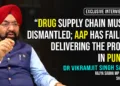

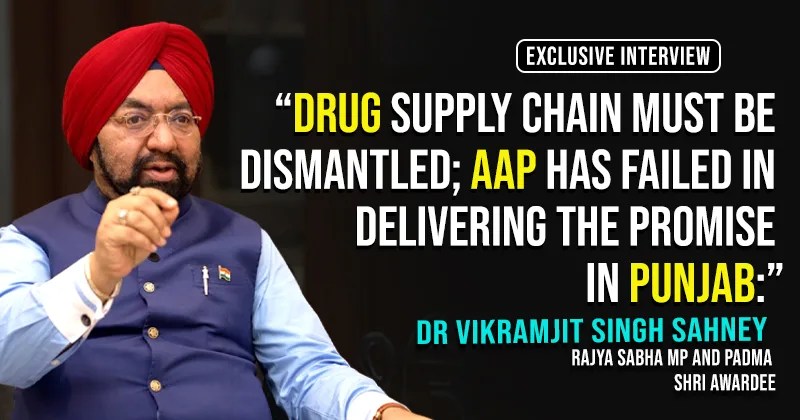
Drug supply chain must be dismantled; AAP has failed in delivering the promise in Punjab: Dr Vikramjit Singh Sahney
August 31, 2026
  • Read Ecopy
  • Circulation
  • Advertise
  • Careers
  • About Us
  • Contact Us
Android AppiPhone AppArattai
Organiser
  • ‌
  • Bharat
    • Assam
    • Bihar
    • Chhattisgarh
    • Jharkhand
    • Maharashtra
    • View All States
  • World
    • Asia
    • Europe
    • North America
    • South America
    • Africa
    • Australia
  • Editorial
  • International
  • Opinion
  • RSS @ 100
  • More
    • Op Sindoor
    • Analysis
    • Sports
    • Defence
    • Politics
    • Business
    • Economy
    • Culture
    • Special Report
    • Sci & Tech
    • Entertainment
    • G20
    • Azadi Ka Amrit Mahotsav
    • Vocal4Local
    • Web Stories
    • Education
    • Employment
    • Books
    • Interviews
    • Travel
    • Law
    • Health
    • Obituary
  • Subscribe
    • Subscribe Print Edition
    • Subscribe Ecopy
    • Read Ecopy
  • ‌
  • Bharat
    • Assam
    • Bihar
    • Chhattisgarh
    • Jharkhand
    • Maharashtra
    • View All States
  • World
    • Asia
    • Europe
    • North America
    • South America
    • Africa
    • Australia
  • Editorial
  • International
  • Opinion
  • RSS @ 100
  • More
    • Op Sindoor
    • Analysis
    • Sports
    • Defence
    • Politics
    • Business
    • Economy
    • Culture
    • Special Report
    • Sci & Tech
    • Entertainment
    • G20
    • Azadi Ka Amrit Mahotsav
    • Vocal4Local
    • Web Stories
    • Education
    • Employment
    • Books
    • Interviews
    • Travel
    • Law
    • Health
    • Obituary
  • Subscribe
    • Subscribe Print Edition
    • Subscribe Ecopy
    • Read Ecopy
Organiser
  • Home
  • Bharat
  • World
  • Operation Sindoor
  • Editorial
  • Analysis
  • Opinion
  • Culture
  • Defence
  • International Edition
  • RSS @ 100
  • Magazine
  • Read Ecopy
Home Politics

Drug supply chain must be dismantled; AAP has failed in delivering the promise in Punjab: Dr Vikramjit Singh Sahney

Nishant Kumar AzadNishant Kumar Azad
Aug 31, 2026, 08:00 pm IST
inPolitics, Bharat, Interviews, Punjab
Follow on Google News
Facebook
Twitter
WhatsAppTelegramEmail

In an exclusive conversation with Organiser Assistant Editor Nishant Kumar Azad, Rajya Sabha MP and Padma Shri Awardee, Dr Vikramjit Singh Sahney speaks about his decision to leave the Aam Aadmi Party (AAP), Punjab’s governance crisis, drug menace, missionary conversion, and why he believes the State needs a new development model. Excerpts:

You spent more than four years with AAP. What compelled you to leave the party?

There were two principal reasons behind my decision. First, my ideological and personal association with the BJP goes back to nearly twenty-five years. When AAP formed the Government in Punjab, it was looking for credible faces beyond their organisational cadre. That is how I was nominated to the Rajya Sabha.

However, despite being a Member of Parliament, I was never called for any party’s political or parliamentary strategy. No forum existed where Members of Parliament could sit with the leadership and discuss governance priorities. We were never regularly invited for consultations by either Arvind Kejriwal or Chief Minister Bhagwant Mann. Even when we wanted to initiate development projects in Punjab, there was very little encouragement or handholding from the Government. After four years, it became clear that precious time was being wasted without meaningful outcomes.

Punjab has witnessed a culture of migration for decades. According to some reports, every year, nearly 1.5 to 2 lakh young people leave for countries such as Canada, Australia, and the United Kingdom. Why has migration become almost a social aspiration in Punjab?

Punjab was once India’s most prosperous State in terms of per capita income. However, after the years of militancy, industrial stagnation and inadequate economic diversification, young people increasingly began looking outside the State. Agriculture alone could no longer absorb the aspirations of the younger generation.

Canada, in particular, actively encouraged immigration because of its demographic requirements. Families started selling land to finance overseas education or migration. Eventually, this became a social trend where almost every household aspired to send at least one member abroad.

What is unfortunate is that Punjab has failed to create sufficient opportunities to retain its own talent. Many Punjabis have achieved extraordinary success across the world – as entrepreneurs, professionals, doctors and political leaders. The question is: if Punjabis can excel everywhere else, why can’t they build similar success within Punjab itself? The answer lies in the lack of opportunities at home.

AAP had promised to make Punjab drug-free within one month of coming to power. How do you assess the Government’s performance on that promise?

Many promises were made – not only regarding drugs but also MSP and several agricultural commitments. Unfortunately, delivery has fallen far short of expectations. The drug problem is complex. It involves cross-border trafficking, organised supply chains and local distribution networks.

Through our organisation, we operate twelve de-addiction and rehabilitation centres. We have rehabilitated many young people, and our experience has taught us that rehabilitation is not simply about medical treatment. A recovering addict needs counselling, yoga, meditation, sports, skill training and sustained psychological support. We try to transform their mindset over several months before reintegrating them into society. However, rehabilitation alone cannot solve the problem. The supply chain must be dismantled, employment opportunities must improve and administrative coordination has to become much stronger. The drug trade involves supply chains, distribution networks and local operatives. Without the involvement, or at least the failure, of influential individuals and sections of the State machinery, such activities cannot continue on this scale. We have repeatedly witnessed that the challenge is not merely the availability of drugs but the ecosystem that allows trafficking and distribution to continue. Unless that ecosystem is dismantled, Punjab will continue to face this crisis.

Religious conversion has become a major concern in Punjab. Reports suggest that missionary activity has expanded rapidly in recent years. What, according to you, is driving this phenomenon?

This is one of the most serious challenges facing Punjab today. The most worrying aspect is that conversions are taking place in regions that have historically been the heartland of Sikhism, particularly Majha and Doaba.

In my view, the root cause lies partly within the society. Sikhism was founded on the principles of equality, dignity and social harmony. However, over time, sections of Scheduled Caste communities often felt excluded or inadequately integrated into mainstream religious and social institutions. Missionary organisations recognised this vacuum. They reached villages, visited families facing illness or hardship, extended emotional support, provided assistance and gradually built trust within these communities.

Has SGPC failed to respond adequately to this challenge?

The SGPC remains the premier institution managing Sikh religious affairs. It has made significant contributions in preserving historic gurdwaras and running educational and medical institutions.

However, on the specific issue of religious conversions, I believe it should have given greater priority. I have personally urged the SGPC leadership to allocate dedicated financial and organisational resources to address this challenge. The institution has both the reach and the credibility to play a much larger role.

This is not merely a religious issue. It has long-term implications for Punjab’s demographic balance and social cohesion.

When SAD leader Sukhbir Singh Badal met Prime Minister Narendra Modi, there were talks that the BJP may fight the polls with the former ally. But the BJP has recently declared it will go solo in the upcoming Assembly polls. How do you see this decision?

The decision regarding alliances is entirely the prerogative of the party high command. However, I must put it on record that one cannot ignore the remarkable momentum and organisational strengthening that the BJP has witnessed in Punjab in the last few months. The party’s campaign received a major push with the rally of Union Home Minister Amit Shah in Moga in March 2026. Thereafter, party President Nitin Nabin’s visit to the State, during which he participated in several public programmes and held extensive organisational meetings, further energised the cadre.

The historic rally of Prime Minister Narendra Modi in Jalandhar gave tremendous confidence and enthusiasm to BJP workers. Today, BJP in Punjab is a strong and rapidly expanding political force. The enthusiasm among workers, growing acceptance of party and strengthening of our organisation at every level will undoubtedly have a significant impact in the 2027 Assembly elections.


Topics: Dr Vikramjit Singh SahneyMSP and several agricultural commitmentsSGPC failedAAPSikhism
Nishant Kumar Azad
Nishant Kumar Azad
@azad_nishantNishant Kumar Azad works as a Senior Correspondent in the Organiser which is the oldest and most widely circulated nationalist English weekly of Bharat. An ambulatory reporter, he predominantly writes about political issues, with a particular underscoring on state politics in Jammu & Kashmir and West Bengal. Withal, he has an enthrallment for intersections of politics and society and its heft on our daily life. His journalistic works have often been adduced in Parliament Library compendiums. He has conducted interviews with conspicuous political figures, cultural emissaries, and sports stars. He is noted for his work as a pollster and for being the sole journalist in India who went on the ground to cover the post-election violence in West Bengal and met the rape victims. [Read more]
Share
Tweet
SendShareSend
✮ Subscribe Organiser YouTube Channel. ✮
✮ Join Organiser's WhatsApp channel for Nationalist views beyond the news. ✮
Previous News

Vande Mataram: Pandit Paluskar ji, still alive

Next News

PLP to PLI: From restrictive quota to proactive incentives

Related News

BJP wages protest outside AAP office, demand resignation of Punjab Education Minister Harjot Singh Bains

Delhi BJP protests against AAP, demand Punjab Education Minister Harjot Singh Bains’s resignation over ‘Paper Leaks’

Kejriwal’s E20 claims fail before Maruti, Toyota, & Hero’s real-world evidence involving crores of vehicles

CJP protest exposes the double standards of opposition parties

CJP Protest Exposes Opposition: Shield violent protesters in Delhi, attack peaceful citizens in their states

Sanitation workers assaulted by police officers

Punjab: Ravneet Bittu condemns police action against sanitation workers on strike in Barnala

Delhi's CJP protest allegedly shifted from student issues to political confrontation, overshadowing educational concerns

Delhi’s CJP Protest: How opposition collectives hijacked the movement and compromised students’ interests

Punjab police baton charge MGNREGA workers

Punjab: Police resort to lathi-charge, teargas, and water cannons to disperse protesting MGNREGA workers

Load More

Latest News

PM Modi held bilateral discussions with Iran President Masoud Pezeshkian on the sidelines of the SCO Summit

SCO Summit: PM Modi meets Iran President; Reaffirms regional stability & freedom of navigation for global security

PM addressing the gathering at the Economic Times World Leaders Forum – 2026 held, in New Delhi on August 21, 2026.

PLP to PLI: From restrictive quota to proactive incentives

Drug supply chain must be dismantled; AAP has failed in delivering the promise in Punjab: Dr Vikramjit Singh Sahney

Vande Mataram: Pandit Paluskar ji, still alive

Rahul Gandhi’s ‘Patriarchy’ Politics Faces a Test in Kerala Over Muslim Women’s Public Participation

Rahul Gandhi sees patriarchy in Hindutva, but remains silent on Islam: What does the Keralam directive on women reveal?

RSS Sarsanghchalak Dr Mohan Bhagwat

From Bharat to Madison Square Garden: A civilisational idea crosses the ocean 

Union government mandates IST as the standard clock for banks, railways and telecoms

One Nation, One Time: Centre notifies new rules to synchronise banks, railways, telecom & power grids with IST

Uttarakhand STF arrested Mohammad Salahuddin for spreading extremist propaganda through Telegram

Unchecked Encryption, Compromised Sovereignty: How Telegram became the digital haven for transnational terror

Tamil Nadu: TVK govt faces criticism over ‘dual stand’ on land for development projects

Maoist weapons recovered from Maoist dump in Chhattisgarh’s Bijapur

Chhattisgarh: Security forces recover Maoist dumps containing explosives, weapons in Sukma, Bijapur and Narayanpur

Load More
  • Privacy
  • Terms
  • Cookie Policy
  • Refund and Cancellation
  • Delivery and Shipping

© Bharat Prakashan (Delhi) Limited.
Tech-enabled by Ananthapuri Technologies

  • Home
  • Search Organiser
  • Bharat
    • Assam
    • Bihar
    • Chhattisgarh
    • Jharkhand
    • Maharashtra
    • View All States
  • World
    • Asia
    • Africa
    • North America
    • South America
    • Europe
    • Australia
  • Editorial
  • Operation Sindoor
  • Opinion
  • Analysis
  • Defence
  • Culture
  • Sports
  • Business
  • RSS @ 100
  • Entertainment
  • More ..
    • Sci & Tech
    • Vocal4Local
    • Special Report
    • Education
    • Employment
    • Books
    • Interviews
    • Travel
    • Health
    • Politics
    • Law
    • Economy
    • Obituary
  • Subscribe Magazine
  • Read Ecopy
  • Advertise
  • Circulation
  • Careers
  • About Us
  • Contact Us
  • Policies & Terms
    • Privacy Policy
    • Cookie Policy
    • Refund and Cancellation
    • Terms of Use

© Bharat Prakashan (Delhi) Limited.
Tech-enabled by Ananthapuri Technologies