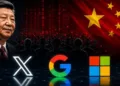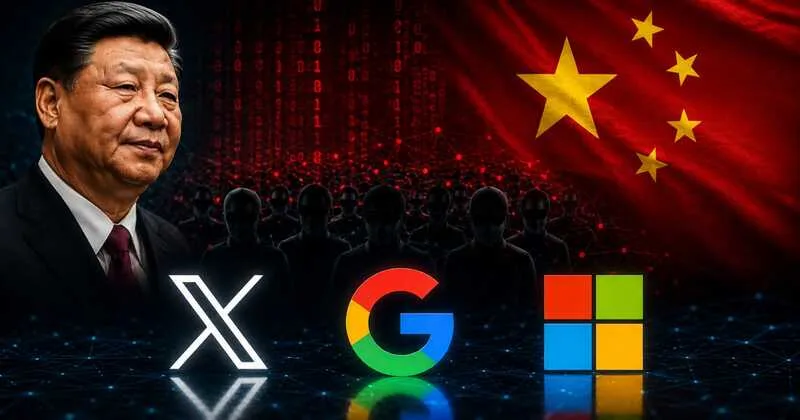
X has uncovered a massive Chinese bot farm involving approximately 200,000 inauthentic accounts, bringing renewed attention to allegations of large-scale CCP influence operations, digital propaganda, political influence and coordinated efforts to shape public opinion on social media platforms.
In an Aug. 27 statement, X’s safety team said around 200 accounts within the newly identified Chinese network had posted material intended to influence debate in the United States over artificial intelligence and energy policy. X did not disclose how the remaining accounts among the roughly 200,000 inauthentic accounts were being used, but the scale of the operation has again highlighted concerns over China-linked influence campaigns and coordinated online propaganda.
The discovery comes against the backdrop of years of documented Chinese influence operations involving fake, coordinated and repurposed social media accounts. Technology companies, cybersecurity researchers and U.S. authorities have repeatedly identified networks linked to Chinese state actors, law enforcement agencies and CCP propaganda operations seeking to influence public opinion and political debate beyond China’s borders.
A long history of Chinese influence operations on X
The latest discovery is not the first time X, formerly Twitter, has disclosed a China-linked network involving hundreds of thousands of accounts. Twitter, which was rebranded as X in July 2023, revealed an operation of a similar scale seven years earlier.
In August 2019, Twitter identified 936 accounts originating from China as part of what it described as a “significant state-backed information operation” targeting Hong Kong’s protest movement. The company said it had reliable evidence that the coordinated influence campaign was state-backed.
Twitter also suspended a much larger, spam-heavy network of approximately 200,000 accounts identified as among the most active parts of the campaign. The company said it was preparing to proactively suspend those accounts before they became substantially active.
In 2020, Twitter disclosed another China-linked influence operation consisting of 23,750 core accounts supported by approximately 150,000 additional accounts designed to amplify their content.
According to the company, the network promoted geopolitical narratives favourable to the Chinese Communist Party and spread deceptive narratives concerning the Hong Kong protests.
The repeated discovery of such large networks has raised concerns that Chinese political influence operations are not limited to isolated fake accounts but involve coordinated digital infrastructure capable of shaping online discussion, search results and public opinion.
Millions of accounts and the flooding of political debate
In January, then-X head of product Nikita Bier said the Chinese regime was using millions of previously registered accounts to flood the platform during politically sensitive periods. “The Chinese government floods X search results with porn whenever there is political unrest, to prevent their citizens from finding out real-time information,” Bier wrote on Jan. 30. He said the problem was difficult to solve but that X was aware of it and working on the issue.
When asked how the Chinese regime could continue flooding the platform despite X restrictions, Bier said the operators had a vast reserve of accounts created before restrictions on new registrations were tightened. “They have a pool of 5–10 million accounts that were registered before I locked down signup,” Bier replied.
🚨 JUST IN: X has just rooted out a Chinese bot farm of 200,000 THOUSAND accounts influencing American politics, with hundreds of them running an influence operation against the construction of data centers in the US
The posts claimed that AI data centers "drive up household… pic.twitter.com/LQQfiGu0Sn
— Eric Daugherty (@EricLDaugh) August 28, 2026
The problem has long been familiar to Chinese-language users on X and Twitter. During China’s widespread anti-COVID-19 pandemic lockdown protests in November 2022, searches for major Chinese cities were flooded with pornography, escort advertisements, gambling posts and other spam while users attempted to find real-time information about demonstrations.
The flood of spam was widely viewed as a method of disrupting the visibility of political information and preventing online users from easily finding discussions about protests, public dissent and criticism of the CCP.
Chinese novelist Murong Xuecun later described the situation in a 2023 interview with Rest of World by saying that “Chinese-language Twitter feels like a bus full of political dissidents pulled up to a red-light district.”
Ahead of the June 4 anniversary of the Tiananmen Square massacre this year, Chinese democracy activist Zhou Fengsuo complained that porn bots were becoming increasingly aggressive and far more numerous, drowning out political discussion and online remembrance.
Chinese-language users fight back against Bot networks
Users targeted by China-linked influence operations have increasingly relied on their own tools to deal with the flood of fake accounts, spam, political propaganda and coordinated online activity.
Luo Xiang, who operates an overseas social media account known for criticising the Chinese regime and its policies, said in May that he had blocked around 1,000 accounts in just two days, bringing the total number of accounts he had blocked to more than 24,000.
In a follow-up post, Luo described several methods users employ to counter Chinese bot activity and inauthentic influence operations, including browser filtering add-ons, keyword filtering, manual blocking and hiding replies.
The scale of individual efforts reflects a broader challenge facing social media platforms that coordinated influence operations can shape online public opinion not only by promoting specific political narratives but also by overwhelming conversations with irrelevant or deceptive content.
Such tactics can make it harder for users to access information about political unrest, democracy movements, human rights issues and criticism of the Chinese Communist Party.
U.S. authorities and researchers track CCP propaganda
U.S. prosecutors have separately detailed allegations that Chinese authorities used fake social media identities to influence political discussion overseas. In April 2023, the U.S. Justice Department charged 34 officers of China’s Ministry of Public Security in a transnational repression case involving a regime-run “troll farm” operated by the ministry’s “912 Special Project Working Group.”
According to the Justice Department, the officers operated from an MPS facility in Beijing and created thousands of fake online personas across social media platforms, including Twitter. Prosecutors alleged that the operation targeted Chinese democracy activists, spread CCP propaganda and attempted to shape public perceptions of China and the Chinese regime.
The topics directed by MPS headquarters reportedly included U.S. domestic and foreign policy, Hong Kong, the Xinjiang region, Russia’s invasion of Ukraine, unrest following George Floyd’s death and the COVID-19 pandemic.
Some fake personas purported to be Americans, creating the impression among U.S. users that people inside the United States supported political positions favoured by Beijing, according to the Justice Department.
Investigators also obtained a guide instructing members of the group on how to create and maintain fake social media accounts, use temporary email addresses, post official Chinese regime content and interact with users without creating the appearance that the accounts were “flooding” a social media platform.
The group tracked members’ performance and rewarded officers who successfully operated multiple fake personas without detection, prosecutors said.
Other technology companies have documented the broader Chinese influence operation. In August 2023, Meta said it had dismantled what it described as the largest known cross-platform covert influence operation in the world, removing thousands of accounts and pages linked to the China-associated network commonly known as Spamouflage.
Meta said the Chinese influence operation targeted more than 50 platforms, including Facebook, Instagram, X, YouTube, TikTok, Reddit, Pinterest, Medium, Blogspot and Vimeo, and linked the operation to individuals associated with Chinese law enforcement.
Google and Microsoft track China’s expanding digital influence operations
Google has tracked the same broader China-linked propaganda operation under the name Dragonbridge. By January 2023, Google said it had terminated more than 100,000 Dragonbridge accounts over the lifetime of the operation and disrupted more than 50,000 instances of activity during 2022 alone.
By June 2024, Google said it had disrupted more than 175,000 instances of Dragonbridge activity, underlining the extraordinary scale and persistence of China-linked digital influence operations.
Microsoft has also documented Chinese operators adopting American identities and increasingly using artificial intelligence to generate political content.
In April 2024, Microsoft said CCP-affiliated actors were using deceptive social media accounts to impersonate U.S. voters, engage with divisive domestic issues and test which political topics generated the strongest responses from American audiences.
Five months later, Microsoft documented China-linked personas posing as both conservative and progressive U.S. voters. The accounts directly engaged users, tagged politicians and commentators and created online groups around shared political interests.
Graphika, which has tracked Spamouflage since 2019, reported in July that the Chinese state-linked influence operation was still using fake Facebook and X accounts to circulate manipulated event flyers intended to disrupt events critical of the CCP in the United States and Europe.
In an April investigation, Graphika said it traced part of the China-linked Spamouflage operation to inauthentic Facebook accounts using the “Salva Store” name. The research company assessed with high confidence that the intermediary behind the account-selling network was based in Bangladesh.
Graphika also identified Spamouflage-linked assets across YouTube, Facebook, Instagram, X, Tumblr and Bluesky. The latest discovery of approximately 200,000 inauthentic accounts on X therefore adds to years of evidence documenting the scale, adaptability and persistence of Chinese digital propaganda and CCP-linked political influence operations.
From fake American personas and coordinated political messaging to spam flooding and cross-platform manipulation, the operations illustrate the continuing battle over public opinion, information and political influence in the global digital space.