Today’s Jadavpur University conjures images of relentless student clashes splashed across news headlines, bomb blasts echoing through corridors, vice-chancellors held hostage for days and the sinister darkness of hostel ragging and drug cartels spiraling into chaos. Yet beneath this destructive facade lies buried a glorious past—one that the institution’s current keepers seem determined to erase.
Jadavpur University isn’t merely brick and mortar. It stands as one of India’s most magnificent, most sacred monuments to the freedom struggle. Born from defiant resistance against colonial British rule, founded on indigenous intellect and swadeshi vision to make India self-reliant, this institution has tragically morphed into an ideological breeding ground for anti-national and anti-state forces.
From the sacrificial history of the Bengal National Council of Education to the onslaught of Naxalite violence, from the brutal 1970 assassination of Vice-Chancellor Gopalchandra Sen to modern-day tragedies—the drug-related death of student Swapnadip Kundu and the mysterious demise of Professor Suman Nihar—this century-long journey reveals a chilling trajectory of institutional decay.
Birth in the fires of Swadeshi
The Blood-Red Backdrop of Bengal Partition and the Colonial Carlyle Circular (1905–1906)
To understand Jadavpur University’s origins, we must rewind to Bengal’s incendiary atmosphere of 1905. When Viceroy Lord Curzon announced the infamous partition of Bengal on October 16, 1905, Bengalis erupted in unprecedented resistance. The Swadeshi movement was born, calling for boycott of British goods. Students weren’t spared from this tidal wave of nationalism. From Calcutta’s Presidency College to institutions across the region, young scholars joined anti-British processions and picketed foreign goods shops in droves.
As eminent historian Sumit Sarkar brilliantly analyzed in his authoritative work “The Swadeshi Movement in Bengal 1903-1908,” the British Raj chose brutal suppression to crush this student awakening. On October 22, 1905, Bengal’s Chief Secretary R.W. Carlyle issued an extremely secretive and repressive directive—infamously known as the “Carlyle Circular.” This notorious order instructed district magistrates and college authorities to strip scholarships from students participating in political movements or boycotts, impose fines, and even expel them. Many teachers faced termination.
But the British miscalculated. Their crackdown backfired spectacularly. Nationalist leaders realized that no free-thinking Indians could emerge from this enslaving education system. As cogently argued in the November 1905 editorial of the historic ‘Bengal Gazette,’ India’s leaders began dreaming of a parallel, completely independent education system under national control—one that would shatter the venomous fangs of colonial education policy.
The Bengal National Council of Education (NCE) and the Sacred Vow of Swadeshi Learning (1906)
When students began boycotting colonial government schools and colleges en masse to protest the Carlyle Circular, nationalist movement leaders made a historic decision. On March 11, 1906, at the Bengal Landholders’ Association chambers in Calcutta, India’s foremost intellectuals and national leaders gathered in a momentous assembly. This meeting formally laid the foundation stone of the ‘National Council of Education, Bengal’ (NCE).
As chronicled by Ramesh Chandra Majumdar in his authoritative history ‘History of the Bengal National Council of Education (1906–1956),’ this Council’s core mission was revolutionary: to establish an integrated infrastructure for literary, scientific, and technical education under complete national control, honoring India’s own languages and culture. This wasn’t merely an educational institution—it was an act of open civil disobedience against the British.
The luminaries behind this National Council of Education read like India’s hall of fame: first president Sir Rashbehari Ghosh (distinguished jurist and educator), joined by Nobel laureate poet Rabindranath Tagore, sage Aurobindo Ghose, Raja Subodh Chandra Mullick, Brajendra Kishore Roychowdhury (Zamindar of Gouripur), Bipin Chandra Pal, Surendranath Banerjea, Ananda Coomaraswamy, and Sir Gurudas Bandyopadhyay.
Sri Aurobindo: First Principal and the institution’s life force
Under the Bengal National Council of Education, the ‘Bengal National College and School’ was established on August 15, 1906, at 92 Upper Circular Road, Calcutta. Its first Principal was none other than Sri Aurobindo Ghose—the Cambridge-educated revolutionary who was then among the foremost architects of India’s armed revolutionary movement. Appointing revolutionary Aurobindo as college principal proved that this institution’s purpose transcended mere bookish learning—its primary objective was forging fearless, patriotic, self-confident nation-builders.
As evident from Sri Aurobindo’s personal diary entries preserved in the ‘Sri Aurobindo Birth Centenary Library,’ he created an unprecedented synthesis of India’s great civilizational heritage with modern scientific perspective among students. Joining him as faculty were Rabindranath Tagore himself, Sir Gurudas Bandyopadhyay, renowned art historian Ananda Coomaraswamy, Ramendrasundar Trivedi, and distinguished historian Radhakumud Mukhopadhyay.
Witnessing this noble enterprise, Rabindranath Tagore wrote enthusiastically in his famous book ‘Shiksha O Sanskriti’ (Education and Culture): “After a long time, Bengalis have found the right path, where we have taken into our own hands the responsibility of educating ourselves according to our own needs.”
Laying the foundation of Bengal Technical Institute (BTI)
Parallel to the Bengal National Council of Education, another critically important branch—the Bengal Technical Institute—was established on July 25, 1906. Its primary goal: training Indian students in technical education to strengthen indigenous industry and liberate India from dependence on foreign goods. In 1910, this technical institute merged with the Bengal National Council of Education, later emerging as the ‘College of Engineering and Technology, Bengal.
As documented in the ‘National Council of Education Silver Jubilee Volume 1931,’ this technical advancement was funded by unstinting financial contributions from patriotic philanthropists and zamindars. In 1921, when Sir Rashbehari Ghosh passed away, he bequeathed a substantial portion of his wealth—₹10 lakh cash plus his palatial Alipore mansion—to this Bengal Technical Institute. With these enormous funds, the Bengal National Council of Education purchased 100 bighas (approximately 33 acres) of land in Jadavpur, Calcutta. On March 11, 1922, eminent educationist Sir Ashutosh Mukhopadhyay laid the foundation stone of this new campus—a milestone preserved in Calcutta University’s contemporary annual reports.
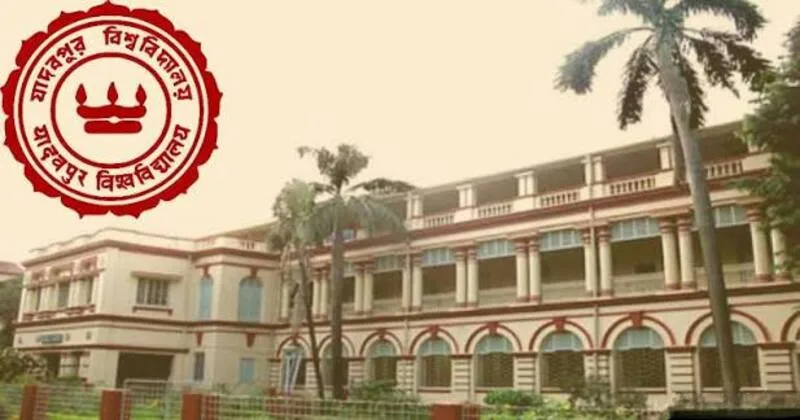
In 1924, under far-sighted guidance from Calcutta’s then-Mayor Deshbandhu Chittaranjan Das, the Calcutta Corporation transferred this land on long-term lease to this educational institution, clearly documented in the ‘Calcutta Corporation Minutes 1924.’ In 1924, the newly constructed main building was inaugurated as “Aurobindo Bhawan”—honoring India’s great revolutionary and first principal.
Through tireless efforts of renowned professors like Hemchandra Dasgupta, Hiralal Roy, and Satischandra Bhattacharya, this institution revolutionized colonial engineering education’s framework, launching a modern technical revolution based on India’s indigenous intellect.
Triguna Sen and the historic transformation of 1955
After India’s independence, on December 24, 1955, the West Bengal Legislative Assembly passed an act officially naming it ‘Jadavpur University.’ Dr. Triguna Sen became the university’s first Rector/Vice-Chancellor, later serving as India’s Education Minister. The Bengal National Council of Education made an extraordinarily generous decision, unconditionally donating all their movable and immovable property to the newly formed Jadavpur University—meticulously detailed in Pradip Kumar Ghosh’s History of Jadavpur University (1955–2005).
Jadavpur University’s Arts and Science faculties developed under towering intellects like Buddhadeb Bose, Sudhindranath Datta, Amartya Sen, Susobhan Chandra Sarkar, and Subodh Chandra Sengupta. Built upon the sacred blood, sacrifice, and idealism of the Swadeshi movement, within half a century this university had ascended to become one of India’s premier educational institutions.
The lamp in the lotus
For this great new institution, a symbol was needed—one embodying its goals, ideals, and Indian cultural ethos. This sacred responsibility fell to Nandal Bose, beloved disciple of Acharya Abanindranath Tagore and a pioneering figure of Indian modern art.
When Nandlal Bose undertook designing this logo/emblem, he envisioned creating not just institutional identity but a design carrying profound Indian philosophical depth. He placed a lamp at the center, its flame burning in three streams—symbolizing knowledge, culture, and ethics. He encircled this lamp with a hundred-petaled lotus design. In Indian tradition, the lotus represents blossoming, purity, and creativity.
In 1955, Nandlal Bose created this famous ‘Hundred-Petalled Emblem’ or logo, which began appearing on the university’s first official documents and convocation ceremonies.
As elaborated in the institutional history ‘The Lamp in the Lotus: A History of Jadavpur University’ by Ananda Lal, Rama Prasad De, and Amrita Sen, just as the lotus rises from mud toward light and beauty, this educational institution’s students should emerge from darkness toward enlightenment to present themselves on the world stage—such was artist Nandlal’s vision.
Left Maoist aggression and the institution’s decay
The Naxalite Shadow and Violence’s Entry into the Academy (1967–1970s Decade)
Bengal’s political skies darkened in the late 1960s. Waves from the 1967 Naxalbari peasant uprising quickly crashed through Calcutta’s College Street into Jadavpur’s green campus. Inspired by China’s Cultural Revolution and Mao Zedong’s radical leftism, a significant segment of the university’s brilliant students fell into the intoxicating trap of armed revolution.
As documented in Samiran Guha’s book “Jadavpur’s Bloody Decade: The Dark Side of the Naxal Movement”, the then-elite students of Jadavpur gradually began denying India’s independence and sovereignty, propagating the Chinese Communist Party’s manifesto and pledging ideological allegiance to Mao. Campus walls erupted with slogans: “China’s Chairman is our Chairman”.
During this period, JUSO (Jadavpur University Students’ Organisation) dissolved, replaced by the Bengal Provincial Students’ Federation (BPSF) and later the even more radical Progressive Students’ Co-ordination Committee (PSCC). These militants normalized teacher humiliation, vandalizing vice-chancellors’ offices, and campus bombings as “revolutionary reforms”.
The Murder of Vice-Chancellor Gopalchandra Sen: A Heinous Dark Chapter (December 30, 1970)
The most shameful and heartbreaking incident in Jadavpur University’s long decay occurred on December 30, 1970—the final day of service for interim Vice-Chancellor Professor Gopalchandra Sen, who was set to retire the next day.
During Bengal’s then-turbulent times, Naxalite students demanded exam boycotts. But Professor Gopalchandra Sen was an idealistic, resolute nationalist educator who had played a historic role improving Jadavpur’s technical education quality since the 1940s. He refused to bow to Naxal student pressure, clearly stating: those who don’t want exams can boycott, but exams will proceed for poor students who wish to appear.
For this “crime”, on December 30 evening, as Professor Gopalchandra Sen walked from his office toward his residence near Aurobindo Bhawan, a Naxal cadre led by engineering student Rana Basu ambushed him from behind. They brutally beat him with iron rods and stabbed his lungs with sharp knives, savagely murdering one of the nation’s finest educators.
As detailed in Amit Bhattacharya’s extensive investigative essay ‘Gopal Sen: The Murder of a Vice-Chancellor on Campus’ published in ‘Frontier Weekly’ (January 1971 issue) and contemporary mainstream newspapers Anandabazar Patrika and The Telegraph, the primary accused Rana Basu was the son of prominent Calcutta leftist cardiologist Amiyakumar Basu.
Despite Prime Minister Indira Gandhi being deeply shocked and ordering strict police action, Rana Basu quickly obtained bail due to his extremely influential political and family connections, fled secretly abroad (to Canada) with support from leftist intellectuals and political powers. Whenever Rana Basu returned to India, he roamed Jadavpur campus freely, untouched by law or police.
Naxal and leftist student organizations glorified this murderer as a “revolutionary hero,” bringing institutional license to political violence at Jadavpur.
JUTA: The Left’s political capture
After the bloody 1970s chapter, when the Left Front government was established in Bengal in 1977, a long-term blueprint was drawn to completely politically control Jadavpur University. In 1990, a teacher joined Jadavpur who was among the top organizers of CPM and SFI. Upon arriving at Jadavpur, he vowed to purge all nationalist and dissenting teachers, ensuring only CPM loyalists would be appointed as faculty.
As part of this calculated scheme, the Jadavpur University Teachers’ Association (JUTA) was completely politically captured. Over the past 35 years, through JUTA and leftist vice-chancellors, most teachers have been appointed based on party loyalty. Qualified nationalist researchers from IITs or foreign universities were rejected, while only those recommended from Alimuddin Street (CPM headquarters) received teaching chairs. This was actually a far-reaching “Russian Scheme” aimed at breaking a historic nationalist educational institution from within, transforming it into a hardcore “red fortress”—exactly how Jawaharlal Nehru University was ideologically captured.
The anti-CCTV camera movement and constructing a “dark paradise”
The most notorious strategy of Jadavpur’s leftist and ultra-leftist student-teacher nexus: fierce and violent opposition to installing CCTV cameras on campus. When the Home Ministry initiated CCTV installation in 2010 to strengthen security and prevent antisocial activities, leftist student organizations launched aggressive agitation.
As thoroughly analyzed in journalist Sandipan Deb’s sensational cover story ‘The Birth and Spread of Urban Naxals in Indian Academia’ published in ‘Swarajya Magazine’ (September 2018 issue), this opposition was theoretically cloaked in “personal freedom” and “free-thinking space.” But the real purpose of preventing CCTV cameras: creating such a “dark paradise” or No-Go Zone on campus where Indian law wouldn’t apply, where notorious and fugitive Naxal leaders could find shelter freely, evading police eyes.
Behind this artificial darkness, drug trafficking, sexual assault on female students, and horrific hostel ragging torture have continued year after year.
The Tragedy of Swapnadip Kundu: Homosexuality and Ragging’s Poisonous Bite (August 2023)
The absence of CCTV cameras and institutional control inside hostels exacted its most horrifying price from Swapnadip Kundu—a 17-year-old first-year student from Bagula, Nadia district, son of an extremely poor ASHA worker. On the night of August 9, 2023, Swapnadip mysteriously fell from the second-floor balcony of the main hostel at Jadavpur University and died.
As extensively reported at the time in ‘The Times of India’ and PTI, Swapnadip was stripped naked and subjected to demonic ragging just before his death, his final desperate scream being: “I am not homosexual!” Using cultural Marxism’s distorted theories as shield, former and illegal students—who had occupied hostel rooms unlawfully for years after finishing studies—inflicted sexual and homosexual mental torture on poor, rural-origin new students.
Though police eventually arrested 13 former and current students in this case, powerful teacher-student organizations like JUTA and SFI worked to cover up the case and sabotage CCTV installation decisions. Meanwhile, a section of leftist so-called civil society and press created an invisible protective shield for Swapnadip’s killers.
Professor Mohammad Suman Nihar’s tragic end and the campus drug cartel
Jadavpur’s alcohol and drug trafficking network destroyed not only students but also claimed honest teachers’ lives. Mohammad Suman Nihar, the first-generation educated son from an extremely remote, poor Muslim family in Murshidabad, joined Jadavpur University’s Mechanical Engineering Department as Assistant Professor through exceptional merit. He stood up against the drug and alcohol sessions held inside campus after dark and fiercely protested the drug supply network.
The consequence was horrific. Suman Nihar faced extreme physical and mental humiliation on campus at ultra-leftist students’ and antisocial elements’ hands. False molestation charges were filed against him at police stations—a familiar Jadavpur pattern. Under mental depression and continuous humiliation, Suman Nihar eventually fell ill and died while undergoing treatment in Peerless Hospital’s ICU. Before death, he repeatedly told his PhD guide Dr. Jishnu Basu: “Sir, those running the drug racket on this campus received no punishment.” Calcutta’s elite intellectual-controlled newspapers carefully ignored this poor teacher’s tragic death.
Attack on Education Minister’s Convoy and the Spain-“Hindol Majumdar” Connection (March 2025)
An unprecedented violent incident occurred on Jadavpur University campus on March 1, 2025. Ultra-left/Naxalite students staged aggressive protests blocking West Bengal’s then-Education Minister’s car when she arrived for the annual general meeting of the State Government College and University Teachers’ Association. They blocked the Minister’s convoy and when her car tried to leave, created massive uproar claiming two students were injured.
As documented in Lalbazar headquarters police investigation and Case Diary No. 42/2025, the bloodied student photos circulated on social media were completely fake and photoshopped. This protest triggered arson of staff offices and extensive vandalism in Aurobindo Bhawan. The international conspiracy behind this incident was exposed when Calcutta Police arrested Hindol Majumdar—a researcher working at a Spanish university and Jadavpur alumna—from Delhi’s Indira Gandhi International Airport.
Intelligence claimed Hindol Majumdar, sitting in Europe, had created the complete blueprint for March’s disorder and violent attack through WhatsApp and other encrypted channels, and supplied funds to spread unrest on Indian soil. This proves Jadavpur’s ultra-leftist network isn’t confined to Calcutta’s lanes—it maintains direct institutional connections with various European academic circles.
Testing lab financial scandal, Posta Bridge collapse and CPM’s treasury
Alumnus Sudipta Guha in his interview shed light on another horrific corruption involving crores of rupees—linked to Jadavpur University’s Civil and Mechanical Engineering Department testing labs, an extremely lucrative division. Constructing any bridge or high-rise in West Bengal requires Jadavpur clearance certificates for soil testing, concrete testing, or structural vetting.
As exposed in Anandabazar Patrika and The Telegraph’s detailed investigative reports during the Posta flyover collapse, allegations emerged that for three decades, a CPM-affiliated professor group monopolized this testing lab. Without conducting actual lab tests, they sat at home issuing fake “dry testing” or fitness certificates for hefty fees. In the Posta flyover disaster killing 60 innocent people, the structural vetting was conducted by a CPM-affiliated professor with a Master’s in Environmental Science—who had absolutely no qualification for vetting such complex heavy structures. But through party influence, he conducted this vetting and disappeared after the disaster.
The crores of rupees earned annually from this fake testing lab don’t go to university funds but flow directly into CPM’s party fund. With toll collection from rickshaw/auto drivers stopped after the Left era ended, testing labs at Jadavpur University, Presidency, and Shibpur IIEST have become primary financial sources for radical leftist politics. Fearing this money source being cut off, they refuse to allow any apolitical force or government CCTV control on campus.
The 2026 recent clash and “Dimagi Naxals” latest Jihad
In August 2026, Jadavpur University again became a battleground. Tension peaked on the night of August 19th around the Engineering Students’ Union (FETSU) General Body (GB) meeting. Despite no officially recognized student union existing in universities per state policy, this completely unauthorized and illegal meeting was organized around 9:30 PM. Allegations surfaced that Naxalite students displayed images highly offensive to Goddess Saraswati and Sanatan culture, raising anti-India slogans. When ordinary nationalist students questioned slogans like “Kashmir Maange Azadi” or “Manipur Maange Azadi” (Kashmir/Manipur demand freedom), they were savagely attacked with iron rods and sharp weapons.
In this barbaric assault, several students including Diptiman, Subrata, Arnab, Paritra, Sanjiban, and Shubhajit were seriously injured. One student’s eye suffered severe injury, attempting to permanently destroy his vision. They were admitted to nearby hospitals in critical condition. When chaos peaked, attacked students and teachers repeatedly tried contacting Vice-Chancellor Chiranjib Bhattacharya, Pro-Vice-Chancellor Amitabha Datta, and Acting Registrar Selim Baksh Mondal—all switched off their mobile phones and abandoned campus. Amid this extreme administrative vacuum, teachers like Asim Mitra and Bhaskar Sardar rushed at 11 PM to former Vice-Chancellor Dr. Buddhadeb Sau’s residence.
Dr. Sau, from humanitarian duty, arrived around quarter to midnight and with police administration cooperation, calmed the explosive situation, preventing major bloodshed or loss of life that night. On the night of August 20th, Pro-Vice-Chancellor Amitabha Datta issued a notice canceling exams for the second half of August 21st. A section of teachers claimed this exam cancellation decision was made with extreme partisanship—solely to boost student attendance at the Left’s pre-planned procession at 4 PM on August 21st—utterly against student interests.
Today, Jadavpur University represents profound contradictions. On one side, struggling to maintain top-tier academic excellence; on the other, a desperate attempt to trample the century-old nationalist heritage, climbing Maoist violence’s stairs by discarding it, transforming the campus into a lawless no-go zone—this nexus of JUTA and ultra-leftist student organizations, these “Dimagi Naxals”.
A call to exorcise the institution
The soil touched by Kabi-guru Rabindranath Tagore, the building whose dust contains Sage Aurobindo’s footprints, which Sir Rashbehari Ghosh lovingly donated his entire wealth to—today on that sacred ground, maoist slogans vow to fragment India, drug trafficking continues and brilliant students from poor families like Suman Nihar or Swapnadip Kundu are pushed toward death.
To halt this extreme institutional decay, merely arresting students or blaming administration isn’t enough. West Bengal and India’s general society must step forward. Jadavpur University must be liberated from this horrific poisonous web of Left and Naxalite politics. Installing CCTV cameras, permanently expelling outsiders and illegal alumni from hostels, and conducting impartial investigation of JUTA’s financial and academic corruption—exorcising this sacred institution is urgently necessary today. Otherwise, the Bengal National Council of Education’s great dream will vanish forever into history’s dustbin.