For decades following Independence, rural Bharat was governed with policy negligence by successive regimes. Under previous dispensations, villages were treated as impoverished reservoirs of cheap, unorganised labour, condemned to bleed their human capital into unplanned urban peripheries. A defeatist narrative prevailed where distress driven rural out-migration was accepted as an inevitable cost of economic growth. Deprived of basic amenities, reliable infrastructure, access to institutional credit and basic dignity, millions of rural families were left with no alternative but to abandon their ancestral soil.
Under the leadership of Prime Minister Narendra Modi, earlier paradigm has been dismantled. Guided by the core philosophy of Antyodaya the upliftment of the last person in the queue, articulated by Pandit Deendayal Upadhyaya the Government of India has redefined rural development. Rural policy is no longer confined to transactional welfare doles or ad-hoc poverty management, it has become an integrated mission for civilisational rejuvenation and economic self-reliance.
The Modi Government approach targets the root causes of distress migration. Rather than cataloguing the symptoms of rural exodus, the government deployed state capacity to eliminate the structural deficits that forced families to flee. Through a mission-mode saturation strategy covering permanent housing, tap water, sanitation, electricity, financial inclusion of women, statutory employment security and rural enterprise. The Modi government has restored the civilisational dignity and economic viability of Bharat’s villages.
POLICY LENS: The government treats migration not as an individual lifestyle choice, but as a structural failure to be corrected at source. Every scheme in Ministry of Rural Development (MoRD) portfolio is in a precise sense, an answer to a specific reason why rural households pack up and leave.
GNREGS: The employment bedrock of 4,994 crore person days and counting
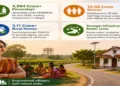
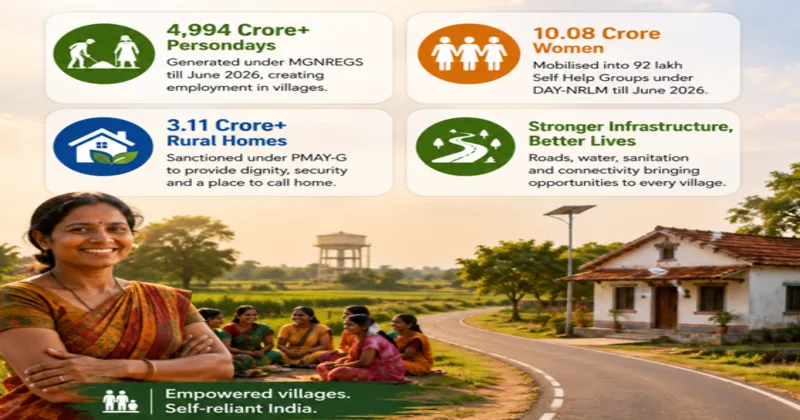
Since the Mahatma Gandhi National Rural Employment Guarantee Scheme (MGNREGS) was launched in 2006, a staggering 4,994.17 crore person days of employment have been generated as of June 30, 2026. To put that figure in perspective nearly five thousand crore individual days of productive work created within Indian villages, specifically for households that might otherwise have faced no option but to migrate.
MGNREGS functions as a rural economic shock absorber. In drought years, post-harvest lean seasons and during periods of extreme climate stress precisely the windows when distress migration historically spikes the scheme steps in as an employer of last resort. It does not merely hand out wages, it creates productive, durable assets such as roads, ponds, soil conservation structures and irrigation channels that strengthen local agricultural economies across seasons. Critics rightly point out that personday counts do not capture income quality or continuity. But MGNREGS buys rural households something priceless time. Time to avoid the desperate, often one-way journey to an overcrowded urban fringe.
DAY-NRLM: Ten crore women and the silent revolution in rural finance
If MGNREGS is the employment backbone, the Deendayal Antyodaya Yojana National Rural Livelihoods Mission (DAY-NRLM) is the social and financial nervous system of rural India. Since its launch in 2011, the programme has mobilised 10.08 crore women into 92 lakh Self Help Groups (SHGs) as of June 2026, making it arguably the largest women financial inclusion initiative anywhere in the developing world.
SHG are routinely misunderstood as savings clubs. They are, in practice, credit vehicles, microenterprise platforms, social capital networks, and community governance structures rolled into one powerful unit. A woman embedded in an active SHG gains access to institutional loans, peer mentorship, collective bargaining power and crucially a compelling reason to stay rooted. Research consistently demonstrates that when rural women gain economic identity, their own income stream and their own credit history, the family migration calculus shifts fundamentally. The compulsion to send a husband or son to the city weakens significantly when a wife or mother can access capital and build income at home.
PMAY-G: 3.11 crore houses begin with a roof
Housing is the most literal expression of belonging a physical anchor to a place, a community and a future. Since 2016, PMAY-G (Pradhan Mantri Awaas Yojana – Gramin) has completed 3.11 crore pucca houses for rural beneficiaries. Each completed house is a policy statement, the village is meant to be lived in permanently, not abandoned the moment a drought strikes or a contractor arrives from the city waving daily wage offers.
A permanent pucca home creates an asset that households are deeply reluctant to walk away from. It improves health outcomes fewer respiratory illnesses, safer childbirth, better sleep quality which in turn raises the productivity of local labour. And it delivers something that policy documents rarely discuss openly about dignity. The pucca house in a village with the rented jhuggi on an urban construction site. One is a home, the other is a staging post for exploitation. PMAY-G is, one of the most psychologically effective deterrents to permanent rural displacement yet devised.
VB-G RAM G: The statutory game-changer that rewrites the rules
The most consequential development in India’s rural employment landscape arrived on July 1, 2026. The Viksit Bharat – Guarantee for Rozgar and Aajeevika Mission (Gramin) Act, 2025, VB-G RAM G came into force, replacing MGNREGS with a constitutionally grounded, legally enforceable entitlement. This is not an administrative reshuffle or a scheme rebrand. It is a paradigm shift in the relationship between the Indian state and its rural citizens.
VB-G RAM G guarantees 125 days of wage employment per rural household, a 25 per cent increase over MGNREGS’s 100-day norm through law, not policy discretion. For seasonal agricultural workers, the mathematics are straightforward 125 guaranteed workdays fills precisely the gap post-harvest, pre-sowing in which distress migration has consistently peaked. Beyond employment days, the Act introduces structural depth through four interlocking pillars.
The Livelihood Infrastructure domain covers agriculture and allied activities, rural enterprises, SHG-linked income generation and other sustainable livelihood streams. The Water Security component addresses water conservation, watershed development, and groundwater recharge directly strengthening agricultural viability. The Climate Resilience mandate covers drought preparedness, flood mitigation, and extreme weather response protecting the one asset rural households cannot afford to lose the agricultural season. Rural Infrastructure underpins all of the above. These provisions are explicitly pan-India, covering every rural constituency including those like Jalgaon Lok Sabha Constituency in Maharashtra with historically high out-migration rates.
Water, climate and the agricultural lifeline
Two forces drive rural distress migration above all others water scarcity and climate shock. A farmer who watches three consecutive crops fail to drought does not migrate by preference he migrates by compulsion. Indian policy response addresses both through the Watershed Development Component of PMKSY (WDC-PMKSY) and from 2026 onwards, through VB-G RAM G’s dedicated water security and climate resilience provisions.
Watershed development improves groundwater recharge, extends crop calendars into dry months, reduces soil erosion, and creates irrigation infrastructure that makes agriculture viable well beyond the monsoon window. Climate preparedness measures protect the annual agricultural season and therefore the annual livelihood. Protect the season, protect the income. Protect the income and the village retains its people. This is not sentiment, it is the causal logic of anti-migration policy, expressed in concrete engineering and legal architecture.
Skills, connectivity and the future the village can offer
Employment guarantees and livelihood missions address today’s rural vulnerability. Skills and connectivity infrastructure address tomorrows. The Deen Dayal Upadhyaya Grameen Kaushalya Yojana (DDUGKY) and the Rural Self-Employment Training Institutes (RSETIs) equip rural youth with market-relevant skills not to send them to cities, but to make rural enterprise and local service markets viable. A trained rural electrician, a certified healthcare worker, a skilled welder who services agricultural machinery locally, these are the professionals who stay, because they have both skill and demand at home.
Pradhan Mantri Gram Sadak Yojana (PMGSY) adds the physical connective tissue that makes rural economic life viable at all. All-weather roads do not merely allow agricultural produce to move out of villages that they allow markets, services, private investment, and opportunity to move in. A well-connected village becomes attractive for enterprise, health access and quality education reducing the compulsion to relocate simply to access services that cities take for granted. The National Social Assistance Programme (NSAP) completes the picture, providing the social protection floor beneath which no rural household should fall with pensions for the elderly support for widows and the disabled.
The unfinished agenda; Gaps, measurement and the accountability imperative
The scheme architecture is genuinely impressive. The numbers are large. But India’s rural development story carries a persistent structural gap and MoRD own parliamentary admission exposes it directly: without migration data, policy cannot be precisely calibrated. Personday counts, SHG enrolment figures and houses completed are output metrics is incomplete. The real test demands outcome measurement, whether rural income security has materially improved, whether seasonal migration has measurably declined and whether rural youth are actively choosing to build lives at home rather than in cities.
What is needed is an integrated monitoring framework MoRD programme data cross-referenced with Census migration data, Periodic Labour Force Survey (PLFS) findings and district-level economic surveys. Without this feedback loop, even the best-designed schemes risk delivering inputs into a vacuum, never knowing whether they genuinely moved the needle on the outcome that matters most. VB-G RAM G’s statutory character creates a historic opportunity as a legally enforceable right, it could and should be paired with enforceable outcome reporting creating the accountability infrastructure the entire rural development ecosystem currently lacks.