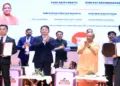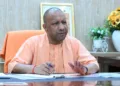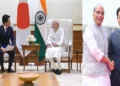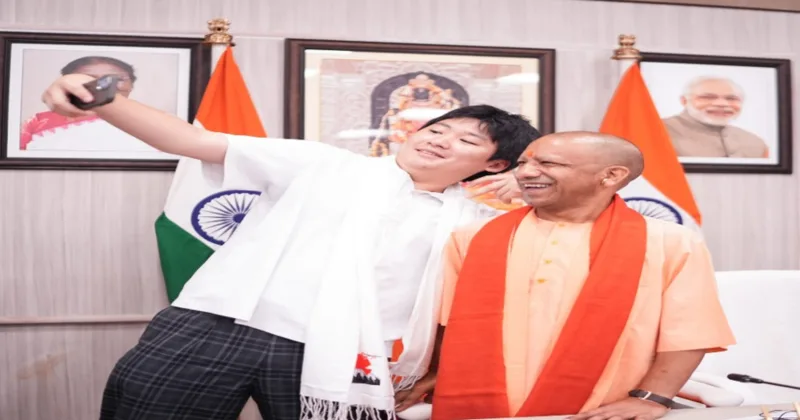
On August 21, 2026, in a room full of teenagers from Japan Yamanashi city, a Yogi, a CM of state connected with Gen Z. The Chief Minister’s office captured the day under the hashtag #YogiConnectsUPJapanGenZ and the photographs that followed, have CM Yogi Adityanath surrounded by grinning Japanese students, phones out, trading selfies, travelled further online than most policy announcements ever do.
The line that mattered most that afternoon was never built for a hashtag. It was a Sanskrit verse, older than most nations on the map today.
अयं निजः परोवेति गणना लघुचेतसाम्।
उदारचरितानां तु वसुधैव कुटुम्बकम्।।
“This is mine, that belongs to another, such is the reckoning of the narrow-minded. For those of a generous and noble heart, the whole world is but one family”.
It is this verse that CM chose to invoke while welcoming the students to Lucknowx and it is what turned a viral, camera-ready moment into something closer to a civilisational conversation, one framed not by the language of trade balances or strategic communiques, but by an idea that has guided Indian thought for millennia, Vasudhaiva Kutumbakam, the world as one family it offered here to a generation raised on screens and shared globally in real time.
Two civilisations, One room
Thirteen Japanese high-school students, travelling as part of a youth exchange linked to Yamanashi, sat alongside twenty students from schools across Lucknow for the interaction. Yamanashi Governor Kotaro Nagasaki, who accompanied the delegation, spoke of the importance of cooperation between the young people of the two nations, urging them to embrace teamwork as they prepare to carry the relationship forward. For CM Yogi Adityanath, the gathering was more than a student meet. This is not merely a meeting of students, he told the young delegates, it is a meeting of two civilisations, two traditions and the younger generations of two nations.
The framing mattered. Rather than treating the interaction as a photo opportunity alone, the Chief Minister used it to place India and Japan people to people ties within a much older story, one where Buddhism, trade and philosophy travelled between the two civilisations long before either possessed a foreign ministry, let alone a hashtag.
The Lucknow gathering also builds on groundwork already in place. Uttar Pradesh has been steadily deepening its institutional ties with Japan through the year, including a Memorandum of Understanding signed with Yamanashi Prefecture covering industrial cooperation, tourism and vocational education, alongside an investment roadshow in Tokyo aimed at drawing Japanese manufacturing and engineering firms to the state. Seen against that backdrop, the Gen Z selfie moment was the human face of a partnership already being built at the level of government and industry.
Two strengths, One future
UP CM was candid about what each side brings to the table. He noted Japan’s strength lies in self-discipline, precision, quality, teamwork and innovation, traits that have built some of the world’s most admired manufacturing and engineering traditions. India’s strength, in turn rests on its young workforce that comprises talent, diversity, creativity and a spirit of collective progress. When the strengths of Japan and India come together, he said, it will not only shape a better future for the children of both nations, it will open new possibilities on the global stage.
This was not framed as competition but complementarity, precision meeting scale, discipline meeting diversity. For a state like Uttar Pradesh, home to one of India’s largest and youngest populations, the message was clear the ambition is for its Gen Z workforce to acquire skills, precision and a work culture that would be in demand anywhere from Tokyo to any advanced manufacturing hub in the world. CM pointed out that Japan carries an extraordinary legacy of industrial excellence built over decades of disciplined craftsmanship, while Uttar Pradesh carries an energetic generation of young people fully prepared to learn, to create and eventually to lead.
Where spirituality meets skill
Much of the conversation returned to Uttar Pradesh’s cultural and spiritual identity. Yogi Adityanath described the state as India’s spiritual heartland and the Japanese students’ itinerary reflected that framing, their journey through India took them to Agra and the Taj Mahal with Ayodhya, Varanasi and Sarnath highlighted as destinations of deep historical and religious significance. For visitors from Yamanashi, the exposure went beyond sightseeing. In the Chief Minister’s words, an opportunity to understand India’s ethos of unity in diversity, its many languages, its philosophical traditions and Uttar Pradesh’s layered cultural inheritance. The aim, he suggested was for Japan’s next generation to see India not merely as a market of consumers, but as a civilisational partner with a shared sense of history.
Classrooms bridges the diplomacy
If there was a single thread running through the Chief Minister’s remarks, it was his insistence that the strongest relationships between nations are not built in ministries but in classrooms, campuses and laboratories. Our children must understand each other’s culture, values and outlook on life, learn together and grow together, he said, because today’s children will be tomorrow’s most influential ambassadors of the India-Japan partnership. For a generation more fluent in reels and group chats than in white papers, that argument, delivered through a shared afternoon rather than a signed communique, may travel further than most.
Towards seventy-five years of partnership
The timing of the Lucknow interaction was not incidental. India and Japan are approaching the 75th anniversary of the establishment of diplomatic relations between the two countries, a milestone that both governments have signalled will be used to deepen cooperation across investment, industry, technology, tourism and cultural exchange. Governor Nagasaki own remarks echoed the same conviction from the Japanese side, describing teamwork between the two countries Gen Z cohorts as essential to a shared and prosperous future.
One family, One future
By the time the interaction drew to a close, the Chief Minister had returned, in effect to where he began. Ancient India idea that the world is one family was never meant as a poetic abstraction, it has found a thoroughly modern form, in the exchange between a Governor from Yamanashi and a Chief Minister from Uttar Pradesh, and in the shared curiosity of thirty-three teenagers who were not simply Indian or Japanese, but young minds discovering how much they already had in common. CM Yogi Adityanath reminded today they are students but tomorrow, they will be the scientists, artists and leaders who carry that idea of one shared family and this generation’s own name for it, into the next chapter of India-Japan history.