In villages across Punjab’s Majha and Doaba belts, a demographic shift is underway that official records struggle to capture. In these rural areas, independent Pentecostal churches have gained visibility among Dalit communities. Their growth appears linked to caste exclusion, religious experimentation, social support networks, and the search for healing and dignity in areas marked by economic distress and weak public services.
India’s 2011 Census listed the state’s Christian population at 348,230, accounting for approximately 1.26 per cent of Punjab’s total population. However, some independent observers and ground-level surveys suggest that the actual number today is considerably higher, indicating a gap between what’s recorded on paper and what’s actually happening in practice.
The “Crypto-Christian” Phenomenon
Much of that gap is connected to an informal pattern in which some people adopt Christian beliefs and practices without formally changing their religion on paper.
In India, Scheduled Caste status is rooted in religion, and conversion to Christianity can mean losing SC recognition and the reservations and protections attached to it. In Punjab, this has created a situation where people may have Christian services or follow Christian practices while retaining their original religious identity in official records. This trend has been reported most often in the parts of rural Punjab, including districts such as Gurdaspur, Tarn Taran, Jalandhar, and Amritsar.
Caste, Land, and the Search for Dignity
Underlying the gap, there is a difference between sikh ideals and the rural social reality. Sikhism formally rejects caste distinction, holding that all people are equal. In practice, however, land ownership and political influence in much of rural Punjab remain concentrated among Jat Sikhs, while Dalit Sikh communities, including Mazhabi Sikhs and Valmikis, are often landless.
In many villages, this hierarchy is visible in daily life through separate gurdwaras and even separate cremation grounds.
Against this context, the independent Pentecostal churches present a different kind of social space. Visitors describe being welcomed as equals, “brothers and sisters,” with no questions asked about caste background. For many, that flat social hierarchy meets a need for dignity that isn’t being met elsewhere.
A Distinctly Punjabi Church
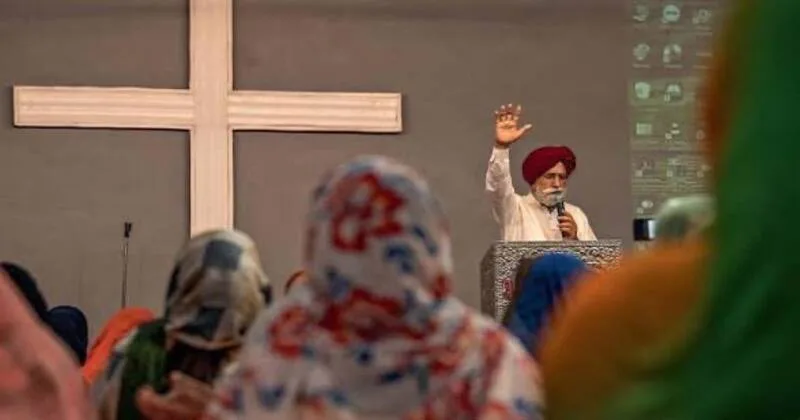
These aren’t churches built on a Western framework. Pastors frequently wear turbans and keep beards, dressing in ways that appear distinctly Punjabi rather than foreign. Services swap Western choral music for devotional singing in a Gurbani-influenced style, accompanied by harmonium, tabla, and chimta. Many conclude with langar, a free communal meal eaten sitting on the floor, in the same spirit as Sikh gurdwara tradition, followed by the distribution of prasad. The effect is a form of faith that allows people to convert without feeling they’ve abandoned their cultural roots.
Scale, Addiction, and the Promise of Healing
Some of these congregations have grown enormous. A few church complexes spread over as much as 60 acres and attract crowds of one to three lakh people each week, so large that police sometimes have to manage traffic nearby.
Part of their appeal is practical, not just spiritual. Punjab faces serious drug addiction problems, and rural healthcare is often underfunded. Many families cannot afford private treatment or rehab. Some churches respond by offering claims of miraculous healing, with testimonies of chronic illness cured or addiction broken overnight, often amplified through slick social media production. For families with few other options, the promise of an immediate, low-cost solution, along with genuine community support, can be a powerful draw.
Pushback From Sikh Institutions
The trend has not gone unanswered. The Akal Takht and the Shiromani Gurdwara Parbandhak Committee (SGPC) have launched campaigns such as “Ghar-Ghar Andar Dharamsaal,” aimed at reconnecting Sikh communities with the faith’s own teachings on equality, alongside public reconversion drives. Religious bodies have also pushed the Punjab government to adopt stricter anti-conversion laws, as many conversions are driven by financial incentives and unverified healing claims rather than genuine spiritual conviction. Tensions have occasionally spilt into physical confrontation, including reported clashes between Nihang Sikh groups and church organisers.
Notably, Punjab itself does not currently have a dedicated anti-conversion law, unlike a dozen other Indian states, including Uttar Pradesh, Madhya Pradesh, Gujarat, and Himachal Pradesh, that already restrict conversions through “Freedom of Religion” acts. Union Home Minister Amit Shah has pledged to introduce such a law in Punjab if the BJP wins power, a promise that has become a live political issue ahead of the 2027 state elections.
A Societal Problem, Not Just a Religious one
Taken together, the pattern points to something wider than a simple story of religious competition. It reflects unresolved caste discrimination, a strained rural healthcare system, and the economic distress linked to addiction.
Another factor is the decline of traditional deras and local spiritual centres, which once provided everyday guidance, counsel, and community in rural Punjab. As these institutions have weakened, they have left behind not only a material gap but also a spiritual one. For many people, the appeal of Pentecostal churches is not only practical; it also reflects a genuine need for spiritual meaning and personal support that older institutions are no longer meeting as consistently as before.
If deras want to remain relevant to the communities they once were, they will likely need to modernise and respond more directly to local needs. That means building de-addiction centres, health camps, and trained counselling services instead of relying only on spiritual authority. Legal restrictions or organised protests may slow public gatherings, but they do not answer why people are turning to these spaces in the first place. The change is already underway, and unless deeper issues of dignity, land, healthcare, addiction, and belonging are addressed, the pull toward communities that offer answers and a sense of welcome is likely to continue.