The narrative that India has missed the Electric Vehicle (EV) revolution ignores the fundamental structural reality that India is not focusing on replicating China’s high-cost, export-driven EV models, but rather making a demand-led, cost-effective and security-oriented transition. Measured against these parameters, the transformation since 2014 has been substantial.
India’s transition towards EVs is driven not just by climate goals, but by economic and geopolitical imperatives. Instead of questioning whether India has produced a company comparable to BYD or Tesla, the relevant discussion should be whether India has built the policy, industrial, and technological ecosystem required to become a leader in the green economy. We have enough evidence to affirm that it has.
Energy Security: The Principal Driver of India’s EV Strategy
India has been one of the world’s most import-dependent countries in terms of crude oil, with nearly 90% of its supply coming from imports. Any disruption in the global energy market translates into uncertainty in supply, increased import bills, inflationary pressures and an increase in fiscal burdens. Russia-Ukraine conflict and instability in West Asia have illustrated this.
The government’s approach to reducing dependence on imported fossil fuels is not just the result of environmental aspiration but a strategic necessity. Increased renewable energy installed capacity over the last decade should be seen as an economic strategy aimed at protecting the nation from external shocks while enhancing long-term macroeconomic stability.
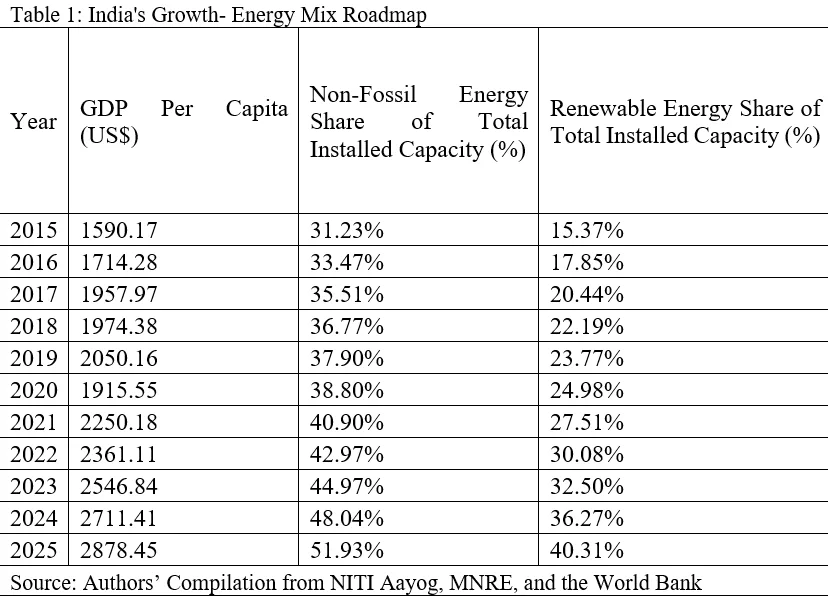
Table 1 clearly illustrates that post 2015, India not only witnessed economic growth but also focused on reducing dependency on fossil fuels, with more than 50 per cent of total energy being sourced from non-fossil sources, which includes renewable energy, large hydro and nuclear energy. The major contributor to this growth is renewable energy, which had a share of just 15.37 per cent in 2015 and increased to more than 40 per cent within a decade.
India has around a 20 per cent overall average renewable energy usage ratio by firms, ahead of developed countries like the US and Japan, only lagging behind France and Brazil with 25.9 per cent and 26.2 per cent respectively.
Policy Transformation Since 2014: Building an Integrated EV Ecosystem
Before 2014, India’s electric mobility ecosystem was mainly confined to pilot projects with very limited charging infrastructure and negligible domestic manufacturing. Since 2014, the policy has, however, changed fundamentally. The government has adopted the strategy of consolidated growth of the ecosystem, which combines demand incentives, indigenous manufacturing support, infrastructure development and research initiatives.
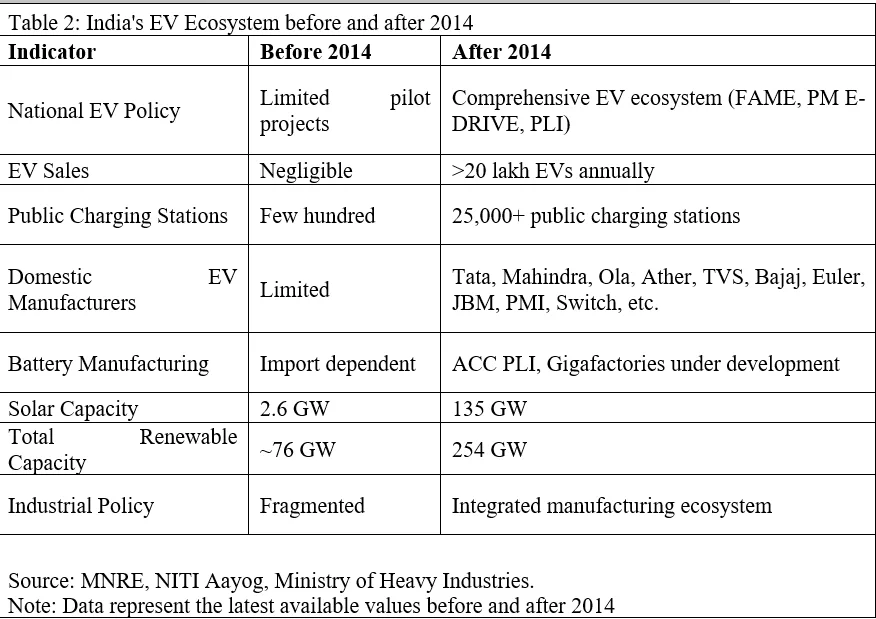
The government launched the PM E-Drive scheme with an outlay of Rs. 9,570 Cr, particularly targeting buses, commercial vehicles, freight and logistics electrification. 35 capital goods used in lithium-ion batteries are exempted from customs duty. To strengthen the battery recycling ecosystem, waste and scrap lithium-ion batteries are also exempt from customs duties. Over Rs. 18,000 Cr Production Linked Incentive Scheme has been approved for Advanced Chemistry Cell (ACC) battery manufacturing. States are also independently making EV policies to promote EVs and related infrastructure. Delhi, Maharashtra, Gujarat and Assam provide the most aggressive upfront purchase subsidies for two- and four-wheeler EVs, by offering full or partial road tax exemptions and subsidised registration fees.
Renewable Energy: The Foundation of Electric Mobility
The basic motto behind promoting electric vehicles is to provide a sustainable solution for clean mobility, which indeed is one of the basic pillars of the Net-Zero transition. However, it’s a well-recognised fact that electric mobility cannot become sustainable unless the electricity itself becomes cleaner.
Indian policymakers, researchers and industrialists noted this and accelerated non-fossil energy, particularly renewable energy deployment.
The Ministry of New and Renewable Energy (MNRE) has been implementing PM Surya: Ghar Muft Bijli Yojana since February 2024 to achieve rooftop solar (RTS) installations in one crore households in the residential sector by FY 2026-27. Over 26 lakh RTS systems have been installed across the country. Since its launch, a total amount of Rs. 17,967.53 Cr has already been disbursed.
The PM-KUSUM scheme provides farmers with up to a 60 per cent subsidy to install standalone solar pumps and solarise existing grid-connected agricultural pumps. Farmers only have to pay 10% to 40% of the total cost of the solar system or pump upfront. The remaining balance is covered by 60% central and state subsidies, with the option to finance up to 30 per cent through bank loans.
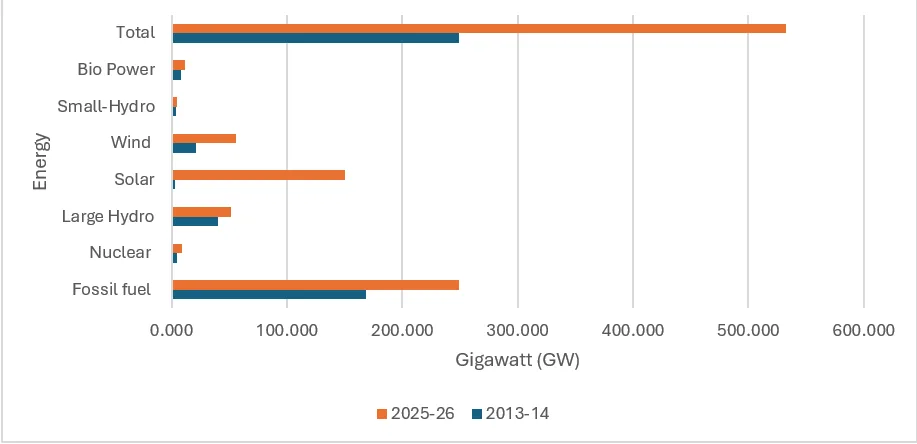
Fossil fuel-based energy had a huge share of 67.46% in 2014, which has reduced to 46.79% in 2025-26. The biggest contributor towards the increase in clean energy in the energy mix is solar energy. In 2014, solar energy had merely a 1.13% share of total energy with just 2.82 GW, which has increased to 28.21% with 150 GW over the last decade.
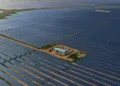
Large-scale renewable energy projects like Bhadla Solar Park, Pavagada Solar Park, Rewa Solar Park and Khavda Renewable Energy Park have fundamentally transformed India’s clean energy drive, shifting the green ecosystem from subsidy-based to system-based sustainability. This transition replaces temporary, budget-dependent incentives with a self-sustaining market architecture that guarantees permanent, long-term impact.
EV Revolution in India: A Drive by Consumer Demand
The narrative that India’s EV market is policy-driven gets shattered when recent market data is referred to, indicating robust consumer demand.
Two-wheeler EV sales reached an all-time high of around 1.91 lakh units in March 2026, covering 9.8% market share amid rising crude oil prices induced by West Asian conflict. Even after seasonal correction, 1.48 lakh units were sold in April 2026, recording 61 per cent year-on-year growth. The increasing demand for EVs illustrates that the Indian electric mobility ecosystem is becoming commercially viable, instead of just being subsidy-dependent.
EV transition is also catalysing the growth of other industries, such as the auto-component sector. BloombergNEF has projected that India’s auto-component industry could grow to around Rs. 19 lakh crores by 2030, supported by projected EV sales growth of nearly 35% annually. Apart from the auto-component sector, other related areas being stimulated by the EV revolution include battery manufacturing, electronics production, semiconductor development, energy storage, and charging infrastructure.
Innovation Beyond Assembly: India’s Indigenous EV Ecosystem
There is a common misconception that Indian companies operating in EVs merely assemble the imported components; however, the reality is different. Companies such as Tata Motors, TVS Motors, Ather Energy, Mahindra, Ola Electric and Bajaj Auto are continuously developing not just indigenous vehicles, but also battery management systems, telematics and software especially designed for Indian operating conditions.
India follows its own innovation model; unlike the US or China, it focuses mainly on affordable two-wheelers and compact passenger vehicles rather than premium EVs. The main target is cost optimisation, aligning with India’s economic realities. Before 2014, India was entirely dependent on imported lithium-ion batteries; today, the focus has shifted to indigenous manufacturing, recycling and advanced cells based on sodium-ion. The government’s ACC PLI Scheme aims to set 50 GWh of domestic battery manufacturing capacity. Large-scale battery manufacturing, recycling and next-generation battery technologies have witnessed investments from Reliance Industries, Tata Group, Exide Industries and Amara Raja Group.
Green Finance: Catalysing India’s Clean Energy Transition
Financial Institutions in India have increased the share of green lending in their portfolio and have started incorporating Environmental, Social and Governance (ESG) parameters and Business Responsibility and Sustainability Reporting (BRSR) disclosures into their credit decisions. The majority of the banks have their own ESG scores of more than 65, with State Bank of India (SBI) and HDFC Bank leading with a score of 72 each. In their BRSR reporting, banks have also started disclosing not only their Scope 1 and 2, but also Scope 3 emissions (along with category 15, i.e. financed emissions). Banks have further begun integrating climate risk into their risk management frameworks to analyse borrower- and portfolio-level financial risks induced by climate change.
Green deposits and bonds are also seeing a hike in recent years. For instance, SBI has raised a green deposit of Rs. 317.39 Cr till March 2026, utilised for financing the EV Car loan portfolio. They have also issued over Rs. 2200 Cr in green bonds. Similarly, Punjab National Bank (PNB) has raised Rs. 394.31 Cr through green deposits. Public Sector Banks are also involved in blended finance mechanisms with institutions such as the World Bank, the Asian Development Bank, and the Green Climate Fund. Private banks such as HDFC Bank, ICICI Bank and Axis Bank also have sustainable finance frameworks and exposure in the renewable energy sector.
Conclusion: Strategic Scaling
The criticism that India has failed to innovate overlooks the systemic transformation going on at the grassroots level. Innovation not only means globally recognised consumer brands but also includes building a sustainable industrial ecosystem, self-reliant technology, domestic manufacturing capability, and strategic supply chains. Post 2014, India has witnessed a shift from fragmented clean-energy policies to a comprehensive strategy integrating renewable energy, electric mobility, battery manufacturing, charging infrastructure, industrial policy and energy security. India’s approach has been clear: it won’t be imitating other countries; rather, pursue its own unique model of innovation reflecting domestic priorities, demographic realities and strategic interests.
The data, facts and figures clearly underscore that India is not lagging behind other countries in the green energy or electric mobility race; in fact, it is scaling systematically, strategically and deliberately.