Prime Minister Narendra Modi on Saturday announced that India aims to operationalise five new nuclear reactors during the current decade as part of a larger push to strengthen the country’s energy security and achieve a nuclear power capacity of 100 GW.
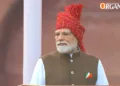
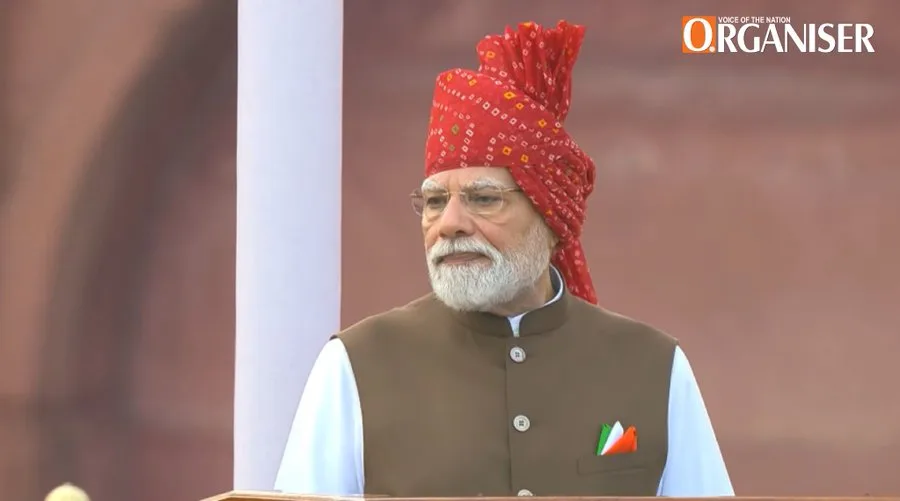
Addressing the nation from the ramparts of the Red Fort on the occasion of India’s 80th Independence Day, PM Modi said energy security had become a critical requirement for the country’s continued economic growth.
He said the recently passed SHANTI Act had created a framework to advance India’s nuclear energy ambitions and reiterated the government’s long-term target of increasing nuclear power capacity.
“Energy security is the demand of the time. With the SHANTI Act passed in Parliament, we have created the framework to achieve our goal. Our goal is to achieve 100 gigawatts of nuclear power capacity. We aim to start five new nuclear reactors in this decade,” the Prime Minister said.
The announcement comes as India seeks to expand its energy infrastructure to meet rising electricity demand while reducing dependence on imported energy resources.
Nuclear Power at centre of energy security push
PM Modi linked the nuclear expansion target with the broader objective of building an Atmanirbhar Bharat, or self-reliant India.
He stressed that India must strengthen its domestic capabilities rather than remain dependent on other countries for critical requirements.
“It is our conviction that India must not be dependent on other countries. We must become self-reliant. We have to strengthen our capabilities and protect our national interests,” he said.
The Prime Minister’s emphasis on nuclear energy reflects the importance of reliable electricity supply as India’s economy expands. Nuclear power can provide continuous electricity generation and can complement renewable sources such as solar and wind.
The 100 GW target represents a major expansion of India’s nuclear energy capacity and would require sustained investment in reactors, technology, infrastructure and skilled manpower.
The five-reactor target for this decade provides a nearer-term milestone towards the larger 2047 goal.
Railway network achieves 100 percent electrification
Apart from nuclear energy, PM Modi highlighted India’s transformation in railway electrification.
He said India had achieved 100 per cent electrification of its railway network, contrasting the pace of electrification in the earlier decades with the progress made over the past ten years.
“Railway electrification in India began in 1925. Yet, over nearly 90 years, only 30 per cent of the railway network had been electrified. In just the last decade, India has achieved 100 per cent railway electrification,” he said.
According to the Prime Minister, the expansion of electric railways has helped reduce dependence on imported diesel while also contributing to cleaner transportation.
The government has increasingly linked railway electrification with energy efficiency, reduced fossil fuel consumption and efforts to lower emissions.
PM Modi also highlighted the launch of India’s first hydrogen-powered train as another example of the country’s efforts to explore cleaner technologies in transportation.
The development of alternative propulsion technologies is part of a broader effort to reduce the carbon intensity of transport while strengthening domestic technological capabilities.
Defence production rises nearly fourfold
The Prime Minister also used his Independence Day address to highlight changes in India’s manufacturing and defence ecosystem.
He said defence production had increased nearly fourfold over the past 12 years.
The growth, he said, reflected India’s efforts to build domestic manufacturing capabilities and reduce dependence on imports for critical defence requirements.
The government has increasingly promoted indigenous defence production through initiatives aimed at boosting domestic manufacturing, encouraging private-sector participation and increasing exports.
The focus on self-reliance in defence is closely linked to the larger Atmanirbhar Bharat strategy highlighted by PM Modi during the address.
Electronics manufacturing expands nearly sevenfold
Electronics manufacturing was another sector highlighted by the Prime Minister.
PM Modi said electronics production had expanded nearly sevenfold, pointing to the growth of domestic manufacturing and the increasing role of India in global technology supply chains.
The electronics sector has emerged as a major area of government focus, particularly as India seeks to expand manufacturing of mobile phones, components and other technology products.
The Prime Minister also cited a 33-fold increase in mobile phone production.
The figures were presented as evidence of the shift towards greater domestic manufacturing and India’s growing role as a production base for technology products.
Modern railway coaches, internet users and patents
PM Modi also highlighted growth across several technology and innovation indicators.
He said production of modern railway coaches had risen 21-fold, while the number of internet users had nearly quadrupled.
The Prime Minister said patent grants had increased fourfold, indicating a significant expansion in India’s innovation ecosystem.
Digital transactions, meanwhile, had increased a hundredfold, reflecting the rapid growth of digital payments and technology-enabled financial services.
These developments, he said, were part of a larger transformation in the country’s digital economy.
India has emerged as one of the world’s largest markets for digital payments, with mobile connectivity, digital identity and financial technology increasingly becoming part of everyday economic activity.
Faster expansion of basic amenities
The Prime Minister also highlighted the pace at which basic amenities have been expanded over the past decade.
He said tap-water connections were being provided at an average annual rate 15 times faster than before.
Gas connections, he said, were being provided at six times the previous annual pace, while toilets for the poor were being constructed at four times the earlier rate.
Housing for underprivileged families, according to PM Modi, was being provided at three times the earlier pace.
The Prime Minister presented these figures as evidence of faster delivery of basic services and infrastructure to households across the country.
The expansion of household-level amenities has been a major component of the government’s welfare and infrastructure agenda, particularly in rural areas.
Governance reforms and reduction in compliance burden
PM Modi also spoke about changes in governance and the legal framework.
“One cannot march into the 21st century relying on laws from the last century,” he said, highlighting the need to modernise India’s regulatory system.
He pointed to the expansion of metro networks and improvements in public transport as examples of efforts to build modern infrastructure.
The Prime Minister also said thousands of compliance requirements had been eliminated and hundreds of outdated laws repealed.
The objective, he said, was to simplify governance and reduce unnecessary regulatory burdens.
The government’s broader deregulation and legal reform efforts have focused on removing obsolete provisions, simplifying compliance and making it easier for citizens and businesses to interact with the government.
PM Modi acknowledges citizens’ contribution
The Prime Minister also used his Independence Day address to acknowledge the contribution of citizens from different sections of society to India’s development.
He said the country’s progress was the result of the collective efforts of people across social and economic backgrounds.
“Over the past 12 years, countless citizens, whether Dalits, the downtrodden, the marginalised, or tribals; whether rural or urban dwellers; the poor or the middle class; youth or the elderly; women or men; from the North, South, East, or West have all strived in every possible way, with unwavering resolve and dedication, to propel the nation to new heights. I respectfully acknowledge these efforts,” PM Modi said.
The remarks placed citizens at the centre of the government’s development narrative, with the Prime Minister emphasising the role of collective participation in achieving national goals.
Indigenous guns used in 21-gun salute
Earlier in the day, PM Modi hoisted the National Flag at the Red Fort, marking India’s 80th Independence Day.
The flag hoisting ceremony was synchronised with a 21-gun salute by the 1721 Field Battery (Ceremonial), which used indigenous 105 mm Light Field Guns.
The ceremonial battery was commanded by Major Pawan Singh Shekhawat, while Naib Subedar (Assistant Instructor in Gunnery) Anuthosh Sarkar served as the Gun Position Officer.
The use of indigenous guns during the ceremonial salute also reflected the broader emphasis on domestic defence manufacturing and self-reliance that featured prominently in the Prime Minister’s address.
Development roadmap focused on self-reliance
The Prime Minister’s Independence Day announcements brought together several sectors that the government considers critical to India’s next phase of development.
The nuclear power target is aimed at strengthening long-term energy security, while railway electrification is intended to reduce fossil fuel dependence and modernise transport.
Growth in defence and electronics manufacturing points towards greater domestic production, while the expansion of internet access, patents and digital transactions highlights India’s growing technology ecosystem.
At the same time, the acceleration of tap-water connections, gas connections, sanitation and housing reflects the government’s focus on expanding basic infrastructure and services.
The common thread running through these announcements was the emphasis on domestic capability and self-reliance.
The target of 100 GW of nuclear power, the plan to operationalise five reactors within this decade and the wider push for indigenous manufacturing will require sustained investment and implementation.
For the government, however, these targets form part of a longer-term roadmap towards energy security, technological capability, modern infrastructure and an Atmanirbhar Bharat.