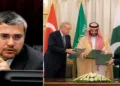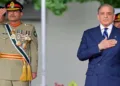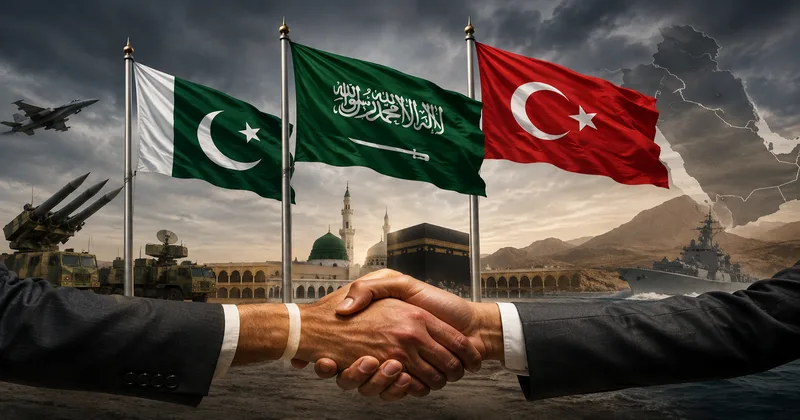
An agreement between Pakistan, Saudi Arabia and Türkiye was signed on August 7 in Mecca, Saudi Arabia. Officially called the “Mecca Joint Defence Agreement”, this trilateral agreement is based on the clause of “Attack on one, attack on all”. This clause, much like Article 5 of the NATO agreement, states that “Any armed attack against any one of the three states shall be regarded as an attack against them all”. Some analysts hurriedly even termed the agreement as an Islamic NATO. Much to the dismay of the three new partners in defence, Iran-backed Houthis and Iraqi militia carried out a series of attacks on Saudi Arabia from 7 August onwards. Houthis even attacked 8 Saudi-linked cargo vessels in the Red Sea and have threatened to block Bab Al Mandeb Strait. Thus, the fledgling pact had a shaky start.
The spirit of this defence pact is questionable because Saudi Arabia had already signed a “Strategic Mutual Defence Agreement” with Pakistan in September 2025. Türkiye has now been added to the similar pact between Saudi Arabia and Pakistan. In the ongoing US-Iran war since February this year, Pakistan has not come to the rescue of Saudi Arabia even once so far. Pakistan already has a sizeable military presence in Saudi Arabia, and yet Saudi Arabian oil infrastructure, cargo vessels and civilian population continues to be targeted by Iran or its proxies. Türkiye has termed the trilateral pact as defensive, Islamic-solidarity driven (all three countries are Sunni majority) and open-ended (open to other friendly nations). Thus, Saudi Arabia is not likely to receive any offensive support from Türkiye against Iran, in the immediate time frame.
It is not difficult to understand that Pakistan Army Chief Asim Munir is the driving force behind this tripartite pact. In fact, Asim Munir was present in Mecca when Pakistani PM Shehbaz Sharif signed the pact on 7 August. Asim Munir has taken a calculated risk because this pact is not to the liking of the US. This alliance is looking beyond the security umbrella provided by the US to the Gulf countries so far. The signing of this agreement when the US-Iran war still continues (with interludes of ceasefire) indicates that the Gulf countries, particularly Saudi Arabia, are feeling uncertain about their security alliance with the US. Saudi Arabia has been the largest importer of military hardware from the US for decades now, and even such modern defence equipment has not been very successful against the Iranian strikes.
Pakistan has achieved another financial package from Saudi Arabia by signing this pact. Saudi Arabia has agreed to an additional $ 3 billion deposit with Pakistan to support their balance of payments. In addition, Pakistan will receive $10 billion in Saudi investments across infrastructure, energy, mining and security sectors. Saudi Arabia has also promised to triple bilateral trade from $5 billion to $15 billion with Pakistan. Thus, Pakistan has been able to bail itself out of the economic mess as a nation, for the time being. It is no secret that Pakistan has misused the financial aid from the US to procure military hardware and harbour banned terrorist outfits like Jaish-e-Mohammad and Lashkar-e-Toiba. Now Pakistan is going to do the same with the Saudi money. Asim Munir also becomes more powerful in Pakistan and in the region.
Türkiye President Erdogan is keen on emerging as the leader of the Islamic nations, particularly the Sunni bloc. With the decline of Saudi Arabia as the leader of the Gulf countries, Türkiye wants to fill that gap quickly. Iran has emerged as the major military power in the ongoing conflict even when it has suffered severe losses. Though Pakistan is a nuclear power, Türkiye fancies itself as more qualified to lead the Islamic nations. Türkiye has the largest military amongst the NATO nations and thus gains from a regional alliance like the Mecca Pact. Türkiye is one of the largest drone and arms exporters. Türkiye already supplies a lot of defence equipment to Pakistan. Thus, this pact opens the route for Türkiye to sell military hardware to Saudi Arabia instead of it depending on the US. Saudi Arabia clearly is in a helpless situation where it has to outsource its security to Pakistan and Türkiye, besides the US.
As regards India, the Mecca Defence Agreement has serious security concerns in our immediate neighbourhood and in the regional context. I will not be surprised if Bangladesh too joins the pact, since Türkiye is seeking to expand the footprint of the Sunni bloc. Mecca pact will also receive the tacit support of China, as it undermines the US influence in West Asia. Pakistan is likely to divert the attention of its public from the chaotic situation in Baluchistan, Khyber Pakhtunkhwa, POJK and the Afghanistan border. Pakistan is likely to test India’s reaction to another major terror attack like the one sponsored by it in Pahalgam in April last year. India’s stated position that Operation Sindoor is still going on offers us multiple options to deal with a threat from Pakistan. India as a nation needs to keep its guard up.