Iran economy crashes as Hormuz blockade looms
June 23, 2026
  • Read Ecopy
  • Circulation
  • Advertise
  • Careers
  • About Us
  • Contact Us
Android AppiPhone AppArattai
Organiser
  • ‌
  • Bharat
    • Assam
    • Bihar
    • Chhattisgarh
    • Jharkhand
    • Maharashtra
    • View All States
  • World
    • Asia
    • Europe
    • North America
    • South America
    • Africa
    • Australia
  • Editorial
  • International
  • Opinion
  • RSS @ 100
  • More
    • Op Sindoor
    • Analysis
    • Sports
    • Defence
    • Politics
    • Business
    • Economy
    • Culture
    • Special Report
    • Sci & Tech
    • Entertainment
    • G20
    • Azadi Ka Amrit Mahotsav
    • Vocal4Local
    • Web Stories
    • Education
    • Employment
    • Books
    • Interviews
    • Travel
    • Law
    • Health
    • Obituary
  • Subscribe
    • Subscribe Print Edition
    • Subscribe Ecopy
    • Read Ecopy
  • ‌
  • Bharat
    • Assam
    • Bihar
    • Chhattisgarh
    • Jharkhand
    • Maharashtra
    • View All States
  • World
    • Asia
    • Europe
    • North America
    • South America
    • Africa
    • Australia
  • Editorial
  • International
  • Opinion
  • RSS @ 100
  • More
    • Op Sindoor
    • Analysis
    • Sports
    • Defence
    • Politics
    • Business
    • Economy
    • Culture
    • Special Report
    • Sci & Tech
    • Entertainment
    • G20
    • Azadi Ka Amrit Mahotsav
    • Vocal4Local
    • Web Stories
    • Education
    • Employment
    • Books
    • Interviews
    • Travel
    • Law
    • Health
    • Obituary
  • Subscribe
    • Subscribe Print Edition
    • Subscribe Ecopy
    • Read Ecopy
Organiser
  • Home
  • Bharat
  • World
  • Operation Sindoor
  • Editorial
  • Analysis
  • Opinion
  • Culture
  • Defence
  • International Edition
  • RSS @ 100
  • Magazine
  • Read Ecopy
Home World North America USA

Iran economy crashes as Hormuz blockade looms; Pakistan markets sink, China faces energy shock

Iran’s economy is spiralling into crisis as a looming blockade of the Strait of Hormuz disrupts trade and oil flows, deepening domestic instability. The fallout is spreading globally, shaking Pakistan’s markets and placing China under mounting energy and economic pressure

Dr Vishnu AravindDr Vishnu Aravind
Apr 14, 2026, 05:00 pm IST
in USA, World, Asia, International Edition
Follow on Google News
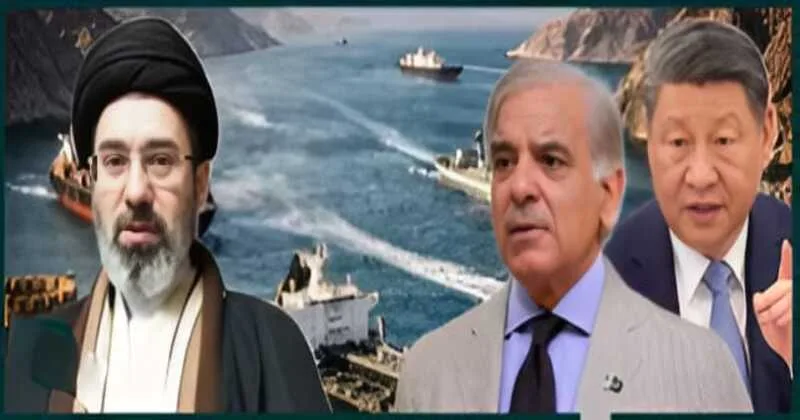
Rising Hormuz tensions bring Iran, Pakistan and China into focus as a looming blockade threatens global trade and energy flows

Rising Hormuz tensions bring Iran, Pakistan and China into focus as a looming blockade threatens global trade and energy flows

FacebookTwitterWhatsAppTelegramEmail

Washington/Tehran: Iran’s economic situation has sharply deteriorated after Pakistan-brokered talks in Islamabad aimed at ending the war collapsed, prompting US President Donald Trump to announce plans to “block” the Strait of Hormuz. The Iranian rial has plunged dramatically, touching 15.80 lakh to the US dollar in the unofficial market, reflecting deepening financial instability. Had the United States accepted Iran’s conditions for peace, it could have provided significant economic relief to Tehran. These demands included lifting sanctions and tariffs, as well as the release of frozen Iranian assets abroad. However, Washington rejected all these proposals, closing off a potential path to stabilisation.

With Trump warning that the US military will move to block the Strait of Hormuz, maritime movement to and from Iran is expected to face severe disruption. This would directly impact Iran’s oil exports, its primary source of revenue, while also restricting the import of essential goods. Even before the escalation, Iran was grappling with soaring inflation and high unemployment. The situation has worsened due to damage inflicted on infrastructure and energy facilities during US-Israeli attacks. Reports indicate widespread destruction of factories, power plants, railway lines, airports, and bridges.

Economic collapse deepens inside Iran

The domestic economic crisis in Iran has intensified significantly since the outbreak of war. Inflation has surged by nearly 40 per cent, placing immense pressure on ordinary citizens. Prices of essential food items have skyrocketed, with costs rising from around 700,000 rials to over 1,000,000 rials. Similarly, the price of certain cancer medications has jumped from 300,000 to 1,800,000 rials, making critical healthcare increasingly unaffordable. The worsening conditions have forced many commercial and industrial establishments to shut down, further aggravating unemployment and reducing economic activity across the country.

Also Read: BLA announces setting up of naval wing ‘HMDF’, releases video of attack on Pakistan Coast Guard boat

At the same time, regional actors have begun to respond diplomatically. The United Arab Emirates has stated that the Strait of Hormuz is not Iran’s sovereign property and has pledged support for efforts to ensure free navigation. Qatar has also urged Iran to adopt a more conciliatory stance in mediation efforts. There are growing indications that Iran may be compelled to soften its position regarding control over Hormuz if the United States escalates its military involvement further.

Pakistan mediation fails, markets react

The collapse of mediation efforts led by Shehbaz Sharif and Asim Munir has also triggered economic repercussions beyond Iran. Pakistan’s stock market witnessed sharp volatility following the failure of talks. The benchmark KSE-100 index at the Pakistan Stock Exchange plunged by 6,000 points in a single day. This came just days after the index had surged by more than 12,000 points amid optimism generated by Pakistan’s role as a mediator. The sudden reversal reflects investor anxiety over escalating geopolitical tensions and the risk of a prolonged conflict in the region.

US pressure strategy targets China

Trump’s decision to push for a blockade of the Strait of Hormuz is expected to have far-reaching global consequences, particularly for China. The move is widely seen as an attempt to deliver a dual economic blow to Beijing. The US President had earlier warned that an additional 50 per cent tariff would be imposed on China if it extended military support to Iran. This threat was followed by the announcement regarding Hormuz, signalling a coordinated pressure strategy.

The US Navy has reportedly initiated steps to restrict passage through the Strait, targeting ships travelling to and from Iranian ports, as well as vessels paying transit-related charges to Iran. Hormuz is a critical global energy artery, accounting for nearly 20 per cent of the world’s oil supply. Any disruption in this route is likely to push global oil prices significantly higher. Indeed, markets have already reacted sharply. Following Trump’s statements and the collapse of talks in Islamabad, US crude (WTI) prices surged by 8.37 per cent to $104.6 per barrel, while Brent crude rose to $103.1 per barrel.

China, the world’s largest oil importer, is particularly vulnerable to such disruptions. Approximately 40 per cent of the oil passing through the Strait of Hormuz is destined for China, along with about 30 per cent of its LNG imports. Any sustained blockade would severely impact Chinese refineries, which depend heavily on energy supplies from Iran and other Gulf countries. There are already indications that Chinese refineries are paying up to $40 more per barrel due to fears of supply chain disruptions. This could further fuel inflationary pressures within China’s economy. Adding to the strain, Trump has reiterated threats of additional tariffs should Beijing deepen its ties with Tehran.

The situation has also created uncertainty in maritime operations. Reports suggest that two Pakistani-flagged oil tankers and a Liberian-flagged vessel successfully entered the Persian Gulf via the Strait of Hormuz. However, a Maltese-flagged ship reportedly turned back amid rising fears of confrontation. While the US Navy is not expected to immediately resort to direct military action such as firing upon vessels or launching missiles, it is likely to issue warnings and instruct ships to turn back. If vessels refuse to comply, there are indications that US forces may attempt to take control of them.

As tensions continue to escalate, the Strait of Hormuz remains at the centre of a rapidly unfolding geopolitical and economic crisis, with consequences that could reverberate far beyond the region.


Topics: Pakistan Stock ExchangeChinaUSAAsim Munir
ShareTweetSendShareSend
✮ Subscribe Organiser YouTube Channel. ✮
✮ Join Organiser's WhatsApp channel for Nationalist views beyond the news. ✮
Previous News

BLA announces setting up of naval wing ‘HMDF’, releases video of attack on Pakistan Coast Guard boat

Next News

Bihar to get 1st BJP CM: Samrat Choudhary elected leader of BJP legislative party after Nistish Kumar’s resignation

Related News

United States Trade Representative Jamieson Greer and Union Commerce and Industry Minister Piyush Goyal

India-US Trade Agreement: Historic deal enters final stretch as USTR Jamieson Greer heads to New Delhi

Chinese President Xi Jinping

China Back to Mao Era? Xi unveils new doctrine of party supremacy over state and people

Yoga Day celebrations in Shanghai, China

International Yoga Day: Global celebrations echo the message of health, well-being and timeless ancient Indian wisdom

UK retailers demand tougher curbs on Chinese online giants amid deepening EU–Beijing trade rift

“Recognise anti-Hindu bias”: Hindu American Foundation alerts California Hate Commission on rising violence on Hindus

Prestige Denim Mills' $20 million project marks India's industrial entry into one of Africa's fastest-growing textile hubs

India enters Egypt’s textile battlefield, challenging Chinese, Turkish and Pakistani dominance in Africa

Load More

Latest News

Israel-Iran crisis has highlighted not only shifting dynamics of West Asia but also growing confidence of India's foreign policy

India, Israel and the rise of strategic autonomy in an era of global geopolitical realignment

Saleem and Jaleel arrested in forced religious conversion case

Karnataka Conversion Case: Forced conversion of Hindu woman and minor son sparks outrage; Saleem and Jaleel arrested

Bareilly Cantonment Emerges as Model for Sustainable Urban Development in India (Image Source X)

Uttar Pradesh: Bareilly Cantonment becomes India’s first carbon-negative cantonment

CM Yogi Adityanath making industry, investment and the connectivity revolution in Eastern Uttar Pradesh

The Purvanchal Growth Story: How industry, infrastructure, tourism & exports are fueling development in eastern UP

(Left) Fire at the coaching centre in Lucknow (Right) Members of ABVP extending all possible help

Lucknow Coaching Centre Fire tragedy is heartbreaking and deeply unfortunate: ABVP seeks action against culprits

Andhra Pradesh Minister and TDP National General Secretary Nara Lokesh

Nara Lokesh dismisses rumours of TDP sabotaging Modi government, reaffirms unconditional NDA support

With new military deployments, export opportunities and potential Russian production, BrahMos is entering a new era of strategic relevance

BrahMos enters high-volume production as military demand and global export orders surge

Dr Mahrang Baloch

Pakistan: Mahrang Baloch gets life sentence, Balochistan erupts in protest; BYC calls for shutdown

Prime Minister Narendra Modi

‘Maoism is breathing its last’: PM Modi highlights crackdown on red terror in last 12 years and growth in tribal areas

(Left) Dr Shyama Prasad Mookerjee (Right) West Bengal CM Suvendu Adhikari

Syama Prasad Mookerjee was instrumental in creation of West Bengal’: CM Suvendu Adhikari

Load More
  • Privacy
  • Terms
  • Cookie Policy
  • Refund and Cancellation
  • Delivery and Shipping

© Bharat Prakashan (Delhi) Limited.
Tech-enabled by Ananthapuri Technologies

  • Home
  • Search Organiser
  • Bharat
    • Assam
    • Bihar
    • Chhattisgarh
    • Jharkhand
    • Maharashtra
    • View All States
  • World
    • Asia
    • Africa
    • North America
    • South America
    • Europe
    • Australia
  • Editorial
  • Operation Sindoor
  • Opinion
  • Analysis
  • Defence
  • Culture
  • Sports
  • Business
  • RSS @ 100
  • Entertainment
  • More ..
    • Sci & Tech
    • Vocal4Local
    • Special Report
    • Education
    • Employment
    • Books
    • Interviews
    • Travel
    • Health
    • Politics
    • Law
    • Economy
    • Obituary
  • Subscribe Magazine
  • Read Ecopy
  • Advertise
  • Circulation
  • Careers
  • About Us
  • Contact Us
  • Policies & Terms
    • Privacy Policy
    • Cookie Policy
    • Refund and Cancellation
    • Terms of Use

© Bharat Prakashan (Delhi) Limited.
Tech-enabled by Ananthapuri Technologies