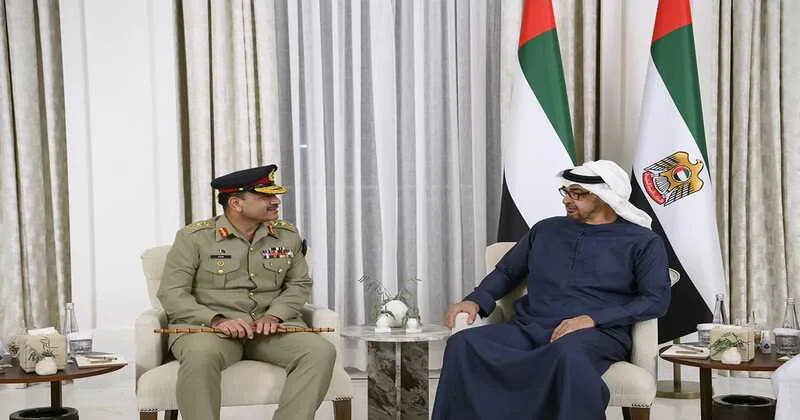
Abu Dhabi/Islamabad: The United Arab Emirates (UAE) has expressed strong dissatisfaction with Pakistan over its perceived support for Iran amid the ongoing conflict in West Asia. The concerns were conveyed at the highest levels, reflecting growing unease within the UAE leadership over Islamabad’s diplomatic positioning in the US–Israel–Iran tensions.
Pakistan Army Chief Field Marshal Asim Munir held a crucial meeting with Prime Minister Shehbaz Sharif upon returning from Abu Dhabi, where he briefed him on the concerns raised by the Emirati leadership during his visit. According to top diplomatic sources, UAE officials directly questioned Pakistan’s stance during the conflict, particularly its perceived closeness to Tehran.
Sources indicated that the UAE was especially concerned, given that it had borne direct consequences of the conflict. Despite this, Emirati officials reportedly conveyed that Pakistan appeared to be aligning itself with Iran. They pointed out that Iran had launched attacks affecting the UAE, yet Islamabad’s position did not reflect solidarity with Abu Dhabi.
Strains in strategic ties
The issue was raised during Munir’s meetings with UAE President Sheikh Mohammed bin Zayed Al Nahyan, National Security Advisor Tahnoun bin Zayed Al Nahyan, and other senior officials earlier this week. During these interactions, the UAE leadership is said to have expressed disappointment over what it viewed as Pakistan’s inconsistent diplomatic engagement. Sources revealed that while Pakistan had actively engaged with Saudi Arabia during the crisis, with multiple visits by both the prime minister and the army chief, there was no comparable outreach to the UAE. This perceived imbalance did not go unnoticed in Abu Dhabi.
A senior source in the Pakistani prime minister’s office, citing the UAE’s message, stated to the media that “The Pakistani prime minister and you (Munir) visited Saudi Arabia several times in solidarity. But the same support was not shown to the Emirates.” Officials also highlighted the UAE’s long-standing financial support to Pakistan, especially during periods of economic instability. This factor has added weight to the current diplomatic friction, raising concerns about potential economic repercussions. According to sources in Pakistan’s finance ministry, the UAE may consider demanding the return of approximately $2 billion that it recently extended as financial assistance. Given that the UAE is also a key guarantor under Pakistan’s International Monetary Fund (IMF) bailout programme, any such move could significantly deepen the country’s economic challenges.
Furthermore, escalating tensions could impact the nearly 1.8 million Pakistani expatriates living in the UAE, placing their status in uncertainty. Diplomatic observers warn that Islamabad’s perceived double balancing between Saudi Arabia, the UAE, and Iran may carry broader strategic consequences.
The developments highlight a visible strain in Pakistan’s ties with key Gulf partners at a time when geopolitical alignments in West Asia are rapidly evolving amid ongoing conflict.