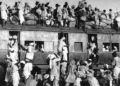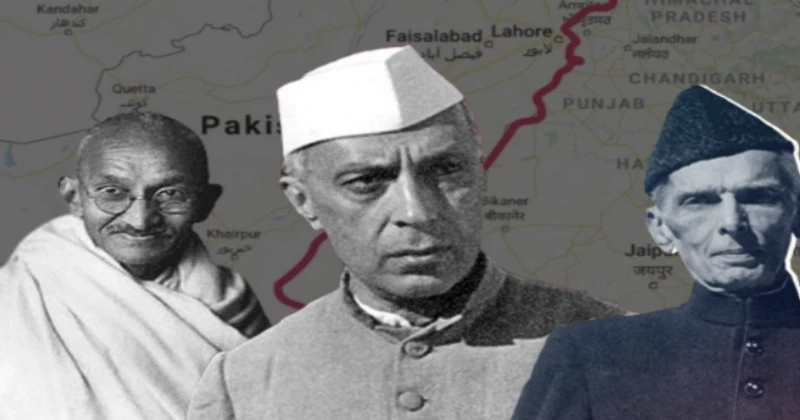
The Partition of India in 1947 remains a haunting scar in the nation’s collective memory, a tragedy marked by unimaginable violence, displacement, and loss. More than a million Hindus perished in the chaos of mass migration, countless families were uprooted and millions more were forced to surrender their homes and heritage. Yet, amid this human catastrophe, one unsettling reality stands out: the role of the Congress party, which professed nationalist ideals but repeatedly sidelined Hindu concerns. Instead of protecting all citizens equally, the Congress leadership often turned a blind eye to the suffering of Hindu refugees fleeing from the newly created Pakistan, showing tacit support to Islamist factions responsible for much of the bloodshed.
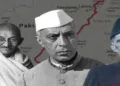
Congress partition 1947 Nehru Gandhi Jinnah
Many people to date believe that India was divided due to political differences. But the fact remains, though ignored by so-called ‘liberals’, that it was Islamist religious fear and the ‘secular’ character of the Congress party that led to the partition of undivided India into two countries. Islamists’ sham religious fears were pat touched by the Congress, which believed (believes) in the code of ‘secularism’! In most countries, secularism means the non-recognition of every religion, but in India, sadly, it means the recognition and pampering of one particular religion – Islam.
Islamists called for a separate nation since the 19th century
Partition was inevitable, as believed by a section of the then-leaders, but understanding what led to the decision is important. The Pakistan Movement was started by those who were educated at Aligarh Muslim University, and they sought another country to ‘protect’ the identity of Islam. The Congress and its associates to date fail to believe that the two-nation theory was first promulgated by Syed Ahmad Khan, the founder of the Aligarh Muslim University, and not Veer Savarkar.
In 1876, Khan had said that Hindus and Muslims could never become one nation as their religion and way of life were quite distinct. Seven years later, he voiced similar sentiments. He said, “Friends, in India, there live two prominent nations which are distinguished by the names of Hindus and Mussalmans…To be a Hindu or a Muslim is a matter of internal faith that has nothing to do with mutual relationships and external conditions…Hence, leave God’s share to God and concern yourself with the share that is yours…India is the home of both of us…By living so long in India, the blood of both has changed.”
Further, twelve years later, he stated that if the British community and the army were to leave India, taking with them all their cannons and their splendid weapons and all else, Hindus and Muslims could not sit on the same throne to rule this one nation. “Is it possible that under these circumstances two nations —the Mohammedans and the Hindus could sit on the same throne and remain equal in power? Most certainly not. One of them must conquer the other. To hope that both could remain equal is to desire the impossible and the inconceivable. But until one nation has conquered the other and made it obedient, peace cannot reign in the land.”
Further, in the year 1906, the Muslim members of the then Congress party formed the All India Muslim League, claiming that they were not respected as much as the Hindu leaders in the party. Later in the year 1930, one of the members of the newly formed Muslim League, Allama Iqbal, placed his demand for a separate state for Muslims. He thought that a separate Muslim state was important in a Hindu-dominated India.
Jinnah, who had striven for Hindu-Muslim unity earlier, also began to feel insecure about the claimed ‘dreadful condition’ of the minorities in India and blamed Congress for being unfair to the Muslims. The Muslim League, under the leadership of Jinnah, then drafted a resolution to form a new Islamic state. In the year 1940, Jinnah, at the Lahore conference, advanced his call for a separate nation. Though the definition of Pakistan was not clear until 1940, Jinnah’s opinion persuaded many Muslim leaders to quit Congress and join the Muslim League to support the two-nation theory.
By 1946, the Cabinet Mission tried to solve the issue by proposing a decentralised state instead of the idea of a separate nation named Pakistan. But neither of the proposals was accepted by the Islamic Party, the Muslim League, as Jinnah remained adamant on his idea of a separate nation for Muslims. Also, Congress’s Nehru then refused to agree to a decentralised state in which substantial powers would be given to local governments.
Congress approved the ‘June 3’ plan
On February 20, 1947, Clement Attlee, the then British Prime Minister, declared that the British would quit India by June 30, 1948. The declaration by Attlee meant that a deadline was already fixed for the transfer of power, even if the Indian politicians had not agreed on a constitution. On the other hand, the Muslim League, led by Jinnah, had boycotted the Constituent Assembly after his call for a separate country (Pakistan) was rejected by the Cabinet Mission.
The process of injecting the fear of ‘threat to Islamism’ in the minds of Islamists by Islamists themselves had begun back in the 19th century. Jinnah’s Islamist party believed that Muslims in Bharat were under threat and that there was a need for a separate nation for Mohammedans. Jinnah had also given the ‘direct action’ call to the Islamists wanting Pakistan to take matters into their own hands for the creation of Pakistan out of undivided India.
After a series of continuous genocides of Hindus, the Islamists won only after the ‘secular’ Congress Party failed to stop violence and negotiate a better deal over Pakistan. They (Congress leaders) eventually sensed the ‘plight’ of the Islamists and accepted the Mountbatten Plan on June 15, 1947. This is days after Lord Mountbatten, the last Viceroy of India, announced a ‘key’ to the political and constitutional deadlock created by the refusal of the Muslim League to join the Constituent Assembly, which was poised to frame the Constitution of India.
On June 3, 1947, Mountbatten was able to bring leaders of both the Indian National Congress and the Muslim League around a conference table, where they collectively endorsed Mountbatten’s plan, also known as the ‘3rd June’ plan. The new plan was accepted by both sides, Congress and the Muslim League, paving the way for the partition in less than 6 hours. Under this plan, the British had agreed to immediately transfer power to two successor authorities, and the plan envisaged dividing British India into two dominions – India and Pakistan on a territorial-cum-communal basis. The idea of Mountbatten was to divide India but to retain maximum unity, to which the Congress Party had readily agreed.
However, hinting at partition on February 20 itself, Attlee had stated in his statement that the British paramountcy on the princely states would lapse with the transfer of power and that it would not be transferred to ‘any successor government’. The League’s position on the creation of Pakistan was tactically conceded by the Indian National Congress in exchange for the Congress’s position on the unity of the future Indian state, especially on not granting independence to princely states, but being given to choose to join either India or Pakistan. The idea was to keep Pakistan as small as possible.
Congress had earlier rejected the ‘secretive’ plan
Lord Mountbatten was sent to India by George VI, the then King of the United Kingdom and the Emperor of British India, in March 1947. He was asked to liquidate the British Empire and quit India as soon as possible, with a deadline set until June 1948. But he wanted to return to Britain to advance his naval career as early as possible. So, he decided to advance the transfer of power by ten months, to August 1947, and for this, he chalked out several plans and held long discussions with Congress and the Muslim League leaders.
Jinnah’s call for ‘direct action’ and Congress’s failed attempts to avoid violence obviously had Jinnah’s rising hand in influencing Mountbatten. In the wake of increasing communal riots in the country, he asked Ismay, his Chief of Staff, to prepare a plan for the transfer of power to responsible hands and the division of the country. It was discussed that the entire plan was to be kept secret, and none of the parties in India should have any information before the plan was finalised.
However, Nehru, who was staying with Mountbatten as a guest at his residence at Simla, looked at the plan and rejected it in its entirety. Later, a Boundary Commission headed by Sir Cyril Radcliffe was constituted by the British government and tasked to delineate the boundaries between India and Pakistan. Radcliffe, who had never been to India in the past, was assigned to create artificial boundaries between the two countries.
Mountbatten went to London, where he got approval for the plan without any alteration. Attlee and his cabinet approved in a meeting that lasted not more than five minutes. On May 31, Mountbatten returned to India and met the Indian leaders, including Jawaharlal Nehru, Sardar Patel, Acharya Kripalani, Mohammad Ali Jinnah, Liaqat Ali, and Baldev Singh. After both Congress and Muslim League leaders approved the plan without raising any objections, Mountbatten discussed it with MK Gandhi and convinced him, saying partition was the best plan under the circumstances.
Why did Gandhi accept partition?
While many people staunchly claim that Gandhi was against the Partition of India, it was he who later supported the Congress, blaming partition on the Hindu and Sikh communities as well. “The Congress never asked for it. But Congress can feel the pulse of the people. It was realized that the Khalsa, as also the Hindus, asked for it”, he was quoted. Among many prime reasons for Gandhi to accept the proposal of partition of India, he chose to accept it only after taking into consideration the ‘pulse of people’. As the Britishers hurriedly prepared for their exit from India, they chose not to interfere in the ongoing communal violence and instead used the situation to execute their pre-planned exit.
Reportedly, Gandhi had at first proposed to make Jinnah an interim Prime Minister of the country. He had attempted to satisfy Jinnah’s long-standing ambition to establish power, and hence kept him away from his insistence on Pakistan. But, later, Gandhi himself withdrew the offer as Jinnah had earlier rejected one similar proposal. It is Gandhi in the end who saw no option but to approve the partition of the country.
To note, Gandhi was also of the opinion that there was nothing wrong on their (Muslims’) part to demand Pakistan, as they could never live where the Hindus had always been in the majority. “They are harming themselves by making this demand, and I pray to God to save them in time from any harm coming to them,” he had said after meeting the Viceroy on June 4. Later in September 1947, after the partition, Gandhi also began expressing his worries for Pakistan and the Muslims of Delhi. He claimed that Muslims were not safe in Delhi. He met Maulana Azad and laid down some conditions in favor of Islamists. He demanded that the annual fair (Urs) should be organised peacefully at Khwaja Bakhtiyar Dargah of Mehrauli. He also demanded that the 100 mosques in Delhi that have been converted into refugee camps be brought back to their former status.
Apart from this, he demanded free movement of Muslims in Old Delhi. Non-Muslims should not object to Muslims returning from Pakistan. Muslims should travel fearlessly in trains. Economic boycott of Muslims should not be done. And Hindu refugees should be settled in the territory of Muslims only if they get permission from Muslims. Gandhi also blackmailed the then Government of India to lend Rs 55 crores to Pakistan.
Chaos at the hands of Congress reported during rehabilitation post-partition
A few historical records further expose Congress’s favoritism towards Muslim community and ignorance towards Hindus and Sikhs who had been rehabilitated from Pakistan immediately post-partition. In West Bengal, relief and rehabilitation efforts were largely ad hoc as refugees languished in camps that were overwhelmed by overcrowding, disease, limited rations, and unsanitary conditions. The then newly formed Congress government often treated rehabilitation as secondary, expecting refugees to return and offering only minimal financial or housing support.
By contrast, refugees in Punjab, where a two-way migration occurred, received much more organized resettlement, including land, housing, schools, and healthcare. This clear imbalance underscores both planning failures and regional favoritism.
Further, the Indian government’s reluctance to define who qualified as a “refugee” led to inconsistent access to support. Local authorities frequently changed criteria via circulars, causing confusion and hardship for displaced persons. This reflects bureaucratic opacity and inequity.
The Partition was executed hastily and without proper coordination. Social reformer Kamaladevi Chattopadhyay sharply criticised the government’s relief efforts as short-sighted and poorly managed, describing the rehabilitation process as a confused series of trial-and-error measures. She pointed out significant delays in distributing land, which disproportionately harmed Hindu refugees from the North-West Frontier Province, while urban elites frequently reaped greater advantages.
Nathuram Godse also had expressed frustration over the Congress government’s treatment of Hindu refugees in the court, especially the removal of refugees from mosques, while Pakistan did not offer similar respect to Hindu and Sikh places of worship.
Opposition figures within Congress and beyond most notably Syama Prasad Mookherjee (later founder of the BJP’s precursor, Jana Sangh) vocally critiqued the government’s approach, claiming its rhetoric and policies were unsympathetic to Hindu refugees and poorly administered. Also, the then Congress leader Khan Abdul Gaffar Khan had opposed Jinnah’s demand for a separate Islamic country, but to no avail. The leader stated that a separate nation, especially for Muslims, would be an un-Islamic idea. However, later he shifted to Pakistan and never returned to Congress.
Congress leaders blatantly believed that by 1950, many refugees were becoming self-reliant but were stirred into dissatisfaction, demanding more compensation, like property. They falsely feared this discontent threatened India’s secular ideals, as refugee grievances were increasingly framed in religious and geopolitical terms, setting the stage for the long-standing ‘conflict’ between secularism and Hindu majoritarianism in Indian democracy.
India attained independence on August 15, 1947, at the cost of millions of lives and brutal riots between Hindus and Muslims. People left behind their homes and all that they owned in fear of communal violence. Crores walked miles to their newly promised homeland. While Indian Muslims left for their newly created home of Pakistan, Hindus and Sikhs who were in what is now Pakistan were forced to move to India. And the rest is history.