New Delhi: For a country of over 1.4 billion people, the number of doctors it trains each year is not a statistic, it is a direct measure of how many families will find a specialist within reach, how many bright students will not have to fly to Ukraine, Georgia, or the Philippines to study medicine and how close India stands to the World Health Organisation’s benchmark of one doctor per 1,000 people. India carried a doctor-population ratio of 1:1,456 at the end of the UPA years.
A fresh reply by the Union Minister of State for Health and Family Welfare, Shri Jagat Prakash Nadda, in the Lok Sabha on July 24, 2026, along with a separate written reply by Minister of State Anupriya Patel the same day, has once again put this transformation on record. A decade’s worth of replies, from 2023 to 2026, lay out a clear, verifiable trajectory of Indian medical education expansion.
The UPA Legacy: A Decade of Slow Progress and Negligence
When the UPA government demitted office in May 2014, India had
-387 medical colleges
-51,348 MBBS seats
-31,185 postgraduate (PG) seats
The UPA government’s own record, published on its official website tracking achievements, shows just how gradual this growth was even in its second term. Between May 2009 and mid-2013, roughly four years of UPA-II, only 72 new medical colleges (including six new AIIMS) were established, adding 12,062 MBBS seats and 9,925 PG seats. By 2013, the country had 362 medical colleges with a sanctioned capacity of 45,629 MBBS seats and 23,763 PG seats, though 12 colleges housing 1,300 seats had lost renewal that year, leaving an effective capacity of roughly 44,329 MBBS seats.
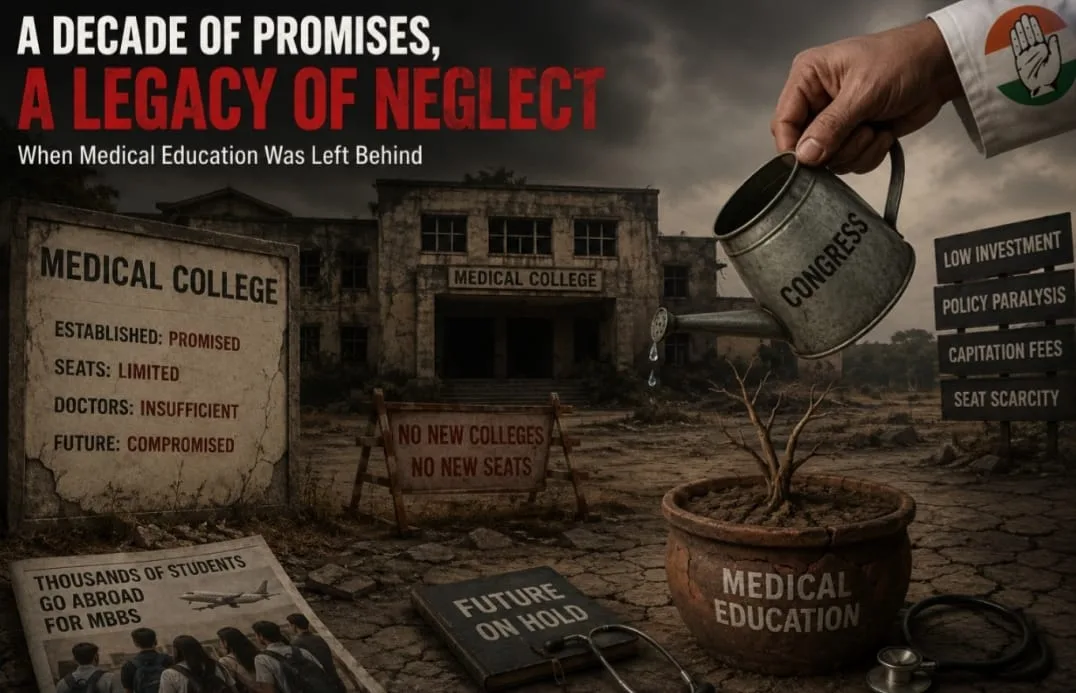
In other words, across nearly a full decade of UPA rule (2004–2014), India added medical college capacity at a pace that left the country with a doctor-population ratio of 1:1,456, far short of the WHO’s recommended 1:1,000 and a bottleneck that pushed thousands of NEET-qualified students towards costly medical degrees abroad every year. The UPA government was simply slow. The reason that it presided over a system rigged to stay small was that scarcity was profitable for the people who controlled the gates.
The Great Medical Exile
The clearest human cost of the shortage was the annual exodus of Indian students abroad. Denied affordable seats at home and priced out by the capitation fees that flourished in a supply-starved private market, tens of thousands of young Indians flew to Ukraine, Russia, China, the Philippines, Georgia, Kyrgyzstan, Bangladesh and Nepal to study medicine. They paid in foreign exchange in years away from family and often in uncertain quality and licensing battles on their return.
The tragedy of this policy failure became impossible to ignore in early 2022, when war in Ukraine stranded thousands of Indian medical students, forcing the government to mount Operation Ganga to evacuate them. The nation watched and was stunned, as it discovered how many of its future doctors it had quietly outsourced to a war zone. That was not an accident of geopolitics; it was the direct, foreseeable consequence of a decade in which the seats those students needed were never built at home. Congress-era scarcity wrote the plane tickets.
The Geography of Neglect
There is also a quieter injustice buried in the old numbers where the colleges were. For decades, medical education clustered in the south and west, while the vast populations of the north, east and Northeast were underserved. The UPA did little to correct this imbalance. It was the post-2014 Centrally Sponsored Scheme attaching new colleges to district and referral hospitals in underserved and aspirational districts, with well over 130 of 157 approved colleges now functional, that began to move medical training into Uttar Pradesh, Odisha’s aspirational districts, the Northeast and Jammu & Kashmir. That is what intent looks like and its absence for a decade is what neglect looks like.
The BJP Decade: A Record of Sustained Expansion
Government replies to Parliament since 2014 show a steady, well-documented climb in capacity, not a one-time jump, but year-on-year expansion sustained across three terms:
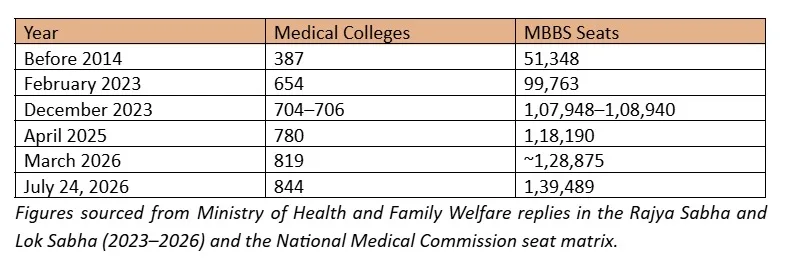 This works out to a 118 per cent rise in medical colleges (387 to 844), a 171 per cent rise in MBBS seats (51,348 to 1,39,489) and PG seats that have nearly tripled up 177 per cent (31,185 to 86,360), since 2014.
The Latest Numbers: What Minister Told the Lok Sabha
The most recent data point, presented by Shri Jagat Prakash Nadda in a written reply in the Lok Sabha on July 24, 2026, tracks the shorter-term trend using the National Medical Commission’s academic-year seat matrix:
-MBBS seats rose from 1,09,115 in AY 2023–24 to 1,28,976 in AY 2025–26
-PG seats rose to 86,360 in AY 2025–26
-As per the Indian Medical Register, India now has 15,35,155 registered allopathic practitioners and 7,51,768 registered AYUSH practitioners
-Assuming 80 per cent availability of registered practitioners across both systems, the doctor-population ratio now stands at 1:778, comfortably ahead of the WHO’s 1:1,000 benchmark and a dramatic improvement from the 1:1,456 ratio India carried at the end of the UPA years.
The modest difference between this seat-matrix figure (1,28,976) and the since 2014 comparison figure cited by Minister Anupriya Patel (1,39,489) reflects the two replies drawing on slightly different reference dates and counting methods; both are official, Parliament-tabled numbers, and both confirm the same underlying story of sustained, multi-fold expansion.
What Drove the Expansion
Parliament replies over the years point to a set of deliberate policy interventions behind this scale-up:
-Centrally Sponsored Scheme for new medical colleges attached to district/referral hospitals of 157 approved colleges under this scheme; well over 130 are now functional, deliberately targeting underserved and aspirational districts.
-Expansion of AIIMS from a single institution historically synonymous with elite medical education in Delhi, the AIIMS network has grown substantially under the Pradhan Mantri Swasthya Suraksha Yojana (PMSSY), with 22 new AIIMS approved and undergraduate courses running in most of them.
-To raise intake capacity, the permissible MBBS intake ceiling per college was raised, and companies registered under the Companies Act were permitted to establish medical colleges, widening the base for private participation alongside public investment.
-NEET as a single national entrance exam replacing a fragmented, multi-exam admission system, NEET-UG (administered by the NTA since 2017, after AIPMT was phased out) streamlined and equalised access to the expanded seat pool.
-Super-speciality upgradation: 75 projects for upgrading government medical colleges with super-speciality blocks under PMSSY, most now complete, have improved both PG training capacity and tertiary care access.
Colleges Alone Don’t Tell the Whole Story
The seat expansion has been accompanied by a shift in geography. Government data placed Uttar Pradesh among the states with the highest number of medical colleges nationally by 2025, alongside Tamil Nadu and Maharashtra, a marked change from the historical concentration of medical education infrastructure in southern and western India. Odisha’s aspirational districts, the Northeast and J&K have also seen new colleges under the district-hospital-upgradation scheme, addressing a regional imbalance that had persisted for decades.
Comparing the two eras on the government’s own tabled figures:
-Medical colleges: UPA-era pace added roughly 25 colleges a year in its final term (72 colleges in ~4 years); the post-2014 period has added colleges at more than three times that annual pace to reach 844 today.
-MBBS seats: UPA-II added about 3,000 seats a year; the post-2014 period has added over 8,000 seats a year on average, including a single-year addition of 13,436 new seats in AY 2024-25 alone.
-PG seats: nearly tripled since 2014, directly easing the historic bottleneck where MBBS graduates struggled to find specialisation seats.
-Doctor-population ratio: from 1:1,456 (short of the WHO norm) to 1:778 (ahead of it), arguably the clearest single indicator that capacity expansion has translated into more practising doctors on the ground.
For a sector where UPA-II’s own record shows barely 72 new colleges added in four years, the post-2014 period’s addition of over 450 new medical colleges, more than doubling the count, marks one of the more consequential and consistently documented shifts in India’s higher education and public health story.
A Fair Word and the Work Still Left
Credit where due does not require pretending the job is finished. Rapid seat expansion brings its own challenges: a shortage of qualified faculty, uneven quality across new colleges, the risk that quantity outruns clinical training standards and the persistent difficulty of getting doctors to serve in rural India rather than migrate to metros or overseas. These are real, and the coming decade must guard the quality of the pipeline as fiercely as it grew the numbers. But acknowledging tomorrow’s tasks is not the same as excusing yesterday’s negligence. One government built the shortage and defended the gate; another dismantled both. The data does not merely record growth; it assigns responsibility.
There is a strategic dimension too. A nation that cannot train its own healers is a dependent one reliant on foreign universities, on distant governments and on the accident of where the next war or pandemic breaks out. Scaling domestic capacity is therefore not merely a welfare project but an act of self-reliance, insulating India’s health security from shocks it cannot control. The UPA complacency had quietly mortgaged that security; rebuilding it was not a favour to the nation but a debt long overdue.
For a country of 1.4 billion, the number of doctors it trains is a moral statement about whose health matters. For a decade, that statement was one of indifference with slow expansion, a corrupted regulator, a bottlenecked pipeline and a generation shipped abroad to learn medicine because their own nation would not teach them. The turnaround from scarcity to scale is genuine and welcome. But every family that waited too long for care, every student who packed a bag for Kyiv or Manila and every speciality that went understaffed for want of a PG seat, is a reminder that the scarcity was not written by destiny. It was written by neglect, and it took a decade of deliberate work to finally begin erasing it.