
New Delhi: Long before cinema, television and animation transformed storytelling, India had its own visual theatre — one in which stories came alive through wooden figures, leather silhouettes, strings, rods and the skilled hands of puppeteers. Across the country, generations of performers have used puppets to narrate stories from the Ramayana, Mahabharata and Puranas, taking audiences into worlds of kings and queens, gods and demons, warriors and sages.
When Stories Were Told Through Puppets
India’s puppet traditions developed differently across regions, with each community creating its own style, materials and performance techniques. Some puppets are controlled with strings, others with rods, while shadow theatre uses leather figures placed between a light source and a screen. Despite these differences, their purpose has remained remarkably similar: to turn stories into a visual experience. The puppeteer becomes storyteller, actor and stage manager at the same time, using movement, narration and music to make an otherwise lifeless figure appear to walk, dance, fight or speak. Over generations, puppetry became an important medium through which communities preserved stories, cultural values and local traditions.
The Ramayana: An Epic Brought Alive Through Puppetry
Among the most enduring narratives in Indian puppet theatre is the Ramayana. Rama, Sita, Lakshmana, Hanuman, Ravana and other characters appear across several regional puppetry traditions. Yet each region gives the epic its own artistic character. Rama may appear as a colourful wooden puppet in one place, a leather shadow figure in another, and a rod-controlled character elsewhere. The visual language changes, but the central story remains familiar. Episodes such as Rama’s exile, Sita’s abduction, Hanuman’s journey to Lanka and the battle between Rama and Ravana lend themselves naturally to visual storytelling. Through puppetry, audiences did not merely hear the epic; they could see its characters and dramatic episodes unfold before them.
Rajasthan’s Kathputli: Stories on Strings
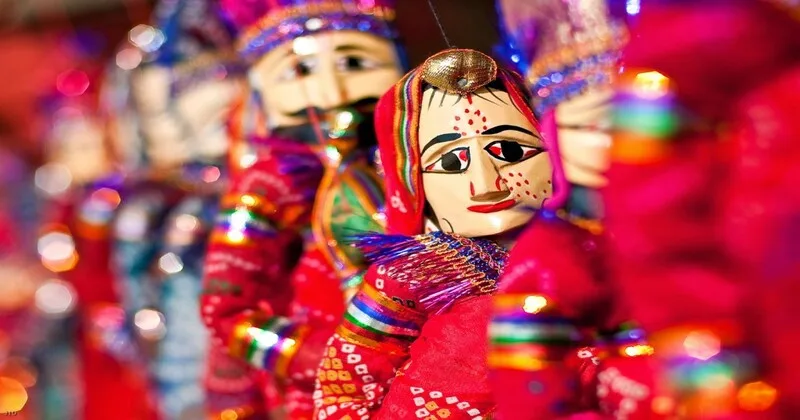
One of India’s best-known puppet traditions is Kathputli, strongly associated with Rajasthan. Traditional Rajasthani puppets are brightly dressed wooden figures manipulated with strings and are known for their distinctive faces, costumes and exaggerated movements. Performances historically featured stories of kings, warriors, heroes, local legends and social life, while mythological narratives also formed part of the wider repertoire. The puppeteers operate the figures from above, making them dance, turn and move across the performance space. Kathputli also demonstrates how Indian puppetry combines two forms of heritage, the creation of the puppet itself and the performance tradition through which that puppet acquires life.
Andhra Pradesh and Telangana: Leather Shadows Narrate Epics
In Andhra Pradesh and Telangana, Tholu Bommalata represents one of India’s important leather shadow-puppet traditions. Flat leather figures are placed between a light source and a translucent screen, allowing their forms to appear before the audience. Traditional performances have drawn heavily from the Ramayana and Mahabharata, along with religious and folk narratives. The puppets can be large and intricately designed, while narration, music and dialogue turn the screen into a moving world of epic characters.
Karnataka’s Togalu Gombeyata
Karnataka has its own distinctive leather shadow-puppet tradition known as Togalu Gombeyata. Like other shadow traditions, it uses leather figures positioned between a light source and a screen, with performers manipulating them to create movement. Gods, heroes, animals and other characters appear in stories drawn from traditional narratives, including episodes associated with the Ramayana and Mahabharata. The puppets themselves demonstrate considerable craftsmanship, with leather treated, cut, decorated and sometimes perforated to create intricate patterns. When light passes through them, these details contribute to the visual effect on the screen, bringing together the skills of the artisan and the puppeteer.
Odisha’s Kandhei Nacha
Odisha’s Kandhei Nacha represents the state’s traditional string-puppet heritage. The puppets are manipulated using strings and have historically been used to depict characters from mythology, folklore and social narratives. Odisha’s rich religious and literary traditions have provided a natural setting for storytelling through puppetry, with narratives connected to the Ramayana, Mahabharata and other traditional stories finding expression through performance. The puppets become a bridge between visual art and storytelling, allowing audiences to encounter familiar cultural narratives through a distinctive regional performance style.
West Bengal’s Putul Nach
West Bengal has a rich puppet heritage that includes Putul Nach, or traditional puppet dance. Different forms of puppetry have developed across the region, including string and rod-based traditions. Performances have drawn on folklore and popular stories, with puppets accompanied by narration and music. The tradition also demonstrates the flexibility of folk puppetry. The ability to combine entertainment, storytelling and commentary allowed puppetry to remain closely connected with local communities.
Tamil Nadu’s Bommalattam
Tamil Nadu’s Bommalattam is another important Indian puppet tradition. Its puppets are generally larger and can be manipulated using a combination of strings and rods, giving performers considerable control over their movements. Traditional narratives have included episodes from the Ramayana and Mahabharata alongside stories connected with local traditions. The performance combines puppetry with narration and music, illustrating how India’s traditional theatre forms rarely existed in isolation. Instead, storytelling, craft, music, movement and mythology came together to create a complete cultural experience.
Kerala’s Tholpavakoothu
Although India’s puppet traditions extend far beyond Kerala, the state’s Tholpavakoothu offers one of the strongest examples of puppetry being connected with temple ritual. The traditional leather shadow-puppet performance is associated particularly with Bhagavathi temples in northern Kerala, where the Ramayana forms the central narrative. The puppets are projected against a screen using traditional lamps while performers narrate and sing the epic.
The Ramayana may be one of the most prominent narratives in Indian puppetry, but it is far from the only one. The Mahabharata, stories from the Puranas, tales of Krishna, Shiva and other deities all found expression through puppetry in different parts of the country. Regional performers often adapted stories to their own languages, cultural settings and audiences. This meant that puppetry became a flexible storytelling medium capable of carrying both pan-Indian epics and local traditions from one generation to another.
For generations, traditional performing arts also functioned as informal means of education. Through stories, audiences encountered ideas about courage, duty, loyalty, devotion, righteousness and the consequences of wrongdoing. Characters from the Ramayana, Mahabharata and Puranic traditions could communicate moral lessons without the need for formal instruction. For younger members of the audience in particular, seeing a character act out a story could make its message more memorable. In this way, puppetry became not only entertainment but also a means of transmitting cultural knowledge and values.
The Artisan Behind Every Puppet
Every puppet tradition depends on specialised craftsmanship. Wood has to be carved, leather treated and cut, faces painted, costumes prepared and strings or rods attached. The appearance of the puppet often reflects the artistic identity of the region from which it comes. A Rajasthani Kathputli, for instance, has a very different visual character from a leather shadow puppet of Karnataka or Andhra Pradesh. The creation of these figures therefore preserves traditional knowledge of materials, tools, painting and ornamentation alongside the performance itself.
The puppeteer is at the centre of the entire tradition. Operating a puppet requires much more than simply moving strings or rods. Performers must know the narrative, understand the characters, coordinate movements with narration and music, and sometimes operate several figures during a single sequence. In traditional communities, this knowledge has often been passed down through families. Children grow up watching parents and grandparents make and perform with puppets, gradually learning the skills required to continue the tradition.
Cultural festivals, museums, schools and heritage programmes have created new opportunities for India’s puppeteers. Performances and workshops can introduce children and young adults to traditional forms that they may otherwise never encounter. These programmes also allow audiences to understand how the puppets are made and operated. For children, making and manipulating a puppet can offer a direct introduction to storytelling, craftsmanship and performance. Such interactions can help transform puppetry from something viewed as an old folk art into a living creative practice.
The greatest importance of Indian puppetry lies in its ability to preserve more than physical objects. It preserves memory, storytelling traditions and cultural knowledge. When a puppeteer presents the Ramayana, the performance carries echoes of generations who told the same story before them. When an artisan creates a puppet of Hanuman, Rama or Ravana, the figure becomes part of a craft tradition that has been shaped by countless hands. And when a young audience watches that puppet perform, an ancient story enters another generation.
From Strings and Shadows to India’s Cultural Future
India’s puppet heritage is ultimately a story of extraordinary diversity. In one region, a wooden figure dances from a string; in another, a leather character appears as a shadow against an illuminated screen; elsewhere, rod-controlled puppets take the stage accompanied by music and narration. The materials, languages and techniques may differ, but the fundamental idea remains the same: a human hand gives life to an inanimate figure so that a story can live again. The strings may be old. The leather may carry the marks of generations. The stories may be centuries old. But every time a puppeteer steps behind a screen, raises a figure and begins to tell a story, India’s ancient theatre comes alive once again.