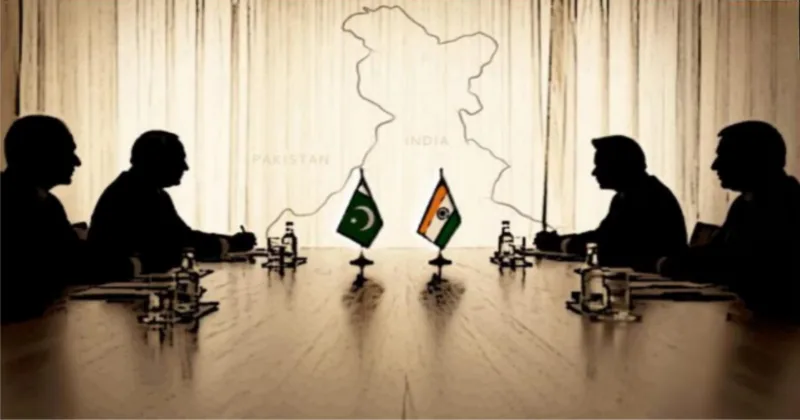
“India-Pakistan Track 2 Dialogue”, this headline hit the news boards and was widely glorified across social media. There were rapid buzz and speculations about the back channel talks and diplomatic efforts alive between New Delhi and Islamabad, post the Pahalgam terror attack and Operation Sindoor, when India kept Indus Water Treaty in abeyance and drew strong red lines between talks and terrorism, by emphasising that “talks and terror cannot go together”.
However, such apprehensions and signals about India-Pakistan peace and diplomacy efforts were stimulated without dissecting the roots of the Track 2 dialogue. Who are the people participating in the dialogue? Where is the dialogue held? Is it purely bilateral in nature or were there representatives from other countries? What is the core agenda of the talks and will it indeed yield any concrete or credible outcomes in solving the India-Pakistan conflict in the long-run? Will the talks dismantle the terror network nurtured in Pakistan?
Most importantly, who is sponsoring such luxurious dialogues at world class locations and isn’t it without any hidden propaganda motive and is embedded with pure intentions of resolving the conflict and eroding the terror menace of Pakistan? Well, digging deep into these doubts, will unravel, the propaganda machine masked behind the false narrative of peace, diplomacy and conflict resolution.
A structured disinformation campaign by Islamabad and western think tanks
The India-Pakistan track 2 dialogue is a disinformation campaign carefully calibrated by Pakistan to picturize itself as a peacemaker in the global stage, while demonising India for weaponising the water by keeping the Indus Water Treaty in abeyance. This was an attempt by Islamabad to manipulate the world to conceal its terror motives & activities and also spill anti-India narratives & derail its counter-terrorism efforts.
Without fact checking, the India-Pakistan Track 2 dialogue was glorified by the sections of the Indian media and so called intellectual hubs. This was exactly the hidden agenda of Pakistan and the western think tanks who funded the dialogue. To amplify the peace talks and erase or blur the strong red lines drawn by India post the Pahalgam terror attack. It is to derail the consistent counter-terrorism efforts of New Delhi. Pakistan is till date, a hotbed and fertile ground that brews notorious terror networks as an integral part of its statecraft.
Lashkar-e-Taiba(LeT), Jaish-e-Mohammad(JeM) and other terror outfits wander freely across Pakistan with much fervour and respect. The military chiefs are repeatedly seen with the chiefs of the terror organisations. Military heads attend the funeral of the terrorists. Thus, it is a proven fact that Pakistan continues to nourish terrorism as a state-sponsored policy. Hence, talks and diplomacy with a terror-state is impossible. India has outrightly rejected talks with Pakistan until it evidently dismantles terrorism, which is deep-rooted in its country.
Luxurious locations, lakhs of funds & a solid propaganda machine
The India-Pakistan Track 2 dialogue was held at luxurious and elite locations in Bangkok, Colombo and other places. Thus, it is said that days of continuous dialogue, expressing & exchanging views at elite locations will not yield a permanent solution to the terror threat emanating from Pakistan. Most importantly, who is funding these talks. It is ofcourse not the Government of India or any other Indian entities.
It is funded by a famous London-based think tank who occasionally conducts dialogues about the geopolitical undercurrents flowing in South Asia. The dialogue is also sponsored by the Ottawa University. Here, the key apprehension rises. Why are western think tanks and universities so ambitiously working on the India-Pakistan peace process and are funding it? Apparently, why should they espouse diplomatic efforts for India and Pakistan, which is purely a bilateral issue. What are the stakes of the western intellectual wings in India-Pakistan conflict and why should they host neutral dialogues, when Pakistan is clearly fabricating terrorism, which has global ramifications in terms of peace and security.
This proves that it is a structured attempt to orchestrate an anti-India narrative, which the western media, think tanks and universities have been running for decades. It is a measured dialogue crafted to defame the growth story of India, its counter-terrorism efforts and propagate the fake narrative of Pakistan across the globe. By holding such dialogues, India and Pakistan are presented in the world as equal stakeholders in a geopolitical or cross-border conflict. And that is the exact propaganda the dialogue is aiming to sell.
However, the reality is, New Delhi and Islamabad are not indulging in a geopolitical conflict. While Pakistan is a perpetrator of terrorism, New Delhi is a victim of terrorism. The perpetrators and victims cannot sit across the table and involve in diplomacy, especially at the cost of India’s national security, sovereignty and lives of its people.
Who participated in the Track 2 dialogue?
Analysing the list of participants in the India-Pakistan Track 2 dialogue, exposes further about how this is a propaganda machine and disinformation campaign fuelled by Pakistan and western think tanks. From India, retired foreign service officials, military personnel and intelligence officers participated. Thus, no serving officials or representatives from the Government of India were present.
The retired officials who are currently detached from the foreign policy or diplomatic book of New Delhi were present in the dialogue. Thus, what they expressed were their personal opinions about the India-Pakistan peace process and it in no capacity represented the official message of the Government of India. These retired officials don’t have any access to the official records, diplomatic credentials and strategic playbook of New Delhi. Based on their professional experience and respective intellectual and ideological capacity, they outlined their personal opinions, but not the message of New Delhi on India-Pakistan relations.
As per the sources, from the Pakistani side, the representatives were a serving diplomat handling South Asia, an official dealing with Afghanistan and a member associated with Pakistan’s ISI. This representation from Pakistan, testifies that it is a propaganda machine by Islamabad to funnel anti-India narrative. To defame India, present the disinformation of Pakistan on the global stage and project itself as a peacemaker. It is also said that the officials from the US and UK were present in the dialogue.
Here comes the critical question. What was the deal for the representatives from the US and UK in a dialogue meant to resolve the India-Pakistan issue, which is purely bilateral in nature. New Delhi has repeatedly reiterated that the India-Pakistan issue is purely bilateral in scope and doesn’t entertain any third party mediation. Thus, involvement of representatives clearly illustrates that the India-Pakistan Track 2 dialogue is not backed by the government and is purely a propaganda to fuel anti-India narrative and present Pakistan’s fake claims on the global stage.
Moreover, if the diplomatic meetings are orchestrated by government channels, then the details of the discussions between state representatives will be predominantly kept confidential as it is directly linked to national security. However, the details of the India-Pakistan Track 2 dialogue was widely circulated across social media and other platforms, without considering the national security costs. Such an irresponsible manoeuvre reflects that this is not a serious diplomatic effort, but a luxurious discussion to elevate the fake narratives of Pakistan, illicitly targeting India.
Foreign Secretary Vikram Misri draws red lines against terrorism
Responding to the news about India-Pakistan Track 2 dialogue, Foreign Secretary Vikram Misri said, “I have seen the reports and am aware of them. Dozens of these kinds of events take place in dozens of places around the world on a whole variety of subjects. As far as we are concerned, these are private events organised by private parties. There is nothing official about them. As far as the Government of India is concerned, there is no official participation or no official support. Anybody from India, who is participating in these events, whether retired diplomats, retired military officials or members of the civil society, they speak for themselves and represent their own point of view”.
“They do not in any way represent the view of the Government of India. We really take no cognizance of these events. They really don’t hold much value”, Vikram Misri thus refuted the India-Pakistan Track 2 dialogue. New Delhi, thus, has kept the red lines intact against state-sponsored terrorism. For nearly 8 decades, Pakistan has traded terrorism as a return for diplomacy, dialogue and India’s peace efforts. New Delhi thus clearly mentioned that terror and talks cannot go together and there is no question of diplomacy until Islamabad ends funneling cross-border terrorism and killing innocent lives in India.