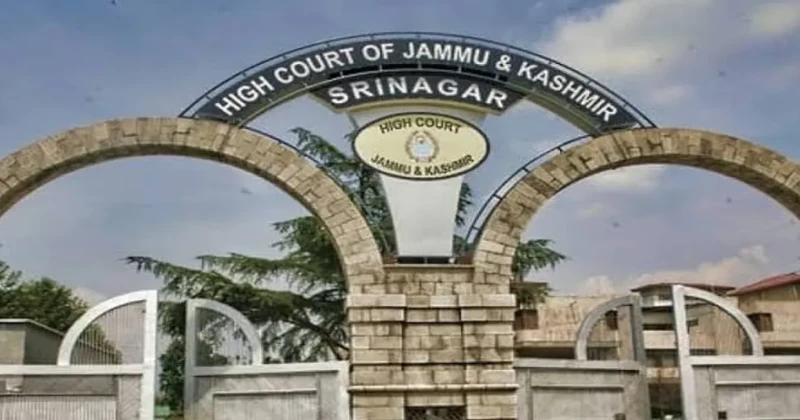
SRINAGAR: The High Court of J&K and Ladakh has set aside the discharge of a man accused of leading a separatist procession with late Hurriyat Conference chairman Syed Ali Shah Geelani, holding that secessionist sloganeering, when accompanied by incitement and violence against security forces, can prima facie fall within the definition of “unlawful activity” under the Unlawful Activities (Prevention) Act.
A Division Bench comprising Acting Chief Justice Sanjeev Kumar and Justice Mohd Yousuf Wani delivered the judgment in UT of J&K through Station House Officer, Police Station Kupwara v. Mohd Yousuf Lone, allowing the Union Territory administration’s appeal against a January 2025 order of the designated NIA court at Kupwara.
The case arises from a procession held in Kupwara on November 8, 2013. According to the prosecution, Lone and Geelani were leading the procession when participants raised slogans challenging India’s unity and territorial integrity and allegedly incited the public against the country’s sovereignty. The procession subsequently turned violent, with stones being pelted at police and security forces.
An FIR was registered under provisions of the Ranbir Penal Code and Section 13 of the UAPA. The designated Special Court, however, discharged Lone of the UAPA charge and certain other offences.
The High Court found the approach legally unsustainable. It emphasised that at the stage of framing charges, courts are not required to conduct a mini-trial or determine whether conviction is certain. The relevant question is whether the prosecution material creates a strong suspicion that the accused committed the alleged offence.
Referring to Section 2(o) of the UAPA, the Bench noted that “unlawful activity” encompasses actions, including spoken or written words, intended to support or bring about cession of Indian territory or disrupt the sovereignty and territorial integrity of India.
Significantly, the Court observed that sloganeering for secession by an accused allegedly leading a mob in the company of the head of a proscribed separatist organisation, coupled with public incitement and violence against security forces, was capable, on a prima facie assessment, of falling squarely within the statutory definition.
The Bench was critical of the Special Court for concluding in a single sentence that the ingredients of unlawful activity were absent without examining the recorded slogans, witness statements, the leadership role attributed to Lone and the resultant violence.
At the same time, the High Court expressly clarified that it was making no finding on Lone’s guilt or innocence. Those questions remain for determination at trial.
Allowing the appeal, the Court restored the charge-sheet and directed the Special Court to reconsider framing of charges after examining the material and hearing both sides.
The ruling is significant in the context of Kashmir’s long battle against organised separatist mobilisation. Equally significant is the legal distinction drawn by the Court: its conclusion did not rest upon a slogan viewed in isolation, but upon the alleged combination of secessionist advocacy, leadership of a mob, incitement and subsequent violence against security forces.