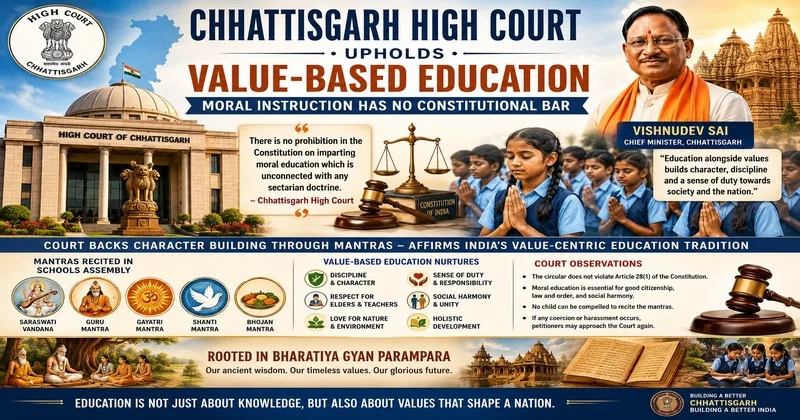
India’s educational tradition has always held that schools are laboratories for personality and character development. Imparting values alongside knowledge is essential for children, as this fosters a sense of duty, discipline and social responsibility. Indeed, this has been the core objective of Indian education; consequently, traditions such as prayers, ‘Shanti Mantras’, ‘Guru Vandana’ and the ‘Gayatri Mantra’ have persisted across generations, from the ancient ‘Gurukuls’ to modern schools, as part of India’s civilizational evolution.
The Chhattisgarh High Court has now placed its significant constitutional seal of approval on the continuation of this tradition of knowledge-oriented prayer. The court clearly stated that the Constitution does not prohibit “moral education that is unconnected to any sectarian principles.” The court further observed that the state government’s order does not compel students to adopt any specific religion or violate their religious freedom. Accordingly, the High Court dismissed the petition challenging the state government’s directive, which mandated the recitation of ‘Saraswati Vandana’, ‘Guru Mantra’, ‘Gayatri Mantra’, ‘Shanti Mantra’ and ‘Bhojan Mantra’ during assemblies in government schools across Chhattisgarh.
The petition was jointly filed by Abdul Salam Rizvi (former Chairman of the Chhattisgarh Waqf Board), Mahendra Chhabra (former Chairman of the Minority Department) and Shafiq Ahmed. They contended that the government’s rule went against the children’s wishes and alleged that the inclusion of prayers from only one religion was inappropriate.
The counsel representing the petitioners argued before the court that the directive violated Article 28 of the Constitution. It was contended that religious instruction or rituals cannot be conducted in institutions that are fully funded by the state. It was further claimed that this order violates Article 14 (Right to Equality), Article 21 (Right to a dignified life) and Article 25 (Freedom of Religion) of the Constitution.
In response to these arguments, the state government strongly presented its case in court. The government stated that the circular in question was issued in alignment with the National Education Policy (NEP- 2020), which emphasizes integrating Indian knowledge traditions and cultural awareness into education.
The government also clarified that terms like “mandatory” and “ensure” used in the circular pertain to school administration and daily routine, rather than being intended to exert religious pressure. There is no provision for any punitive or disciplinary action against a student who does not recite these mantras.
The state further submitted to the court that the Gayatri Mantra, Shanti Mantra and other Vedic verses express sentiments of universal well-being, knowledge, environmental conservation, gratitude and human values; they do not aim to propagate any specific religion or facilitate religious conversion. These mantras and prayers are part of India’s culture and values; their objective is to instill discipline, respect for elders, and a love for the environment in children.
The government also noted that the rule is already in effect and neither children nor parents have raised any objections to it. Under this rule by the School Education Department, the morning assembly in all state government schools includes the recitation of the National Anthem, National Song, Deep Mantra, Saraswati Vandana, and Guru Mantra, alongside stories about great personalities. Additionally, a meal prayer is recited before lunch and the Gayatri Mantra and Shanti Mantra are recited before school dismissal.
After considering the arguments and evidence from both sides, Justice Amitendra Kishore Prasad dismissed the petition, deeming it premature. The Court stated that the petitioners failed to prove that there had been any actual violation of fundamental rights or that students were being compelled to participate in the prescribed prayers. The School Education Department’s circular does not violate Article 28(1) of the Constitution; this Article prohibits religious instruction in educational institutions wholly maintained out of state funds.
The Court clarified that there is no restriction on moral education under this provision. However, the High Court granted the petitioners an opportunity, stating that if any child is subjected to coercion or harassment in the future, they may approach the Court again with concrete evidence.
During the proceedings, the court clarified that Article 28(1) of the Constitution does not prohibit moral instruction that is distinct from the tenets of any specific religious sect. Such moral instruction is considered essential for molding good citizens, maintaining law and order and fostering social harmony and unity. A single-judge bench led by Justice Amitendra Kishore Prasad further clarified that India’s rich tradition of knowledge and moral education cannot be viewed through a narrow sectarian lens.
It is noteworthy that the State School Education Department issued a circular on June 12, 2026. This directive mandated that, starting from the 2026-27 academic session, schools must include the recitation of the National Anthem and the National Song, alongside the ‘Saraswati Vandana’ and the ‘Gayatri Mantra’. Following the issuance of this order, a specific section of society became active in opposition. They argued that the recitation of mantras linked to a particular tradition in government schools could make students from minority communities feel uncomfortable.
Education alongside Values, Not Education versus Values
It is worth noting that in recent years, following the implementation of the National Education Policy (NEP-2020), discussions regarding the integration of Indian knowledge traditions, value-based education and cultural heritage into school education have intensified. During the formulation of the National Education Policy, there was deep deliberation on the fundamental objective of education: Is education merely about shaping individuals to meet market demands?
The conclusion drawn was that if students become academically proficient but lack moral values, discipline and a sense of social responsibility, the true purpose of education remains unfulfilled. Consequently, it is essential to ground children in moral education, a need that Indian culture effectively addresses.