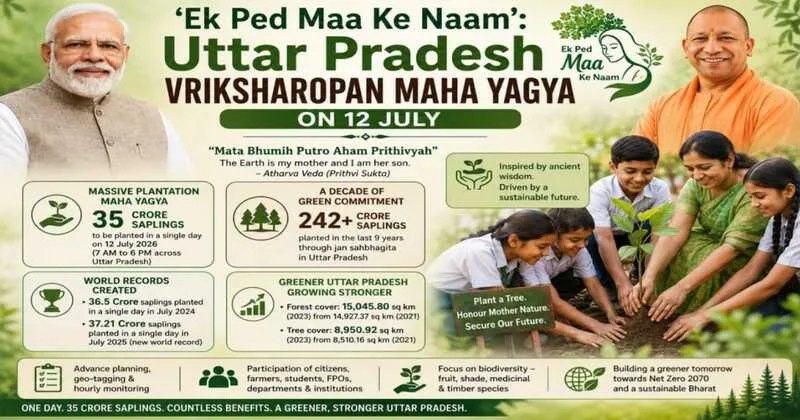
The Earth is my mother, and I am her son. Thousands of years before the world coined the phrase ‘climate action’, the rishis of the Atharva Veda enshrined this truth in the Prithvi Sukta, teaching that the soil beneath our feet is not a resource to be exploited but a mother to be served. The Rigveda Aranyani Sukta sang hymns to the forest as a living, nurturing presence; the Yajurveda Shanti Mantra invoked peace upon the waters. The herbs, the vanaspati and the Matsya Purana declared one tree equal to ten sons: “dasha putra samo druma” for a tree serves all beings and asks nothing in return. It is this ancient wisdom that Uttar Pradesh will enact on an epic scale on July 12, when the state undertakes a vriksharopan maha yagya in the name of the mother.
Chief Minister Yogi Adityanath, reviewing the preparations for Vriksharopan Mahabhiyan-2026 through video conferencing in Lucknow, announced that on July 12, under the ‘Ek Ped Maa Ke Naam’ campaign, a massive plantation maha yagya of 35 crore saplings will be organised in a single day in a festive atmosphere across the state, running from 7 in the morning to 6 in the evening.
“This campaign is part of our efforts to save the present and the future, and it is also a medium of expressing our gratitude towards nature,” the Chief Minister said, inviting every citizen to become part of the Vrihad Abhiyan and contribute to its success.
Nine Years, 242 Crore Trees: A Movement, Not an Event
The July 12 mahabhiyan does not stand alone; it rests on nearly a decade of sustained, people-powered afforestation. Inspired by Prime Minister Narendra Modi, Uttar Pradesh has successfully completed a mammoth campaign of planting more than 242 crore saplings over the past nine years through Jan Sahbhagita. A scale of public participation in ecological restoration that has few parallels anywhere in the world.
In July 2024, the state planted over 36.5 crore saplings in a single day under the first edition of ‘Ek Ped Maa Ke Naam’, the campaign launched by the Prime Minister on World Environment Day that year, urging every Indian to plant a tree in their mother’s name. In July 2025, Uttar Pradesh surpassed its own record under ‘Ek Ped Maa Ke Naam 2.0’, more than 37.21 crore saplings were planted in one day, exceeding the target and setting a world record. Students, farmers, advocates, government employees, public representatives and thousands of voluntary organisations and Farmer Producer Organisations joined hands in what became a genuine mass movement.
According to the India State of Forest Report 2023, Uttar Pradesh’s forest cover rose to 15,045.80 sq km from 14,927.37 sq km in 2021, while tree cover climbed to 8,950.92 sq km from 8,510.16 sq km, proof that the drives are translating into a measurably greener landscape. This year alone, on World Environment Day on June 5, the state achieved its target of planting more than five crore saplings, a prelude to the July 12 mahabhiyan.
Preparation with Accountability: The Yogi Model
What distinguishes Uttar Pradesh plantation drives from the token exercises of earlier decades is the administrative rigour behind them. Reviewing departmental micro-plans of Environment, Forest and Climate Change, Rural Development, Agriculture, Horticulture, Panchayati Raj, Revenue, Urban Development and other allied departments, the Chief Minister directed that the campaign be executed with complete preparation, coordination and accountability.
His instructions were exacting for the advance verification of plantation sites, pit preparation, assured availability of saplings, selection of species suited to local conditions, irrigation arrangements, geo-tagging of plantations and regular monitoring, all to be ensured beforehand. Hourly progress reports are to be issued throughout the day on July 12, keeping the entire operation transparent and answerable in real time.
The Chief Minister has directed that all beneficiary farmers of the PM Kisan Samman Nidhi be connected to the campaign and that maximum biodiversity be ensured in the plantations with a balanced mix of fruit-bearing, shade-giving, medicinal and timber species. Participation is being sought from the Railways, the Ministry of Defence, the High Court and all courts, public representatives, government personnel, farmers, FPOs, students, advocates and voluntary organisations, with dialogue and coordination at all levels to be completed within three days.
“The success of this campaign will be determined not merely by achieving the target, but by the protection of every sapling planted and its growth into a tree,” the Chief Minister cautioned. “It will succeed not as a formality, but with a spirit of commitment.” His stated ambition is larger still to link environmental protection with Jan Sahbhagita and make Uttar Pradesh the national model of green development.
The Green Road to Net Zero
The mahabhiyan must also be read against the horizon of Bharat’s climate commitments. At COP26 in Glasgow, Prime Minister Modi announced the Panchamrit, pledging that India will achieve Net Zero emissions by 2070 and, along the way, create an additional carbon sink of 2.5 to 3 billion tonnes of carbon dioxide equivalent through forest and tree cover by 2030, as committed in India’s Nationally Determined Contributions under the Paris Agreement.
It is here that Uttar Pradesh’s plantation yagya acquires national significance. A growing tree is nature’s own carbon-capture technology, where it sequesters carbon dioxide throughout its life, cools its surroundings, recharges groundwater, binds the soil and purifies the air. When 35 crore saplings are added in a single day and 242 crore over nine years, the state is beautifying its landscape, it is also building the biological infrastructure of Bharat’s decarbonisation. Every neem, peepal and banyan planted along an expressway, every mango and moringa on a farmer’s field boundary, is a quiet contribution to the 2070 pledge. For India’s most populous state, which is simultaneously its fastest-growing economic engine, expanding the green sink alongside expressways and industrial corridors is the truest expression of sustainable development where Vikas walks with Paryavaran.
The emphasis on species diversity strengthens this further. Timber species lock carbon for decades, fruit trees create rural incomes, while the medicinal species revive the pharmacy of tradition. The campaign thus serves climate, economy and health in a single stroke.
‘Maa Ke Naam’: The Vedic Soul of the Campaign
The ‘Ek Ped Maa Ke Naam’ have an attachment with mothers. By asking every citizen to plant a tree in the name of their mother, the campaign touches the deepest chord of Bharatiya sanskriti, where the mother and Mother Earth are one continuum of reverence.
The Upanishadic instruction “Matru Devo Bhava” reveres the mother as the divine completes the circle drawn by the Prithvi Sukta, to honour one’s own mother by nurturing the Earth-mother is dharma twice performed. When a child in Gorakhpur or Prayagraj plants a sapling in the name of their mother on July 12 and tends it through the years, they are not performing a government formality; they are enacting a living sanskar, offering shraddha to the two mothers who sustain them. An entire environmental philosophy that the modern world is only now rediscovering has thus been folded into a single, tender gesture accessible to every household.
This is why the Chief Minister calls the campaign a “maha yagya of jan bhagidari”, a sacrifice in the truest Vedic sense, where every participant offers their shram as ahuti. On July 12, as crores of hands across Uttar Pradesh lower saplings into the soil from morning to evening, the state will once again demonstrate what Bharat has always known: that the surest path to saving the future runs through gratitude to the Mother, both the one who gave us birth and the one who gives us life every day.