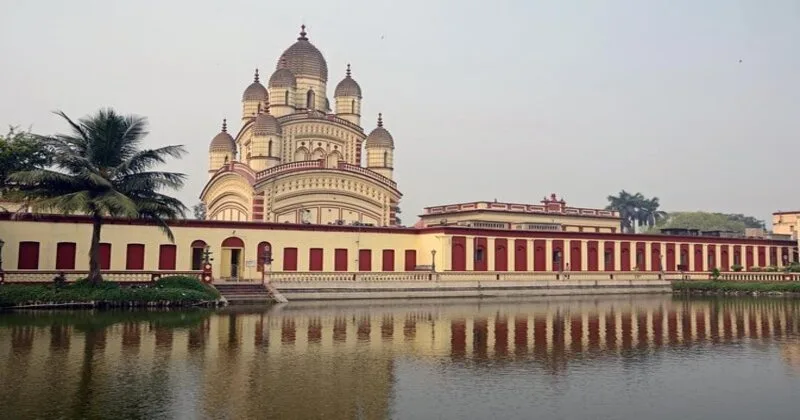
When discussions about lost temples and forgotten sacred sites emerge, attention often gravitates towards ruins, destroyed monuments and abandoned shrines. Yet some temples tell a different story. They survive not because they were spared hardship, but because they endured centuries of political upheaval, invasions, demographic shifts and Partition. The Dhakeshwari Temple in Dhaka is one such monument. Standing today as the most important Hindu temple in Bangladesh, it is both a place of worship and a living reminder of a civilizational legacy that predates modern national borders.
Unlike many temples that exist only in historical records, Dhakeshwari continues to attract devotees. Yet its story is inseparable from the broader history of Hindu civilization in eastern Bengal, a history that has often remained overshadowed by narratives centred on modern political developments. The temple’s survival offers a rare window into a cultural landscape that once flourished across present-day Bangladesh.
The origins of Dhakeshwari Temple are wrapped in legend. According to popular tradition, the temple was established by King Ballal Sena of the Sena dynasty during the twelfth century. The story recounts that the king discovered a hidden image of the goddess Durga in a forested area and subsequently built a shrine to house it. The name “Dhakeshwari” itself is often interpreted as “Goddess of Dhaka” or “The Hidden Goddess,” derived from the Bengali word ‘dhak’, meaning concealed or hidden.
Although historians debate the precise date of construction, there is broad agreement that the temple is of considerable antiquity. The present structure has undergone multiple reconstructions and renovations over the centuries, making it difficult to determine how much of the original temple survives. Nevertheless, the site’s continuous religious significance is beyond dispute. For generations of Hindus in Bengal, Dhakeshwari has remained a centre of devotion and cultural identity.
The temple’s architectural history reflects the turbulent history of the region itself. Unlike the monumental stone temples of Khajuraho, Konark, or Hampi, the architecture of Bengal developed in response to local conditions. Brick became the primary building material due to the scarcity of suitable stone. As a result, many ancient Bengali temples underwent repeated reconstruction because brick structures were more vulnerable to decay and damage.
Dhakeshwari Temple displays a blend of traditional Bengali temple architecture and later influences acquired through centuries of rebuilding. The complex includes the main shrine dedicated to the goddess, several subsidiary temples, courtyards, and prayer spaces. While portions of the structure exhibit features associated with Bengal’s temple traditions, much of what visitors see today reflects renovations carried out during different historical periods.
The history of Dhakeshwari Temple cannot be separated from the larger story of Bengal’s political transformations. From the thirteenth century onward, the region witnessed the establishment of various Muslim dynasties. Like many sacred sites across the subcontinent, Hindu temples in Bengal faced periods of uncertainty as political authority shifted. Historical records indicate that several temples suffered destruction, neglect, or conversion during different phases of medieval history.
The precise history of Dhakeshwari during these centuries remains difficult to reconstruct due to limited surviving documentation. However, the fact that the temple survived while many other shrines disappeared speaks to its enduring significance among local communities. Through changing rulers and changing political circumstances, the temple continued to function as a centre of worship.
The Mughal period brought further transformations to Bengal. Dhaka emerged as an important administrative centre under Mughal rule, increasing the city’s political and economic importance. Despite these changes, Dhakeshwari retained its place within the religious life of Bengali Hindus. Pilgrims continued to visit the shrine, and religious festivals remained integral to community life.
Perhaps the most defining chapter in the temple’s modern history arrived with the Partition of India in 1947. The division of British India created the state of Pakistan, with East Bengal becoming East Pakistan. For millions of Hindus living in the region, Partition brought uncertainty, displacement, and violence. Communities that had lived in eastern Bengal for centuries suddenly found themselves minorities within a new political framework.
Dhakeshwari Temple became a witness to this profound transformation. As waves of migration reshaped the demographic landscape, many Hindu families left their ancestral homes and crossed into India. Temples, schools, and cultural institutions that had once served thriving communities struggled to adapt to rapidly changing circumstances. Yet Dhakeshwari endured.
One of the most significant episodes associated with the temple concerns the original idol of the goddess. During periods of communal tension in the years following Partition, concerns arose regarding the safety of the sacred image. Eventually, the original idol was moved to Kolkata, where it remains enshrined. A replica was subsequently installed at Dhakeshwari Temple in Dhaka, ensuring the continuation of worship at the historic site.
The decades that followed were marked by both challenges and resilience. During the Bangladesh Liberation War of 1971, the Hindu community once again found itself vulnerable amid widespread violence and upheaval. Numerous temples and cultural institutions suffered damage during this period. Dhakeshwari Temple, however, survived and continued to serve as an important symbol of religious continuity.
Following the emergence of Bangladesh as an independent nation, the temple gradually assumed an even greater symbolic role. Today it is widely regarded as the national temple of Bangladesh, although this designation is cultural rather than constitutional. For the country’s Hindu minority, Dhakeshwari functions as both a spiritual centre and a marker of historical belonging.
The temple’s significance extends beyond religious practice. It stands as a reminder that the cultural history of Bangladesh is far more diverse than modern political narratives sometimes suggest. Long before contemporary national identities emerged, the region was shaped by centuries of interaction among Hindu, Buddhist, and Islamic traditions. Dhakeshwari embodies this layered history.
Every year, thousands of devotees gather at the temple during Durga Puja, one of the most important festivals in the Hindu calendar. The celebrations attract worshippers from across Bangladesh and reinforce the temple’s role as a focal point of community life. In a country where Hindus constitute a minority, such gatherings carry both religious and cultural significance.
The temple also serves as a bridge connecting Bengalis across national borders. For many families whose roots lie in present-day Bangladesh but who now live in India or elsewhere, Dhakeshwari remains a powerful symbol of ancestral memory. It evokes a shared heritage that predates Partition and reminds people of cultural ties that political boundaries cannot entirely erase.
What makes Dhakeshwari particularly remarkable is that it represents continuity rather than disappearance. Many sacred sites discussed in histories of civilizational loss survive only as ruins or memories. Dhakeshwari, by contrast, remains a living temple. Bells still ring within its precincts. Devotees still offer prayers. Festivals still draw crowds. The site continues to fulfil the purpose for which it was originally established centuries ago.
Yet its survival should not obscure the challenges faced by the Hindu community in Bangladesh over the decades. The temple’s history reflects broader questions about cultural preservation, minority rights, and the safeguarding of heritage in times of political change. Its endurance is therefore not merely an architectural achievement but also a testament to the determination of generations who refused to allow a sacred tradition to disappear.
The story of Dhakeshwari Temple ultimately transcends the history of a single monument. It is the story of a civilization that adapted, endured and survived despite repeated disruptions. It is the story of communities that carried their faith across centuries of uncertainty. Most importantly, it is a reminder that heritage is not measured only by the grandeur of monuments but also by the resilience of the people who sustain them.
In the crowded streets of modern Dhaka, where glass towers and urban expansion increasingly define the skyline, the temple stands as a quiet witness to nearly a millennium of history. It reminds visitors that beneath the layers of contemporary politics lies a deeper cultural landscape shaped by memory, devotion, and continuity. Dhakeshwari Temple is not merely a relic of the past. It is the surviving heart of a heritage that refuses to be forgotten.