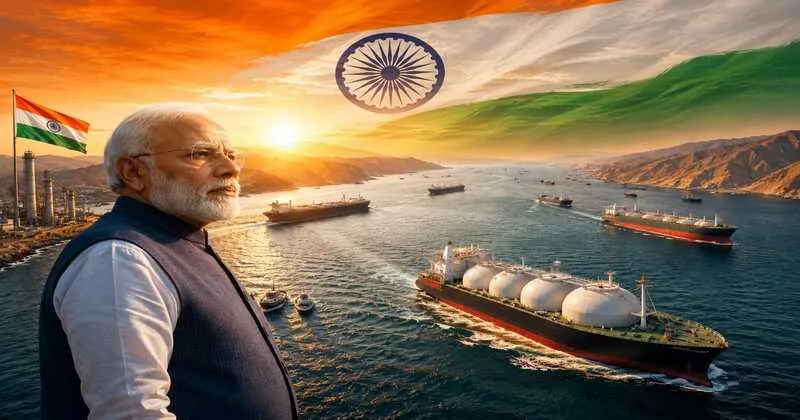
The prolonged disruption of the Strait of Hormuz in 2026 emerged as one of the most consequential tests of global energy security in recent decades. The narrow maritime corridor, through which nearly one-quarter of the world’s seaborne crude oil and petroleum products and about one-fifth of global liquefied natural gas (LNG) trade normally passes, became the centre of a geopolitical crisis that immediately rattled international energy markets.
Brent crude surged beyond US$120 per barrel, tanker freight charges and war-risk insurance premiums escalated sharply, and governments across the world began preparing for supply disruptions, inflationary pressures and slower economic growth.
For India, the challenge appeared particularly severe. The country imports nearly 88 per cent of its crude oil requirements, around 51 per cent of its natural gas and almost 60 per cent of its liquefied petroleum gas (LPG). Before the crisis, nearly half of India’s crude imports and almost 90 per cent of its LPG imports depended on shipping routes through the Strait of Hormuz.
Conventional indicators suggested that India would rank among the world’s most vulnerable energy-importing economies. Instead, the country transformed a potentially destabilising crisis into a demonstration of institutional preparedness, strategic planning and policy execution.
Rather than allowing the disruption to evolve into a domestic energy emergency, India ensured uninterrupted fuel availability, protected households from international price shocks and maintained confidence across the energy market. The experience highlighted a significant shift in India’s approach to energy security, from dependence on stockpiles alone to resilience built through diversification, infrastructure, governance and diplomacy.
A crisis that tested more than oil supplies
The closure of the Strait of Hormuz by Iranian forces on 28 February 2026 triggered widespread concern because of the waterway’s central role in global energy trade. Around one-fifth of the world’s seaborne crude oil and a similar share of LNG shipments move through this narrow passage. Energy-importing nations anticipated shortages, fuel rationing and sustained price escalation.
On paper, India appeared considerably more exposed than several advanced economies. Japan, despite importing almost all its crude oil, possessed emergency reserves covering approximately 254 days of net imports through government and commercial stockpiles. South Korea maintained reserves equivalent to nearly 180–208 days, while China’s combined strategic and commercial inventories were estimated to cover around 80–90 days of consumption.
🚨 BIG STATEMENT
PM Modi said an LPG cylinder could have cost ₹2,000 during the global oil crisis 🤯
— "The government kept the peak price at around ₹950." pic.twitter.com/DAxFZnOBB2
— The Analyzer (News Updates🗞️) (@Indian_Analyzer) July 4, 2026
India’s Strategic Petroleum Reserve (SPR), by comparison, stood at 5.33 million tonnes, providing only around nine to ten days of coverage, well below the International Energy Agency’s 90-day benchmark, although India is not an IEA member and is therefore not obligated to maintain that level. The country’s dependence on Hormuz also remained substantially higher than many major economies, with approximately 45 per cent of crude imports, half of LNG imports and almost 90 per cent of LPG imports transiting through the strait before the conflict.
Yet the expected fuel crisis never materialised. Petrol pumps continued normal operations, LPG cylinders remained available across the country, and the feared large-scale supply disruptions did not occur. Retail fuel prices increased by only around 7–8 per cent, while international markets experienced price increases ranging between 25 and 30 per cent.
A decade of preparation behind the response
India’s ability to withstand the disruption was not the product of emergency measures alone. It reflected structural reforms and investments undertaken over the previous decade across the entire energy ecosystem.
One of the most important changes involved the diversification of crude oil sourcing. India’s supplier base expanded from 27 countries to 41 countries, bringing producers such as Guyana, Gabon and Equatorial Guinea into the procurement network while simultaneously increasing purchases from Russia, Iran, Venezuela and several African nations. As the Hormuz crisis intensified, refiners rapidly increased sourcing from West Africa, the Americas and Russia, reducing dependence on Gulf transit routes.
The country’s refining sector also evolved into a major strategic asset. India developed an annual refining capacity of 256.8 million tonnes, enabling refiners to process multiple grades of crude oil instead of relying upon limited specifications. This flexibility allowed procurement decisions to respond quickly to changing geopolitical realities without requiring major infrastructure modifications.
Balotra, Rajasthan: Union Minister Hardeep Singh Puri says, "In the last 3–4 months, when supply disruptions occurred globally due to the Strait of Hormuz being closed-through which 20–30% of global energy supplies pass, our supply system remained stable. Not a single one of our… pic.twitter.com/eltOyBCr8O
— IANS (@ians_india) July 4, 2026
Strategic petroleum reserves further strengthened operational resilience. Existing reserves of 5.33 million tonnes, together with ongoing expansion projects at Chandikhol and Padur, created additional security buffers while allowing policymakers greater flexibility during periods of market uncertainty.
India simultaneously expanded its city gas distribution network from only 55 geographical areas in 2014 to more than 300 by 2026. This significantly broadened access to piped natural gas and reduced dependence on LPG in many urban centres, thereby easing pressure on household fuel demand during the crisis.
Rapid policy measures protected domestic supply
As international markets became increasingly volatile, the Government of India adopted a series of coordinated policy interventions focused on ensuring uninterrupted domestic energy availability.
Within days of the crisis, the government invoked the Essential Commodities Act and introduced an LPG Control Order permitting refineries to divert propane and butane streams towards domestic LPG production. Indigenous LPG output increased dramatically from around 35,000–36,000 tonnes per day to nearly 54,000 tonnes per day within a week. The increase substantially reduced dependence on imported LPG cargoes precisely when global supplies faced maximum disruption.
While addressing a public meeting in Rajasthan, Prime Minister Modi explained in detail how India successfully navigated the global energy crisis at a time when many economies were struggling.
As the Opposition was busy fearmongering and creating panic, the government focused on… pic.twitter.com/IBIjB8g5kz
— Amit Malviya (@amitmalviya) July 4, 2026
Crude procurement was simultaneously reorganised through India’s wider supplier network, ensuring that refinery operations continued without interruption despite disruptions affecting traditional Gulf routes.
The government’s strategy extended beyond physical supply. Digital public infrastructure, including OTP-based verification for LPG cylinder deliveries, helped prevent diversion into grey markets and discouraged panic buying. Demand-side management focused primarily on commercial and bulk LPG consumers, allowing household requirements to receive priority without resorting to nationwide rationing.
Unlike several countries that introduced shortened working weeks, restricted vehicle movement or fuel rationing, India relied on production flexibility, logistics management and targeted administrative interventions to stabilise supplies while maintaining normal economic activity.
Shielding consumers from global price shocks
A defining feature of India’s response was its decision to prevent international energy price volatility from directly affecting households and farmers. As Brent crude crossed US$120 per barrel, the central government reduced excise duty on petrol and diesel by Rs 10 per litre. The measure involved an estimated annual revenue sacrifice of approximately Rs 1.7 lakh crore. Simultaneously, public sector oil marketing companies absorbed substantial under-recoveries that reached almost Rs 1,000 crore every day during the peak of the crisis. These interventions significantly moderated domestic retail price increases.
VIDEO | Union Petroleum Minister Hardeep Singh Puri (@HardeepSPuri) addresses concerns over ethanol-blended fuel.
Addressing a press conference in Delhi, he says, "Somebody is saying that fuel mileage is going to drop. It is now well established that ethanol is even used in… pic.twitter.com/pzFN4f0o6y
— Press Trust of India (@PTI_News) July 2, 2026
Between late February and early May 2026, petrol prices in the United Kingdom increased by around 19 per cent, while diesel prices in the United Arab Emirates rose by more than 85 per cent. India, however, maintained retail fuel prices for an extended period before allowing only modest increases of approximately 8 per cent.
Household LPG represented an even stronger example of consumer protection. Although the import-linked cost of a standard 14.2 kg domestic LPG cylinder exceeded Rs 1,600 during the crisis, retail prices for consumers were maintained at Rs 942. This ensured uninterrupted access to clean cooking fuel for more than 33 crore households despite extraordinary pressures on international LPG markets.
The sequence of policy implementation proved equally significant. Domestic production was strengthened before shortages emerged, consumers received protection before international prices filtered into household budgets, and market confidence remained intact before uncertainty could generate panic.
Energy security beyond stockpiles
The Hormuz disruption demonstrated that modern energy security extends beyond the size of emergency reserves. India’s experience highlighted the importance of institutional capacity, coordination mechanisms and operational adaptability.
Instead of depending solely on stockpiles, India relied upon a combination of diversified suppliers, refinery flexibility, digital governance, strategic reserves and coordinated decision-making across multiple ministries. The ability to redirect crude supply chains within weeks, recalibrate refinery output rapidly and manage nationwide fuel distribution through digital systems became as valuable as reserve volumes themselves.
Diplomatic engagement also played a decisive role. Long-standing energy partnerships with Saudi Aramco, ADNOC and QatarEnergy helped sustain supply relationships during one of the most uncertain periods in recent energy history. Rather than attempting to build these partnerships during the crisis, India benefited from years of sustained engagement with key producing nations.
The experience also reinforced the importance of institutional preparedness over purely physical assets. Strategic reserves provided valuable time, but administrative coordination, diversified procurement and infrastructure flexibility ultimately ensured continuity of supply.
Building the next phase of energy independence
The Hormuz crisis has accelerated India’s determination to strengthen long-term energy security through greater domestic production and cleaner energy alternatives.
Union Minister for Petroleum and Natural Gas Hardeep Singh Puri has stated that the crisis provided renewed momentum for expanding indigenous energy production. India is preparing to auction nearly 250,000 square kilometres of previously unexplored acreage for oil and gas exploration. The initiative forms part of a broader effort to increase domestic production, which currently remains modest by global standards.
India produced 25.98 million metric tonnes of crude oil during 2025–26, equivalent to roughly 522,000 barrels per day. This meets only around 10 per cent of the national crude requirements.
To reverse this trend, the government has launched Samudra Manthan to expand offshore exploration through advanced seismic surveys and accelerated monetisation of frontier basins. ONGC’s Technical Services Agreement with bp for the Western Offshore fields seeks to improve production from mature reservoirs using enhanced recovery technologies. Exploration activities have also intensified in the Andaman offshore region.
Diversification is equally evident across the broader energy mix. India achieved 20 per cent ethanol blending in petrol five years ahead of schedule, reducing dependence on imported crude while saving an estimated Rs 1.36 lakh crore in foreign exchange. The SATAT initiative continues expanding compressed biogas production using agricultural residues and municipal waste, while the National Green Hydrogen Mission and sustainable aviation fuel programmes are creating new pathways for industrial decarbonisation and future energy security.
The country’s macroeconomic stability further reinforced the effectiveness of these initiatives. Foreign exchange reserves remained above US$700 billion throughout the crisis, while economic growth stayed resilient at around 7.7 per cent despite prolonged geopolitical uncertainty.
PM Modi ON FIRE 🔥
PM Modi SLAMMED the Opposition for trying to spread FEAR and MISLEAD the nation during the CRISIS.
He said India's diplomacy ensured UNINTERRUPTED ENERGY security by EXPANDING fuel sourcing from around 25–26 countries to over 40. pic.twitter.com/xn2xfU0eYB
— Megh Updates 🚨™ (@MeghUpdates) July 4, 2026
Speaking at the inauguration of the HPCL Rajasthan Refinery Limited (HRRL) at Balotra on 4 July 2026, Prime Minister Narendra Modi described India’s response as the outcome of timely assessment, decisive policymaking, effective utilisation of domestic resources and the constructive use of diplomatic partnerships.
He noted that India avoided fuel rationing, ensured uninterrupted cooking gas supplies and protected consumers and farmers from the full impact of global price increases, with public sector oil marketing companies bearing substantial financial burdens. He also remarked that those who had spread rumours regarding an impending energy collapse during the crisis had been proven wrong.
The Strait of Hormuz disruption will eventually become another milestone in the history of geopolitical crises, but its enduring significance for India lies elsewhere. It validated a decade-long strategy that combined refining expansion, diversified sourcing, strategic reserves, digital governance, infrastructure investment and energy diplomacy into a coherent national resilience framework.
The crisis reaffirmed that geography may define exposure, but policy determines vulnerability. India’s experience demonstrated that while stockpiles provide valuable insurance, institutions create adaptability. In transforming one of the world’s most serious energy disruptions into an opportunity for structural strengthening, India effectively rewrote the rules of energy security for the twenty-first century.