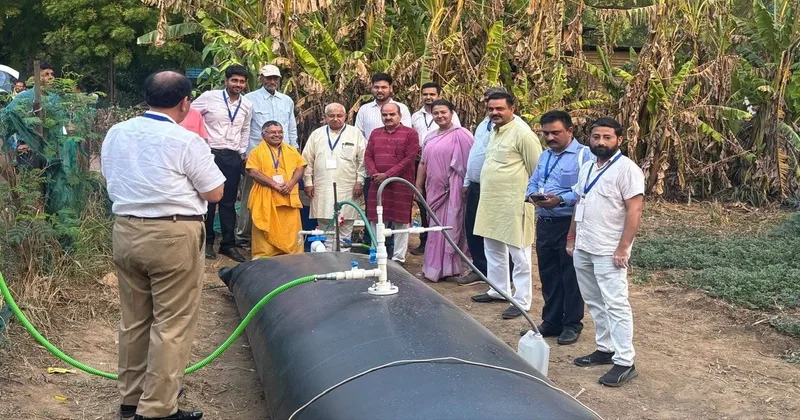
New Delhi: More than 120 policymakers, researchers, industry leaders and biogas experts gathered at IIT Delhi for a national workshop on the “Swadeshi Energy and Fertiliser Self-Reliance Campaign”, focusing on how biogas technologies can help India achieve self-reliance in clean energy, organic fertilisers, and rural development.
आईआईटी दिल्ली में 'स्वदेशी ऊर्जा एवं खाद आत्मनिर्भरता अभियान' पर कार्यशाला का आयोजन
नई दिल्ली। स्वदेशी शोध संस्थान ने आईआईटी दिल्ली, उन्नत भारत अभियान, बायोगैस विकास एवं प्रशिक्षण केंद्र भारतीय प्रोद्योगिकी संस्थान, बायोगैस फोरम इंडिया, गौ सेवा आयोग उत्तर प्रदेश के सहयोग से… pic.twitter.com/xOhr5qhrWj
— VSK BHARAT (@editorvskbharat) July 3, 2026
National Workshop Brings Together Key Stakeholders
The Swadeshi Research Institute, in collaboration with IIT Delhi, the Unnat Bharat Abhiyan, the Biogas Development and Training Centre (IIT Delhi), Biogas Forum India, and the Gau Seva Commission, Uttar Pradesh, organised the workshop at IIT Delhi to promote indigenous solutions for India’s energy and agricultural needs.
The event witnessed participation from over 120 policymakers, researchers, academicians, representatives from industry, biogas specialists, and members of various government and social organisations. The diverse gathering enabled discussions on scientific innovations, policy interventions and practical implementation strategies to expand the use of biogas across the country.
Focus on Energy and Fertiliser Self-Reliance
The central objective of the workshop was to explore how biogas technologies can contribute to India’s long-term self-reliance in energy production and fertiliser availability. Experts emphasised that converting agricultural residues, cattle dung and organic waste into biogas can simultaneously generate clean energy while producing high-quality organic manure.
Participants highlighted that widespread adoption of biogas systems can reduce dependence on imported fossil fuels and chemical fertilisers, lower greenhouse gas emissions, improve waste management and provide additional income opportunities for rural communities.
Discussions also focused on the role of bio-slurry, the nutrient-rich by-product of biogas plants, as a sustainable alternative to chemical fertilisers. Experts noted that increased use of organic fertilisers can improve soil fertility, enhance crop productivity and support environmentally friendly farming practices.
The workshop stressed that integrating biogas technology with agriculture can help farmers reduce cultivation costs while promoting circular economy principles by converting waste into valuable resources.
Strengthening Rural Economy Through Biogas
Speakers underlined that decentralised biogas infrastructure has the potential to transform rural India by creating employment opportunities, improving energy access and supporting local entrepreneurship. Community-based and household biogas plants were discussed as practical solutions that can meet local energy requirements while reducing environmental pollution. Participants also explored ways to encourage greater participation from farmers, cooperatives, local bodies and private enterprises in expanding the biogas ecosystem.
The workshop emphasised that achieving large-scale adoption of biogas technologies would require coordinated efforts among government agencies, research institutions, industry and civil society organisations. Experts called for stronger policy support, financial incentives, technological innovation and awareness campaigns to encourage greater acceptance of biogas-based solutions. Capacity building, skill development and demonstration projects were identified as important measures for accelerating implementation at the grassroots level.
A key outcome of the workshop was the commitment to develop a comprehensive action plan aimed at accelerating India’s transition towards energy and fertiliser self-reliance through indigenous biogas technologies. Participants agreed that collaborative efforts between scientific institutions, policymakers, industry and local communities would be essential to achieving the campaign’s objectives.
The workshop concluded with a shared vision of promoting sustainable energy, strengthening agricultural resilience and advancing India’s broader goals of environmental sustainability, rural prosperity and self-reliance through innovative, home-grown solutions.