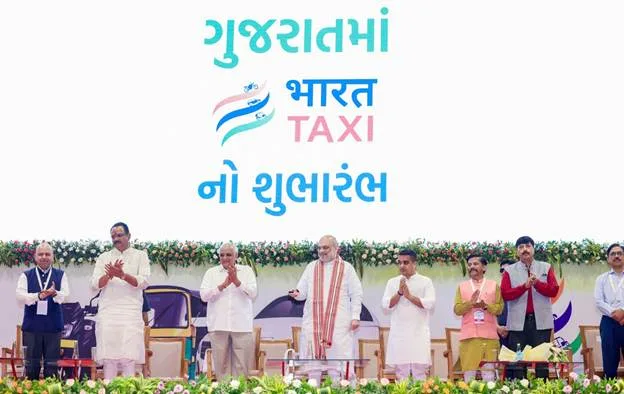
In India’s rapidly expanding mobility sector, Union Home and Cooperation Minister Amit Shah on June 27 launched Bharat Taxi, a cooperative-based ride-hailing platform that seeks to challenge the dominance of private app-based cab aggregators.
The launch event was held at Mahatma Mandir in Gandhinagar and was attended by Gujarat Chief Minister Bhupendra Patel, senior state ministers, representatives of leading cooperative institutions and more than 4,000 drivers. The event marked the formal rollout of Bharat Taxi across 14 major cities in Gujarat and signalled the government’s intent to promote a driver-owned transportation ecosystem rooted in the cooperative movement.
Addressing the gathering, Shah described the launch as more than just the introduction of a new taxi service. He said it represented a new economic model in which drivers become stakeholders and owners rather than remaining dependent on large technology companies that control pricing, commissions and access to customers.
“Drivers have been exploited”
In one of his strongest criticisms of private ride-hailing platforms, Shah alleged that existing app-based aggregators have built business models that disproportionately benefit corporations while placing drivers at a disadvantage.
Without naming specific companies, he accused major platforms of charging high commissions, delaying payments, suspending drivers based on customer complaints without adequate hearings and creating systems that leave operators with little bargaining power.
According to Shah, the rise of app-based transportation transformed the way Indians travel, but it also concentrated economic power in the hands of a few technology companies.
“Other apps used to exploit the drivers. I give you a guarantee that this will not happen in Bharat Taxi,” he said.
The minister also stressed that he prefers using the term “saarthi” rather than “driver”, arguing that transport operators play a crucial role in India’s economy and deserve dignity, security and financial stability.
A cooperative alternative
Bharat Taxi has been developed under the cooperative sector through Sahkar Taxi Cooperative Limited with support from major cooperative institutions, including Amul, IFFCO and NABARD.
The project is being promoted as India’s first large-scale cooperative ride-hailing platform designed around a zero-commission model. Unlike conventional aggregators that deduct a percentage of every ride fare, Bharat Taxi aims to ensure that the maximum share of earnings remains with the driver.
Officials associated with the initiative say the model has been inspired by the success of India’s dairy cooperative movement, particularly Amul, which transformed millions of milk producers into stakeholders in a nationwide enterprise.
The idea is simple: instead of being treated as service providers working for a platform, drivers themselves become part-owners of the organisation.
Shah announced that around seven lakh drivers have already become shareholders in the cooperative structure, giving them a direct stake in its future growth.
“Today, I say with pride that seven lakh drivers are owners of the company. They will get respect, as well as security and prosperity,” he said.
Launch across 14 cities
The service has initially been rolled out in 14 major cities across Gujarat, including Ahmedabad, Surat, Vadodara, Rajkot, Bhavnagar and Jamnagar.
Officials said the platform will cover two-wheelers, auto-rickshaws and four-wheelers, creating a broad transportation network capable of serving different categories of passengers.
The organisers have set an ambitious target of expanding operations across the entire state within a month.
To strengthen its ecosystem, Bharat Taxi has already signed key Memorandums of Understanding with several institutions, including Ahmedabad Airport and local municipal authorities.
These partnerships are expected to provide dedicated access points and improve operational efficiency during the initial stages of expansion.
Early numbers show momentum
According to data shared during the launch event, Bharat Taxi has already witnessed significant growth during its pilot phase.
The platform was soft-launched in December 2025 and has since registered more than 1.5 lakh drivers and nearly seven lakh customers across Gujarat.
Officials claimed that the service is currently facilitating over 3,500 rides every day.
While these numbers remain small compared to the scale of national ride-hailing giants, supporters of the project argue that they demonstrate the viability of the cooperative model.
The government hopes that a combination of lower commissions, driver ownership and institutional support will help Bharat Taxi gradually expand its user base.
The launch comes amid discussions over whether Bharat Taxi’s fares are competitive with those offered by established ride-hailing platforms.
Responding to reports that rival apps were offering lower prices, Shah accused competing companies of temporarily reducing fares to undercut the cooperative platform.
He described such tactics as an attempt to financially weaken Bharat Taxi during its early stages.
“The pattern of lowering prices adopted by other apps is designed to bankrupt Bharat Taxi so that Bharat Taxi leaves the market,” Shah said.
He argued that large corporations often use aggressive pricing strategies to eliminate competition before raising prices later.
“Bharat Taxi is here to stay and it will certainly succeed,” he added.
Why the government sees a need for Bharat taxi
The rise of app-based transportation has fundamentally changed urban mobility in India.
Millions of commuters now depend on mobile applications to book taxis, auto-rickshaws and bike rides. However, concerns regarding commission structures, surge pricing and driver welfare have remained persistent issues within the sector.
Driver unions in several cities have repeatedly alleged that high commission rates reduce earnings and make it difficult to sustain livelihoods.
There have also been complaints regarding algorithm-based account suspensions, incentive structures and unpredictable fare calculations.
The cooperative model seeks to address these concerns by ensuring that those providing the service have greater control over decision-making and a share in profits generated by the platform.
Supporters argue that the model could help create a more equitable transportation ecosystem.
Inspired by the Amul story
A recurring theme in Shah’s speech was the success of India’s cooperative movement.
Drawing parallels with Amul, he reminded the audience that cooperative institutions have successfully competed with large private companies for decades.
When Amul was established, many doubted whether a farmer-owned organisation could survive against powerful private businesses. Today, it has become one of India’s most successful brands and one of the world’s largest dairy cooperatives.
Shah suggested that Bharat Taxi could follow a similar path.
“Did Amul not have to face competition from the private sector? But look at how successful it is today,” he said.
The minister argued that the same principles that empowered milk producers could also empower drivers in the digital economy.
A new direction for India’s cooperative sector
The launch also reflects the central government’s broader effort to expand the cooperative movement into new sectors.
Since the creation of the Ministry of Cooperation in 2021, the government has pushed for cooperative participation in areas beyond agriculture and dairy production.
The objective is to apply the cooperative ownership model to modern economic sectors including logistics, digital platforms, transportation and financial services.
Bharat Taxi is among the most visible examples of this strategy.
If successful, it could serve as a template for similar initiatives across other sectors where concerns over platform monopolies and worker welfare have emerged.
What is Bharat Taxi, and why was it created?
Bharat Taxi was conceived as a driver-centric alternative to conventional ride-hailing platforms.
The initiative was developed under Sahkar Taxi Cooperative Limited with support from major cooperative institutions. Its core objective is to ensure that drivers retain a larger share of their earnings while participating in the ownership structure of the company.
Unlike traditional aggregator models where drivers are effectively contractors working under platform rules, Bharat Taxi aims to make drivers stakeholders in the enterprise.
The platform follows a zero-commission approach, meaning that earnings are intended to flow directly to drivers rather than being reduced through platform commissions.
The broader vision is to combine technology with cooperative ownership, creating a ride-hailing ecosystem that balances consumer convenience with worker welfare.
What lies ahead?
The success of Bharat Taxi will ultimately depend on its ability to attract customers, maintain service quality and compete with established industry leaders.
Private ride-hailing platforms possess extensive technology infrastructure, large customer bases and years of operational experience. Bharat Taxi will therefore face significant competition as it expands.
However, supporters believe that its cooperative ownership model could become a major differentiator at a time when questions surrounding gig-worker rights, fair wages and platform accountability are gaining prominence across the world.
For now, the launch in Gujarat marks the beginning of an ambitious experiment, one that seeks to test whether the principles that transformed India’s dairy sector can also reshape the future of urban transportation.
Whether Bharat Taxi becomes a nationwide success story or remains a regional experiment, its launch has already opened a new chapter in the debate over platform economics, driver welfare and the future of India’s cooperative movement.