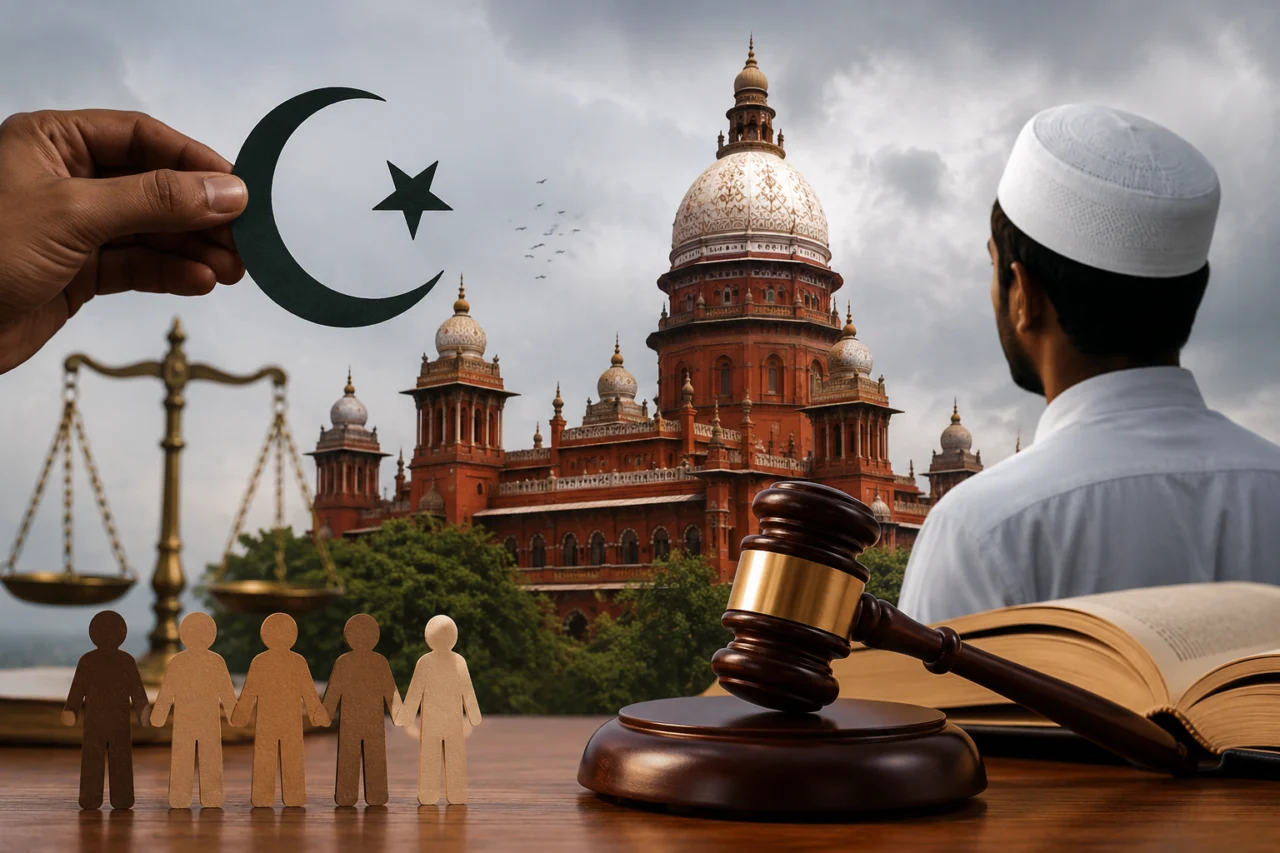
The Madras High Court has delivered an important ruling on reservation benefits after religious conversion, holding that a person who converts to Islam cannot claim the status of a Backward Class Muslim merely by embracing the faith. In a judgment that goes far beyond an individual community certificate dispute, the court struck down a Tamil Nadu Government Order issued in March 2024 that sought to protect reservation benefits for BC, MBC, DNC and SC individuals who converted to Islam.
A Division Bench of Justice G.R. Swaminathan and Justice P.B. Balaji held that while every individual has the constitutional right to profess and practice a religion of choice but conversion to Islam does not automatically make a person a member of any of the Muslim communities notified by the State under the BC(Muslim) category.
The Bench ruled that communities such as Labbai, Rowther, Marakkayar, Syed, Sheik and Deccani Muslims are birth-based communities and not theological sects into which a person can convert.
The court struck down a Tamil Nadu government order issued on March 9, 2024, calling it unconstitutional. It also upheld the decision of the Tahsildar to reject the petitioner’s request for a Muslim Labbai community certificate.
The Bench said the State Government had no power to issue an order that went against settled court rulings. Concluding the case, the judges held that a person who converts to Islam cannot claim Backward Class Muslim status for reservation benefits, observing, “He is only a Muslim and that’s all there is to it.”
A petition that became test of state policy
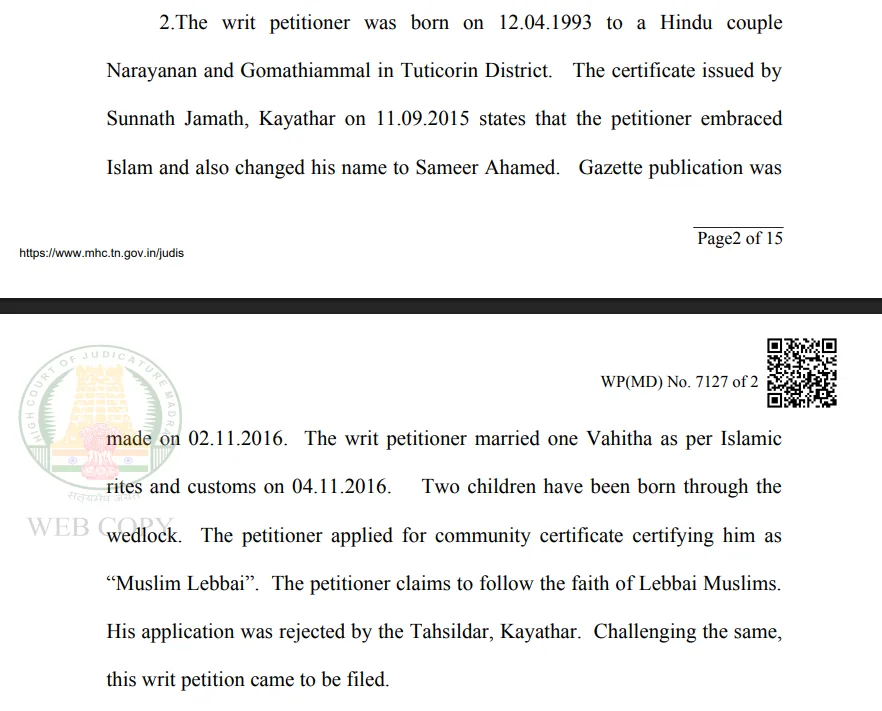
The case arose from a petition filed by Sameer Ahamed, formerly known as Paramasivam, who was born to a Hindu family in Thoothukudi district. According to the court record, he embraced Islam in September 2015 and changed his name to Sameer Ahamed. The change was later published in the Tamil Nadu Government Gazette. He subsequently married under Islamic rites and customs and had two children.
The petitioner later applied for a community certificate identifying him as “Muslim Lebbai”. He claimed that he followed the faith of Lebbai Muslims and sought recognition under that category to avail reservation benefits available to BC(Muslim) communities. His request was rejected by the Tahsildar, Kayathar, following which he approached the High Court.
However, the court pointed out that when the petition was originally filed in 2022, the petitioner had virtually no legal basis for the claim. The Bench made a striking observation on this aspect, “As indicated at the outset, the writ petitioner had no case when he filed the writ petition. Life was infused into his case only by virtue of the aforesaid G.O. If the G.O is sustained, the writ petition has to be allowed. If the G.O is found to be bad in law, the petition will suffer dismissal.”
That Government Order became the central issue before the court.
The Akbar Ali case and the government’s response
The judgment reveals that the controversy did not begin with Sameer Ahamed.
The Bench traced the origins of the Government Order to an earlier case involving U. Akbar Ali, who belonged to the Most Backward Class category and later embraced Islam. Akbar Ali sought consideration under the BC(Muslim) category in public employment. The Tamil Nadu Public Service Commission treated him as a General Category candidate.
Justice Swaminathan, then sitting singly, upheld the TNPSC’s position in December 2022 by following earlier judicial precedents. Recalling that case, the Bench noted, “The substance of the said decisions was that when a person converts to Islam, he becomes a Muslim and his place in Muslim society is not determined by the caste to which he belonged before his conversion.”
The court then made one of the most significant observations in the entire judgment, “The said decision probably disincentivised conversion to Islam as the beneficiaries of reservation face the prospect of losing the said benefit. Islam being a proselytising religion, its votaries naturally took up the matter with the Government.”
According to the court, the issue was subsequently referred to the Tamil Nadu Backward Classes Commission. The Commission recommended that persons belonging to Backward Classes, Most Backward Classes, Denotified Communities and Scheduled Castes who converted to Islam should be accommodated within one of the seven identified BC(Muslim) communities and continue receiving reservation benefits.
The State Government accepted this recommendation and issued G.O. (Ms) No.31 on March 9, 2024.
Government’s defence of the order
Defending the policy, the State argued that the Government Order was not arbitrary and had been issued only after consultations and recommendations from the Backward Classes Commission.
The Additional Advocate General argued that the policy was crafted to ensure that converts from already reserved communities did not lose reservation benefits after conversion.
According to the Government, a person from a Forward Community who converted to Islam would not receive reservation benefits under the BC(Muslim) category. The benefit was confined only to those who were already beneficiaries of reservation before conversion.
The State also argued that individual Jamaths were competent to determine whether a convert had been accepted into a particular Muslim community and that such determinations should not be questioned by Revenue authorities or courts.
The High Court ultimately rejected these arguments.
Who are the BC(Muslim) communities?
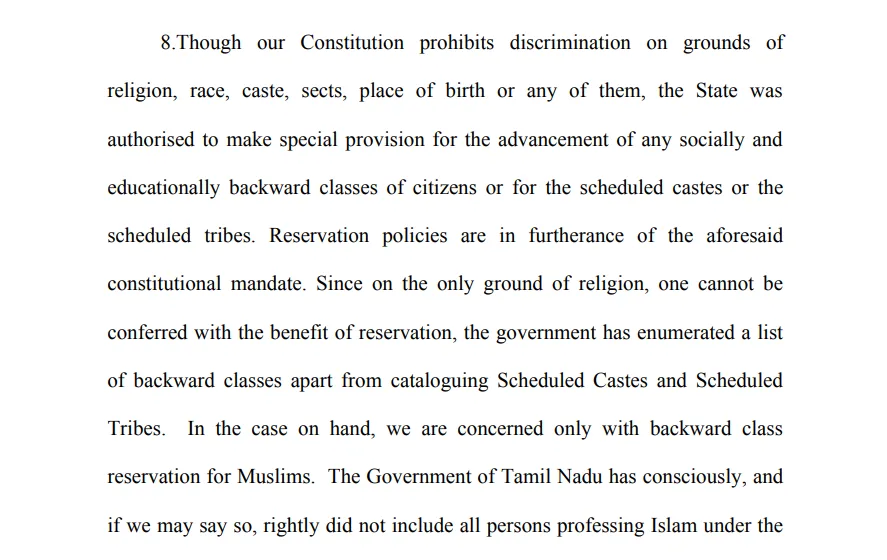
A key aspect of the judgment is the court’s explanation that Tamil Nadu does not treat all Muslims as Backward Class Muslims.
The Bench noted that the State has consciously restricted BC(Muslim) status to only certain communities and not to every person professing Islam. It observed that some Muslim groups are socially and educationally advanced and therefore do not qualify for reservation benefits.
The court reproduced the seven communities currently notified under the BC(Muslim) category and then categorically stated, “A Muslim who does not belong to any of the aforesaid 7 sects cannot be called as a BC(Muslim).”
These communities are Ansar, Dekkani Muslims, Dubekula, Labbais (including Rowther and Marakayar, whether Tamil-speaking or Urdu-speaking), Mapilla, Sheik and Syed. The court observed that a Muslim who does not belong to any of these seven notified communities cannot be treated as a BC(Muslim).
This became crucial because the court concluded that membership of these communities arises by birth and cannot be acquired through conversion.
‘Just a Mussalman’: The precedent that decided the case
The foundation of the judgment lies in a 1951 decision of the Madras High Court in G. Michael v. S. Venkateswaran.
The Bench noted that the ruling has repeatedly been approved by the Supreme Court, including in Kailash Sonkar v. Maya Devi, K.P. Manu v. Scrutiny Committee and as recently as C. Selvarani v. Special Secretary-cum-District Collector in 2024.
The earlier judgment held, “When a Hindu gets converted to Islam, he becomes just a Mussalman and his place in Muslim society is not determined by the caste to which he belonged before his conversion.”
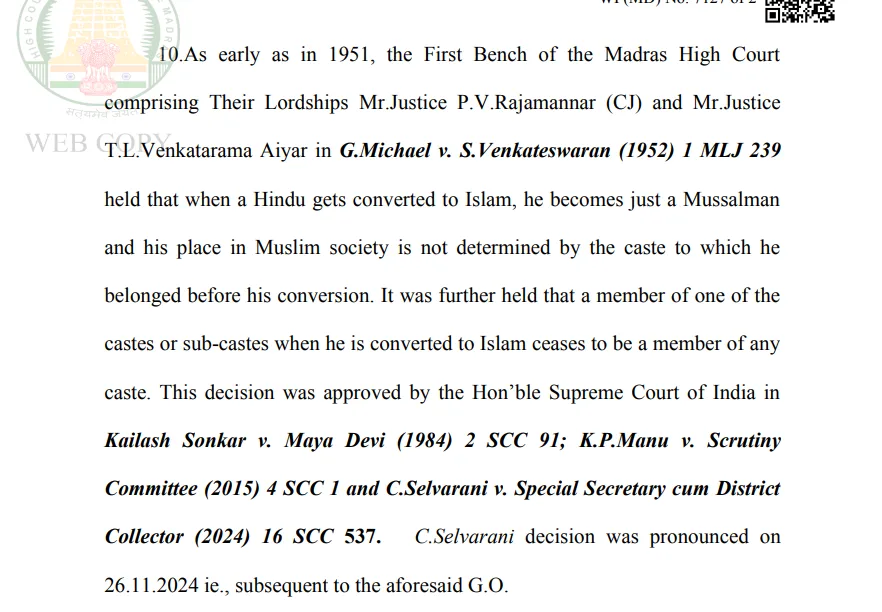
It further held, “A member of one of the castes or sub-castes when he is converted to Islam ceases to be a member of any caste.”
According to the Bench, this principle continues to hold the field and cannot be altered through an executive order.
Court turns to Quran and the Prophet’s farewell sermon
One of the aspects of the judgment is its extensive discussion of Islamic theology.
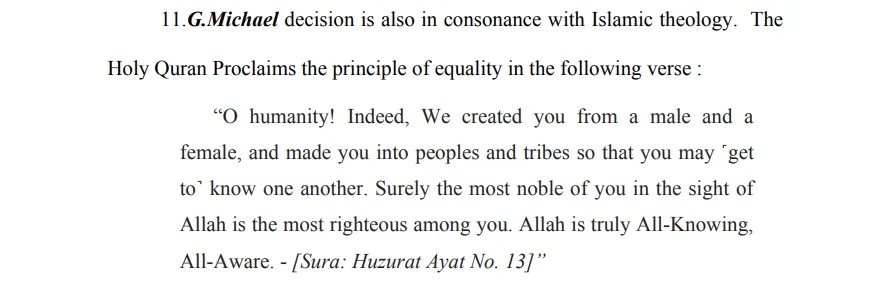
The court reproduced a verse from Surah Hujurat, “O humanity! Indeed, We created you from a male and a female, and made you into peoples and tribes so that you may get to know one another. Surely the most noble of you in the sight of Allah is the most righteous among you. Allah is truly All-Knowing, All-Aware.”
The Bench also reproduced a passage from Prophet Muhammad’s Farewell Sermon, “All mankind is from Adam and Eve. An Arab has no superiority over a non-Arab, nor does a non-Arab have any superiority over an Arab; a white person has no superiority over a black person, nor a black person over a white person, except by piety and good deeds. Learn that every Muslim is a brother to every Muslim and that the Muslims constitute one brotherhood.”
The judges relied on these passages while discussing social hierarchy and classification within Islam.
The strongest observations in the judgment came when the court discussed social equality and religious conversion.
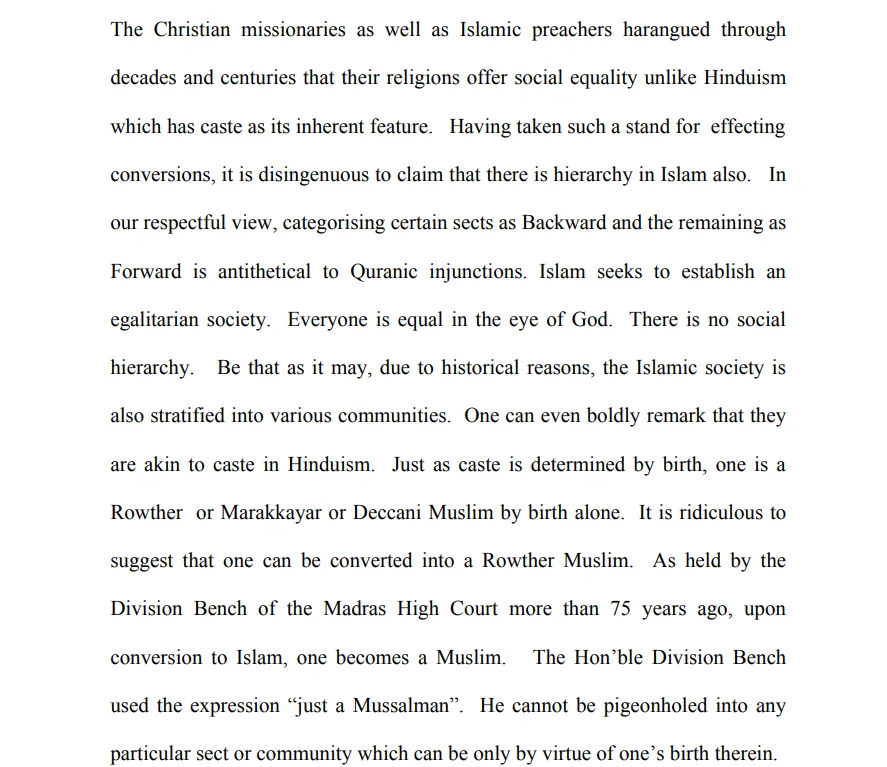
The Bench observed, “The Christian missionaries as well as Islamic preachers harangued through decades and centuries that their religions offer social equality unlike Hinduism which has caste as its inherent feature. Having taken such a stand for effecting conversions, it is disingenuous to claim that there is hierarchy in Islam also. In our respectful view, categorising certain sects as Backward and the remaining as Forward is antithetical to Quranic injunctions. Islam seeks to establish an egalitarian society. Everyone is equal in the eye of God. There is no social hierarchy.”
At the same time, the court acknowledged the historical reality of social stratification within Muslim society.
The judges continued, “Be that as it may, due to historical reasons, the Islamic society is also stratified into various communities. One can even boldly remark that they are akin to caste in Hinduism. Just as caste is determined by birth, one is a Rowther or Marakkayar or Deccani Muslim by birth alone. It is ridiculous to suggest that one can be converted into a Rowther Muslim. As held by the Division Bench of the Madras High Court more than 75 years ago, upon conversion to Islam, one becomes a Muslim. The Hon’ble Division Bench used the expression ‘just a Mussalman’. He cannot be pigeonholed into any particular sect or community which can be only by virtue of one’s birth therein.”
Government cannot override courts
The court then turned to the constitutional issue.
The Bench emphasised that the doctrine of separation of powers is a basic component of the rule of law and that executive authorities cannot nullify judicial decisions.
The judges observed, “The executive cannot sit in an appeal or review or revise a judicial order.”
Applying that principle to the present case, the Bench stated, “When the Division Bench of the Madras High Court in G.Michael had held that a convert to Islam becomes just a Mussalman, it is not open to the State Government to issue a G.O undermining the said decision. That is exactly what the Government has done by recognising that there can be conversion to any one of the 7 sects of Muslims identified as Backward Class Muslim.”
Court finds the policy arbitrary
The court also found fault with the way the Government attempted to club BC, MBC, DNC and SC converts together.
The Bench observed, “The sheer arbitrariness of the impugned G.O. becomes manifest for one more reason. The Backward Classes Commission’s recommendation as well as G.O (Ms) No.31 dated 09.03.2024 provide for accommodating BC/MBC/DNC/SC convertees in any one of the 7 slots. In other words, a SC who is at the bottom-most rung of the social ladder is put on par with a BC. The Hon’ble Supreme Court in catena of decisions has held that OBCs and SCs form separate categories. Just for the sake of ensuring that the converts to Islam continue to enjoy some form of reservation benefit, such a bunching has been done by the State Government. This exposes the inherent flaw in the approach adopted by the Government.”
The court further noted that when a person converts to Islam, Jamats generally certify only that the individual has embraced Islam and not that he has become a member of a particular birth-based community.
The judges observed, “One can take judicial notice of the fact that when a person embraces Islam, the Jamath issues a certificate to the effect that he has become a Muslim. Even in the petitioner’s case, the certificate issued by the Sunnath Jamath of Kayathar certifies that he has embraced the Islamic path.”
The Bench then delivered one of the sharpest observations in the entire judgment, “We have no option but to conclude that only to undo the judgments of this Court, has the Government come out with an innovation that is not only unconstitutional but also un-Islamic.”
The court further endorsed the Tahsildar’s reasoning that the petitioner had converted to a religion and not to a caste. It also referred to historical records, including the Madras Census Report of 1901 and the writings of Edgar Thurston, to conclude that communities such as Labbai, Syed, Sheik and Deccani Muslims are communities acquired by birth and not sects that a person can enter through conversion.
The final verdict
After concluding that the Government Order violated settled law and sought to circumvent binding judicial precedents, the court declared G.O. (Ms) No.31 unconstitutional.
The Bench held, “Once we find that the said G.O is illegal, it is our bounden judicial duty to declare it to be so. We accordingly declare that the said G.O is unconstitutional. The order impugned in the writ petition is sustained. This writ petition is disposed of accordingly. No costs. Connected Miscellaneous Petition is closed.”
The court then delivered its final conclusion, “As a corollary, we hold that a convert to Islam cannot claim the status of Backward Class Muslim. He is only a Muslim and that’s all there is to it.”
With that, the petition was dismissed, the Government Order was struck down and the High Court made it clear that conversion to Islam, by itself, cannot be used as a route to claim membership of Tamil Nadu’s notified BC(Muslim) communities for reservation purposes. The ruling is likely to have far-reaching implications for reservation claims and community certificate disputes involving religious converts in the State.