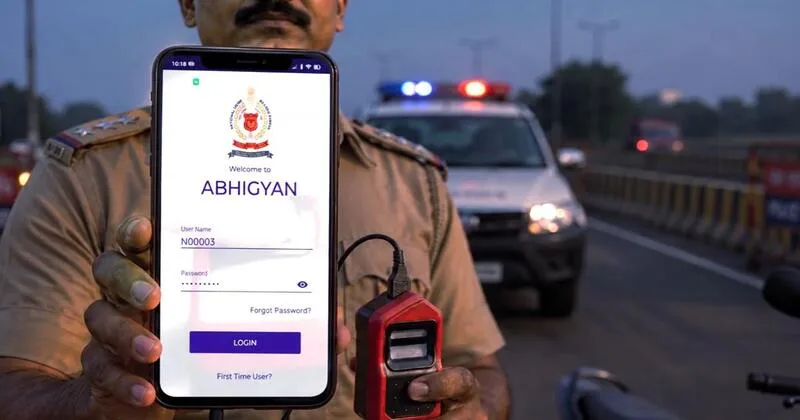
New Delhi: India has introduced a major upgrade to its policing and criminal identification capabilities with the launch of the ABHIGYAN mobile application, aimed at dramatically speeding up fingerprint-based suspect verification across the country. The initiative, launched by Union Home Minister Amit Shah, marks a significant step toward digitising and modernising criminal investigations.
India Launches ABHIGYAN: Criminals Can Now Be Identified in Just 35 Seconds 🔥
In a major boost to India's criminal justice and policing system, HM Amit Shah has launched the ABHIGYAN app, giving police forces across the country access to one of the world's largest fingerprint… pic.twitter.com/pIxQ4jCq8F
— The Tathya (@_TheTathya) June 19, 2026
A major leap in forensic identification
The ABHIGYAN system is designed to provide near-instant fingerprint matching by connecting police personnel to a vast national database containing records of over 1.29 crore individuals. With this integration, authorities claim that suspect identification, which earlier took days, can now be completed in as little as 35 seconds.
The system is directly linked with the National Automated Fingerprint Identification System (NAFIS), which serves as the backbone for automated biometric matching across multiple law enforcement agencies.
How the system works
Once a fingerprint is scanned at a police station or field location, the ABHIGYAN app processes and matches it against the central database in real time. The system uses automated algorithms to quickly narrow down potential matches, allowing officers to verify identities without waiting for manual forensic reports.
Key features of the system include:
-Instant fingerprint matching within seconds
-Direct integration with national criminal databases
-Continuous expansion as new biometric records are added
-Support for field-level policing and investigations
-Reduced dependence on manual verification processes
According to officials, the introduction of ABHIGYAN is expected to significantly improve the efficiency of investigations, particularly in cases involving repeat offenders or unidentified suspects. By reducing identification time from days to seconds, police forces can respond more quickly and build stronger evidence chains during investigations.
The app also aligns with broader efforts to modernise India’s criminal justice system through digital tools, biometric databases, and AI-assisted verification systems.
The launch of ABHIGYAN reflects a broader global trend in law enforcement, where biometric data and automated systems are increasingly used to enhance accuracy and speed. Indian policing, long reliant on manual records and delayed forensic reports, is now moving toward real-time identification capabilities.
Officials say this shift will not only improve case resolution rates but also act as a deterrent against repeat offences by making identity verification faster and more reliable.
With ABHIGYAN, India is taking a decisive step toward technology-driven policing. By combining fingerprint databases, automation, and mobile accessibility, the system aims to make criminal identification faster, more accurate, and more efficient—reshaping the way law enforcement operates in the digital era.