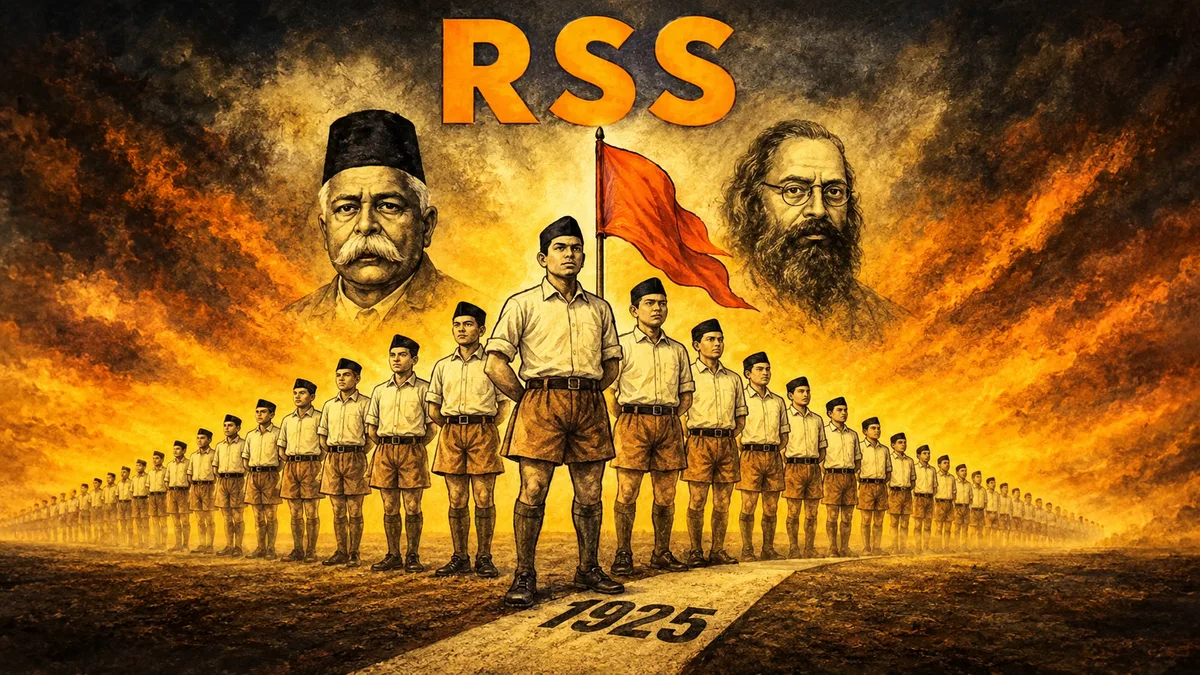
The centenary Rashtriya Swayamsevak Sang( RSS) marks an important milestone in India’s modern social and organisational history. Founded on September 27, 1925, on the auspicious occasion of Vijayadashami, by Dr. Keshav Baliram Hedgewar in Nagpur, the Sangh began with the objective of organising Hindu society and strengthening national consciousness through character-building, discipline, social responsibility and collective action.
Over the past century, the RSS has developed from a small local initiative into a nationwide organisation with an extensive network of daily shakhas, volunteers and associated organisations working across diverse fields of public life. Its centenary provides an opportunity to examine not only its history and philosophy but also the evolution of the wider organisational network inspired by its ideas.
The RSS’s organisational journey has centred on the belief that a nation’s lasting strength depends on the character of its people, the unity of its society, its cultural self-confidence and the willingness of individuals to work for the larger national interest.
Through its shakha system and the activities of numerous associated organisations, the Sangh-inspired network has developed initiatives in education, healthcare, rural development, labour welfare, agriculture, student affairs, environmental awareness, indigenous enterprise, culture, literature, sports, consumer rights and social service. The centenary is therefore not merely an occasion to remember the past. It is also an opportunity to understand how an organisational philosophy has sought to influence India’s social development and national life.
The founding vision of Dr. Keshav Baliram Hedgewar
Dr. Keshav Baliram Hedgewar was deeply influenced by India’s struggle for independence and the condition of Indian society under British colonial rule. He believed that political freedom, although essential, would not by itself resolve the deeper challenges facing the nation. He sought to understand the historical and social factors that had weakened Indian society. His answer emphasised social organisation, national self-confidence, discipline, unity and the development of individuals committed to the welfare of the country.
Hedgewar’s approach was to create an organisation that would work continuously rather than depend exclusively on temporary movements, political campaigns or emotional mobilisation. He established the RSS with the conviction that an organised, confident and socially responsible society would be better equipped to protect its freedom, preserve its cultural heritage and pursue national progress.
The Sangh’s early method was simple but distinctive: bring people together regularly, encourage collective discipline, cultivate a sense of belonging and inspire them to devote their abilities to society. The daily shakha became the principal instrument for translating this vision into practice.
The Early Years: From Nagpur to a wider national presence
The RSS initially concentrated its activities in Nagpur and gradually expanded to other parts of Maharashtra and beyond. According to the historical account presented in the source material, Sangh activities began in Wardha in 1929 and Pune in 1932. The number of shakhas increased from approximately 37 in 1929 to 125 by 1933. During this period, Dr. Hedgewar encouraged committed workers to travel to different regions and establish new centres of activity.
Several individuals played important roles in this expansion. Bhau Rao Deoras contributed to organisational work in Lucknow, Rajabhau Paturkar in Lahore, Vasantrao Oak in Delhi, Eknath Ranade in Mahakaushal, Madhavrao Mule in the Konkan region, and other workers helped extend the organisation into different parts of the country.
By the end of the 1930s, Sangh shakhas had begun operating in regions including Delhi, Punjab, Bengal, Bihar, Karnataka, the Central Provinces and the Bombay Presidency. The expansion demonstrated the importance the organisation attached to developing local leadership and establishing a durable organisational structure.
The colonial government and the question of organisational freedom
The growth of the RSS attracted the attention of the British administration. The source material describes restrictions introduced in December 1933 that prevented certain government employees, teachers and local-body employees in the Central Provinces from participating in Sangh activities.
These restrictions were challenged in the provincial legislative assembly in March 1934. Several legislators reportedly opposed the government’s position, and the restrictions were subsequently withdrawn. This episode forms part of the early history of the RSS and illustrates the political and administrative debates surrounding its activities during the colonial period.
From an emerging organisation to a nationwide network
Dr. Hedgewar served as the first Sarsanghchalak of the RSS until his death in 1940. At the time of his passing, the organisation had established a foundation for further expansion. The Sangh’s emphasis on regular shakhas, personal contact, organisational discipline and dedicated workers helped it continue its activities under subsequent leadership.
M. S. Golwalkar, popularly known as Shri Guruji, succeeded Hedgewar and played a significant role in the organisation’s subsequent development. The early years established the institutional framework that would shape the RSS for decades to come.
The Shakha: The foundation of individual and social development
The shakha is the central feature of the RSS’s traditional organisational method. A shakha is generally a regular gathering in which volunteers participate in physical activities, games, exercises, collective practices, discussions and activities intended to encourage discipline and social responsibility. The underlying idea is that national development begins with the development of individuals.
The shakha seeks to cultivate qualities such as:
- Discipline and punctuality
- Physical fitness and mental alertness
- Cooperation and teamwork
- Courage, perseverance and self-confidence
- Respect for society and a sense of collective responsibility
- Commitment to service and national life
- Leadership, initiative and organisational ability
The emphasis is on consistent practice rather than occasional participation. Through regular interaction, volunteers from different social and professional backgrounds come together in a shared setting. The organisation views this interaction as a way to develop mutual trust, a sense of belonging and the willingness to work collectively.
The shakha model also reflects the Sangh’s belief that social transformation requires sustained effort at the grassroots level. Rather than concentrating exclusively on public campaigns, it seeks to develop individuals who can contribute to society through their personal conduct, professional work and participation in community initiatives. The broader significance of this approach lies in its emphasis on the relationship between individual character and collective progress.
Shri Guruji and the development of the organisational philosophy
M. S. Golwalkar, known as Shri Guruji, became the second Sarsanghchalak after Hedgewar’s death in 1940. His leadership coincided with a period of major political and social transformation, including India’s independence, Partition and the subsequent challenges of national reconstruction. Golwalkar placed considerable emphasis on cultural continuity, social organisation, collective identity and the importance of developing a sense of responsibility towards society.
In his view, an organisation’s purpose was not simply to create a large following. It was to cultivate socially responsible individuals capable of contributing to the larger community. He also stressed the importance of India’s historical experience and civilisational traditions in shaping its national consciousness. These ideas influenced the development of the RSS and several organisations that subsequently emerged within its broader ideological and social network.
The Sangh’s approach increasingly found expression in specialised institutions addressing education, labour, agriculture, student welfare, cultural activities and social service. The resulting organisational landscape became much broader than the original shakha structure.
The RSS Today: Organisational reach & expansion
The annual figures reproduced in the source material indicate that the RSS’s shakha network has continued to expand. According to those figures, the number of locations hosting shakhas increased from 51,740 to 55,683, while the number of shakhas rose from 83,129 to 88,949. This represents an increase of 3,943 locations and 5,820 shakhas over the reporting period.
These figures suggest a widening geographical presence and continued organisational activity. For publication, the figures should be attributed to the relevant annual report and accompanied by its reporting year, as organisational statistics change over time. The RSS’s broader influence is also associated with a network of organisations working in specialised areas of public life.
These organisations have different institutional structures, legal identities, programmes and constituencies. Many share ideological affinities with the RSS, while the nature of their organisational relationship with the Sangh varies.
They should therefore not all be described as departments of the RSS. It is more accurate to understand them as organisations associated with, inspired by or connected to the wider Sangh network, depending on the particular institution. Their activities demonstrate how a broad ideological outlook can find expression through specialised initiatives addressing different social needs.
The wider Sangh-inspired organisational network
One of the most significant developments in the RSS’s century-long journey has been the emergence of organisations working in different sectors of society. Their activities reflect an attempt to connect cultural and national ideas with practical programmes in education, economic development, healthcare, agriculture, social welfare and public life. The following overview highlights the principal organisations identified in the source material.
A. Education and the development of national consciousness
Vidya Bharati Akhil Bharatiya Shiksha Sansthan
Vidya Bharati is a major education network associated with the Sangh-inspired educational movement. Its early institutional development is connected with the establishment of Saraswati Shishu Mandir in Gorakhpur, Uttar Pradesh. The first such school was established in 1952. The organisation subsequently developed a broader institutional structure to coordinate educational initiatives across different states.
Vidya Bharati seeks to combine academic education with character development, cultural awareness, discipline and social responsibility. Its educational activities cover different levels of schooling and emphasise the role of teachers, parents and communities in children’s development. The wider educational philosophy places importance on Indian cultural traditions, moral values, Indian languages and a sense of national belonging. Its long-term objective is to prepare students not only for professional success but also for responsible participation in society.
Akhil Bharatiya Vidyarthi Parishad (ABVP)
Established on July 9, 1949, the Akhil Bharatiya Vidyarthi Parishad is a student organisation active in colleges and universities. Its activities include student representation, leadership development, educational discussions, campus initiatives, youth participation and programmes addressing social and national issues. The organisation presents students as participants in national reconstruction rather than merely recipients of education. It has developed a broad network across educational institutions and has engaged with debates concerning education policy, youth leadership and campus life.
Bharatiya Shikshan Mandal
Bharatiya Shikshan Mandal works towards developing an education system informed by Indian intellectual traditions and cultural perspectives. Its areas of interest include educational reform, research, the Indian knowledge tradition and the development of educational approaches suited to India’s social and cultural circumstances. The organisation’s emphasis is on strengthening the relationship between education, national development and the country’s intellectual heritage.
Akhil Bharatiya Rashtriya Shaikshik Mahasangh
The Akhil Bharatiya Rashtriya Shaikshik Mahasangh brings together teacher organisations and educational associations. Its activities include representing teachers’ professional interests, addressing service conditions and promoting discussions on education and cultural values. The organisation operates through state-level and university-level associations.
Shiksha Sanskriti Utthan Nyas
Established in 2007, Shiksha Sanskriti Utthan Nyas works on educational reform and the incorporation of Indian cultural and intellectual perspectives into education. Its areas of interest include value-based education, character development, Indian languages, mother-tongue education, Vedic mathematics, environmental education and institutional autonomy. The organisation argues that education should reflect the country’s cultural heritage while preparing students to respond to contemporary challenges.
Sanskrit Bharati
Sanskrit Bharati works to promote the study, use and wider accessibility of Sanskrit. Its activities include Sanskrit conversation workshops, teacher training, educational programmes and efforts to encourage the use of Sanskrit in everyday communication. The organisation seeks to make Sanskrit accessible to people from different social backgrounds and to encourage renewed interest in India’s classical linguistic heritage. Its work highlights the relationship between language, literature, philosophy and civilisational continuity.
B. Cultural identity, literature and historical research
Vishva Hindu Parishad (VHP)
Established on August 29, 1964, the Vishva Hindu Parishad works on issues concerning Hindu religious institutions, traditions, cultural identity and community organisation. Its activities have included campaigns and initiatives concerning temples, pilgrimage centres, religious heritage, cow protection and the preservation of Hindu traditions. The organisation has also played a prominent role in major public controversies, including the Ram Janmabhoomi movement.
Its work and public positions have generated significant political and social debate. An assessment of its contribution must therefore consider both its stated cultural objectives and the wider public consequences of its campaigns.
Samskar Bharati
Established in 1981, Samskar Bharati works to promote Indian art, literature and cultural traditions. Its activities encompass performing arts, visual arts, literary programmes, cultural events and platforms for artists. The organisation views art as a means of social education and cultural expression rather than merely entertainment. Its guiding motto, Sa Kala Ya Vimuktaye, expresses the idea that art should contribute to human development and liberation from negative influences. Through cultural programmes and local units, it seeks to connect artistic practice with India’s broader cultural heritage.
Akhil Bharatiya Sahitya Parishad
The Akhil Bharatiya Sahitya Parishad is a nationwide literary organisation working to promote Indian languages and literature. Its activities include literary conferences, discussions, publications and programmes intended to encourage writers and readers. The organisation places importance on India’s linguistic diversity and literary traditions. Its work seeks to strengthen the role of literature in cultural awareness, social dialogue and national life.
Akhil Bharatiya Itihas Sankalan Yojana
The Akhil Bharatiya Itihas Sankalan Yojana works to research and document Indian history. Its stated objective is to examine historical interpretations, identify gaps in existing narratives and bring attention to events, personalities and traditions that it believes have received insufficient recognition. Its work raises important questions about historical evidence, interpretation and the relationship between academic research and civilisational perspectives. Historical claims, regardless of their source, must ultimately be evaluated through documentary evidence, archaeological findings, reliable primary sources and rigorous scholarly debate.
Pragya Pravah
Pragya Pravah is associated with intellectual and cultural discourse within the wider Sangh network. Its activities include discussions, seminars, intellectual exchanges and programmes addressing questions of Indian society, culture, national identity and contemporary public life. Its broader emphasis is on developing Indian-centred perspectives on social, cultural and intellectual questions. Intellectual engagement is an important dimension of any large social movement because ideas influence institutions, public policy and the direction of national debate.
C. Agriculture, labour and economic self-reliance
Bharatiya Kisan Sangh
Established on March 4, 1979, the Bharatiya Kisan Sangh works to organise farmers and represent their economic, social and agricultural interests. Its areas of concern include agricultural policies, farmers’ livelihoods, rural development and supplementary income opportunities. The organisation promotes the idea that agricultural development should strengthen the economic position of farmers while improving the quality of life in rural areas. Its work reflects the importance of agriculture to India’s economy, food security and social structure.
Bharatiya Mazdoor Sangh (BMS)
Established on July 23, 1955, the Bharatiya Mazdoor Sangh is a major labour organisation. It represents workers across various sectors and participates in discussions concerning labour rights, wages, social security, industrial relations and employment conditions. The organisation has been involved in labour-related committees and consultations at different levels.
Its stated approach places emphasis on workers’ welfare, national economic development and the responsibilities of both employers and employees. The BMS has contributed to debates about labour policy and the relationship between industrial growth and workers’ interests.
Swadeshi Jagran Manch
Established on November 22, 1991, the Swadeshi Jagran Manch promotes economic self-reliance and greater awareness of indigenous production. Its activities include discussions on trade, industrial policy, domestic enterprises, consumer choices and India’s position in the global economy. The organisation argues that a strong domestic economic base is essential for national independence and sustainable development.
Its programmes seek to connect local producers, professionals, entrepreneurs and citizens with broader economic debates. The idea of Swadeshi has evolved over time, encompassing domestic manufacturing, support for local enterprises, technological capability and economic resilience.
Laghu Udyog Bharati
Laghu Udyog Bharati works with micro, small and medium-sized enterprises. Its areas of activity include entrepreneurship, industrial development, policy representation and support for small businesses. Small enterprises are important to India’s employment generation, regional development and manufacturing capacity.By bringing entrepreneurs together, the organisation seeks to strengthen the position of small industrial units.